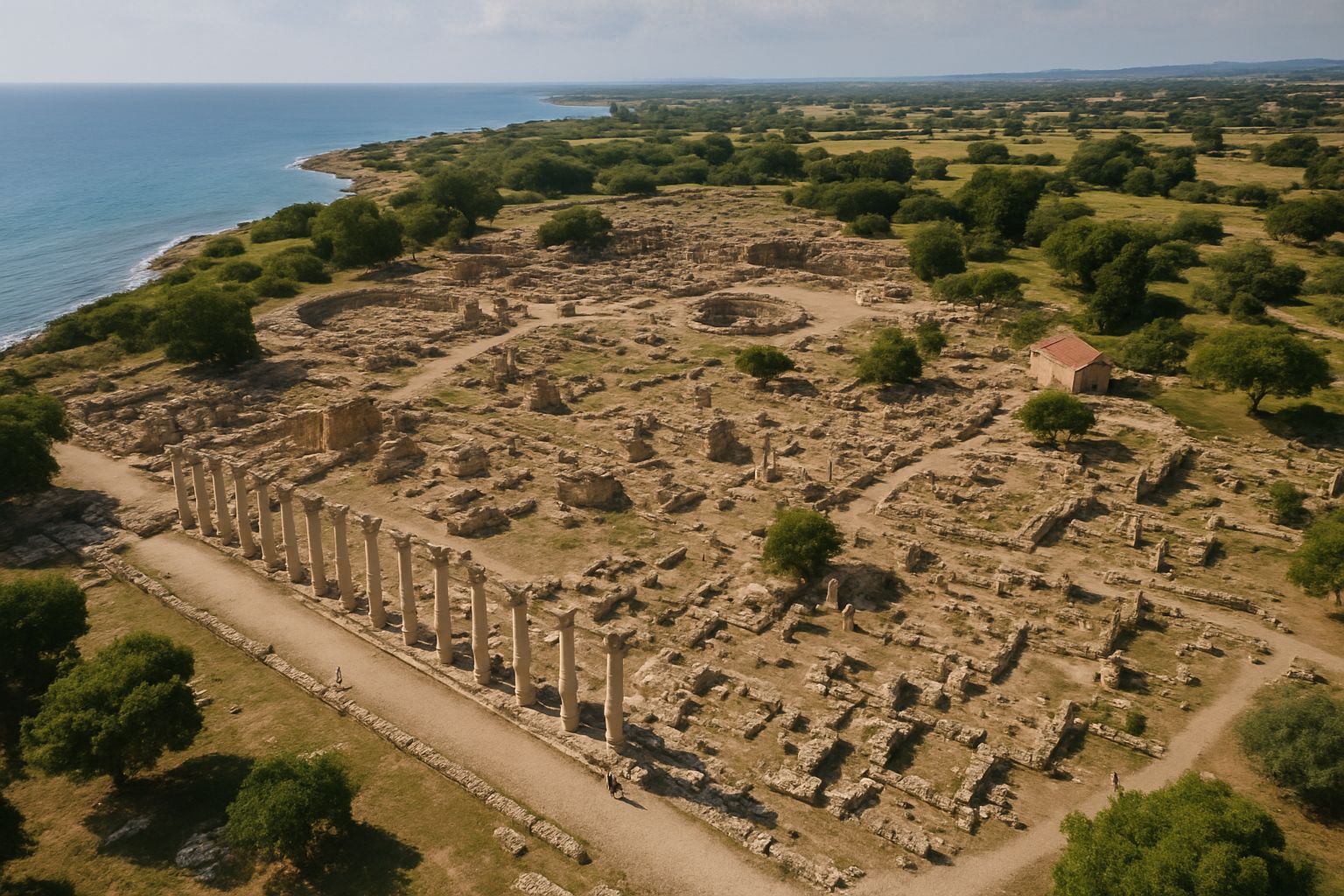
The Department of Antiquities lists twelve archaeological sites open to the public. Two of them, the mosaics of Nea Pafos in the Kato Paphos Archaeological Park and the cliff-top city of Kourion west of Limassol, have their own guide, and so do the Tombs of the Kings. This one covers the rest, from farming villages of the 7th millennium BC to the city-kingdoms that lasted until the Ptolemies abolished them at the end of the 4th century BC. The paid sites below all cost 2.50 EUR, except Palaipafos at Kouklia (4.50 EUR with its museum), and four of them open on weekdays only.
Choirokoitia, in Larnaca district, covers a hillside in a loop of the Maroni river about 6 km from the south coast. UNESCO inscribed it in 1998 as one of the most important prehistoric sites in the eastern Mediterranean: a farming village of about 3 hectares, lived in from the 7th to the 5th millennium BC. Porphyrios Dikaios found it for the Department of Antiquities in 1934, and in 1976 a French CNRS mission under Alain Le Brun took over the excavation. The river guards the village on three sides and a succession of walls closed the fourth, to the west. Inside, people built round houses of stone, pisé and sun-dried mudbrick with flat roofs, and buried their dead in pits inside the houses. By the entrance the Department has rebuilt five huts and a stretch of the defensive wall with its entrance. The site opens daily, 08:30 to 17:00 from 16 September to 15 April and 08:30 to 19:30 in summer, with the last ticket at 19:00. The path up the hill is too steep for wheelchairs, but the reconstructed huts can be reached.
Kalavasos-Tenta, about 8 km by road to the south-west, belongs to the same Aceramic Neolithic culture and is easy to spot from the Nicosia to Limassol motorway under the pyramid-shaped roof that the Department and the A.G. Leventis Foundation built over it in 1994 and 1995. The name comes from a local tradition that St Helen, mother of Constantine the Great, stayed here in a tent, tenta in Cypriot Greek, in 327 AD. Inside its walls stood round buildings of mudbrick and stone, some with a partial upper floor of timber, and one house kept a wall painting of two human figures with raised hands. Dikaios dug here first in 1947; from 1976 the Vasilikos Valley Project of Brandeis University, led by Ian Todd, took over. Tenta opens Monday to Friday only, 08:30 to 16:00 in winter and 09:30 to 17:00 in summer, and is not wheelchair accessible.
Amathous, at Agios Tychonas about 12 km by road east of Limassol Castle, was one of the ancient kingdoms of Cyprus and grew rich in the Archaic period on trade with the Aegean and the Syro-Palestinian coast. On the acropolis hill the local goddess, called Aphrodite from at least the 4th century BC, had her sanctuary, and a Roman temple was built for her at the end of the 1st century AD. Two huge monolithic stone vessels stood there: one survives in part on the spot, and the other was shipped to Paris in the 19th century and is in the Louvre. On the slope below are the storerooms of the royal palace, built in the 8th century BC and abandoned after Androkles, the last king, around 300 BC. In the lower town are the Roman agora, a stone-paved square whose west portico had thirteen Doric columns, and public baths. The harbour that Demetrios Poliorcetes built at the end of the 4th century BC silted up and now lies under the sea in front of the agora, where Cyprus opened its first underwater archaeological park in 2022. Amathous keeps the same daily hours as Choirokoitia, and only the lower town is wheelchair accessible.
Kition lies under modern Larnaca. At Kathari, the Department of Antiquities, digging from 1959 under Vassos Karageorghis, found five temples built one after another and copper-smelting workshops dating from the end of the 13th to the end of the 11th century BC, when Mycenaean Achaeans lived in the city. Around 850 BC the Phoenicians built a large temple on top of them, identified as that of Astarte, and it stayed in use until the early 3rd century BC. The city's most famous find, a stele of the Assyrian king Sargon II, turned up in 1845, long before systematic digging began in 1929, and is now in Berlin; a replica is on display in the Larnaca District Archaeological Museum. The site's entrance has moved to the south side, on Archbishop Kyprianou Avenue. Kition opens Monday to Friday only, 08:30 to 16:00 in winter and 09:30 to 17:00 in summer, and the entrance and paths are wheelchair accessible. At weekends the district museum is the alternative: entry is free and it opens Tuesday to Sunday, 09:00 to 16:30.
Tamassos, at Politiko about 21 km south-west of Nicosia, was a city-kingdom founded around the 8th century BC that grew rich on the copper mines around it; in the second half of the 4th century BC its king, Pasikypros, sold the city to Poumiathon, king of Kition. The visit centres on two royal tombs of the Cypro-Archaic period, cut in stone to imitate timber buildings with a pediment: Max Ohnefalsch-Richter excavated three in his digs of 1889, 1890 and 1894, and only two survive. In 1997 the Department found six intact limestone sculptures beside them, two sphinxes and four lions, now in the Cyprus Museum in Nicosia. German excavations between 1970 and 1980 uncovered part of the Archaic city wall and the sanctuaries of Aphrodite and of a Mother Goddess identified as Cybele. Next door is the convent of Agios Irakleidios, on the burial place of the city's first bishop; its church took its present form in 1773. Tamassos keeps Kition's weekday hours and is not wheelchair accessible.
Idalion, on the southern edge of Dali, south of Nicosia, starts at the Local Archaeological Museum of Ancient Idalion, which works as the site's information centre and gate. A path runs from it past two excavated parts of the lower city and up Ampeleri hill, the administrative acropolis of the city from about 750 to 310 BC. Its large building complex was the seat of a Greek-speaking royal dynasty in the Cypro-Archaic period and, after about 450 BC, when Idalion had been absorbed by the kingdom of Kition, the administrative centre of its territory. On the summit are a Late Bronze Age settlement and an Archaic sanctuary of Athena, excavated about a century ago by the Swedish expedition. Site and museum open Monday to Friday, 08:30 to 16:00 (the museum from 08:00 on Fridays); the 2.50 EUR ticket covers both, the museum on its own is free, and the main site is wheelchair accessible.
In Paphos district, Palaipafos at Kouklia, 16 km east of Paphos, shares the 1980 UNESCO listing with Nea Pafos; its Sanctuary of Aphrodite and the museum in the Lusignan manor house are covered in our Aphrodite's Rock guide. It is closed on Mondays and opens 08:30 to 17:00 the rest of the week, all year. On the small peninsula at Coral Bay, north of Paphos, Maa-Palaiokastro was walled on its landward and seaward sides around 1200 BC by newcomers the excavators took to be Aegean settlers, and the excavators link it to the hellenisation of the island, a reading some archaeologists now question. According to the Department, the settlement was destroyed around 1175 BC, probably by pirates, then rebuilt, and finally abandoned around 1150 BC. Its museum, opened in 1996 and designed by the Italian architect Andrea Bruno, is built underground with only a bronze dome showing, and the Department's pages say, without a date, that its displays are being redesigned. Further up the coast, Agios Georgios at Pegeia has three Early Christian basilicas and a bath of the 6th century AD; its cliff-top tombs are in our rock-cut tombs guide. Maa and Agios Georgios both open daily, 08:30 to 16:00 in winter and 09:30 to 17:00 in summer, and neither is wheelchair accessible.
If you are visiting Kourion anyway, the Sanctuary of Apollo Hylates, Apollo of the woodland, is about 3 km further west on the road to Paphos and has its own 2.50 EUR ticket. Apollo was worshipped there from as early as the 8th century BC until the 4th century AD, and most of what stands, including the partly restored temple, dates from the rebuilding of the 1st century AD. Between the two lies Kourion's Roman stadium, built in the 2nd century AD with seven rows of seats for about 6,000 spectators. The sanctuary keeps Kourion's daily hours.
The newest addition is on the east coast. On 28 July 2025 the Department opened a newly arranged site at Nisia in Protaras: the remains of a Neolithic settlement excavated on the hill above Vyzakia beach, with signs explaining village life and the finds. It has published no opening hours or fee for it.
Before you set out: Kition, Tenta, Tamassos and Idalion are shut at weekends, and Palaipafos on Mondays. On public holidays the Department's holiday timetable lists Choirokoitia, Amathous and Apollo Hylates as open (on 28 October, for example, from 08:30 to 17:00), but not the weekday-only sites, and every site closes on 1 January, Greek Orthodox Easter Sunday and 25 December. The special entry cards sold at every ticket office cover all the Department's museums and ancient monuments, one visit to each: 8.50 EUR for one day, 17 EUR for three days and 25 EUR for seven. The one-day card pays off from four 2.50 EUR sites, or two at 4.50 EUR, and organised groups of more than ten get 20% off. Our historic sites directory puts every site's hours, tickets and phone number in one table.
If you are weighing a move to Cyprus, Cyprus Decoded offers relocation help to make settling in straightforward.
