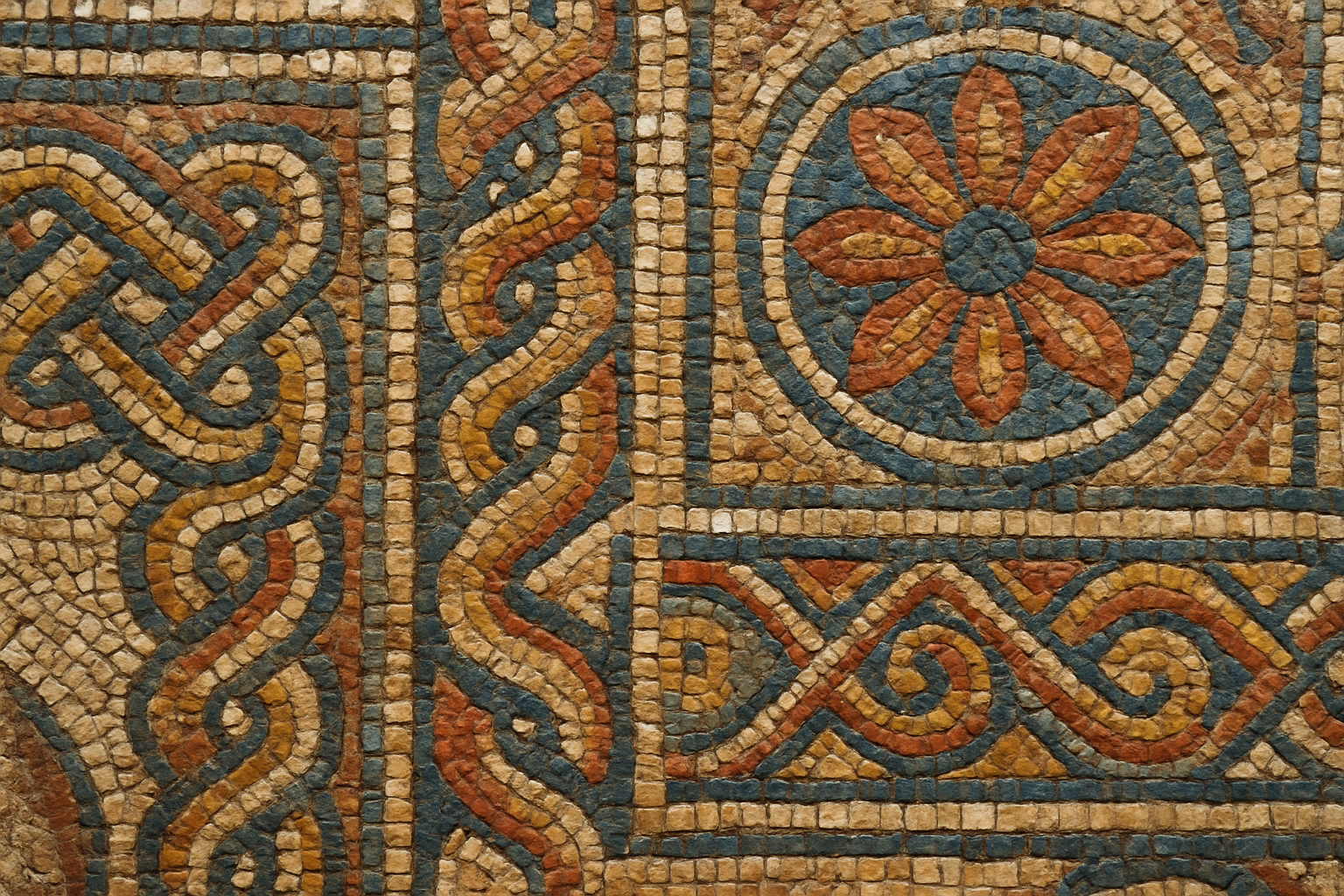
UNESCO counts the mosaics of Nea Paphos "amongst the finest specimens in the world" and says they cover the Hellenistic period to the Byzantine. Paphos, on the World Heritage List since 1980, is the most visited archaeological site in Cyprus, and Kourion, which is on neither the World Heritage List nor its Tentative List, is the second, according to the Deputy Ministry of Culture. Their floors adorned the houses of the wealthy, public buildings and churches, with gods and heroes, hunts and the grape harvest, and many purely geometric carpets. Beyond the two parks, a 6th century wall mosaic survives in a village church near Larnaca, and fragments of another, taken from a church in the occupied north, are kept in Nicosia.
Kato Paphos: Dionysos, Theseus, Aion and Orpheus
The richest group lies in the Kato Paphos Archaeological Park on the south-west coast. Mosaic fragments turned up by chance during levelling work in 1962, and the Department of Antiquities' excavations that followed uncovered the House of Dionysos, built at the end of the 2nd century AD and abandoned after the earthquakes of the 4th. Of its 2,000 square metres, 556 are mosaic floors with mythological, grape-harvest and hunting scenes: Dionysos returning in triumph from India on a chariot drawn by two panthers, Icarios beside an inscription reading "the first wine drinkers", and a hunt that includes the mouflon, the largest endemic animal of Cyprus. At the entrance lies a much older pebble mosaic of the sea monster Scylla, made at the end of the 4th or the start of the 3rd century BC and found in 1977 while the shelter was being built.
Since 1965 a University of Warsaw mission has dug here, the longest-running foreign excavation in Cyprus. Its Villa of Theseus, a house of more than 100 rooms thought to have been the residence of the governor of Cyprus, has Theseus about to kill the Minotaur in a circular panel, with the Labyrinth personified as an old man behind him and Ariadne and Crete above, laid at the very end of the 3rd or the start of the 4th century AD; later floors show Poseidon and Amphitrite and, only partly preserved, Achilles' first bath. In 1983 the mission found the House of Aion, whose apsidal room holds what the Department of Antiquities calls the most spectacular mosaic of Paphos: five panels showing the newborn Dionysos, Leda and the Swan, the beauty contest between Cassiopeia and the Nereids, Apollo and Marsyas, and the Triumph of Dionysos. The House of Orpheus shows Orpheus among the beasts, with Hercules and the Lion of Nemea and an Amazon with her horse in the next room.
Kourion: Eustolios, Achilles and the Gladiators
Kourion, an ancient city-kingdom on the cliffs about 19 km west of Limassol on the road towards Paphos, is the other essential stop. The University of Pennsylvania Museum excavated it from 1933 to 1954, with a break for the war, and the Department of Antiquities dug the Agora, the House of the Gladiators and two basilicas between 1975 and 1998. The House of Eustolios, from the end of the 4th or the early 5th century AD, stands under a roof. An inscription at its entrance reads "Enter the residence in good faith and joy", another says the house is girt by "the much venerated signs of Christ", among early Christian symbols such as the fish, the partridge and the peacock, and a third records that Eustolios gave the town its baths. In the baths, one floor of four panels has two geometric designs, a partridge, and the bust of a young woman holding what seems to be a standard measure, almost exactly a late Roman foot long, labelled Ktisis, Creation.
The House of Achilles, a villa of the first half of the 4th century AD around a central peristyle court, has a floor showing Odysseus, disguised as a merchant, revealing Achilles' true identity at the court of King Lycomedes on Skyros; its excavators suggest it was a reception centre for distinguished visitors. A few metres to the east, the House of the Gladiators, from the second half of the 3rd century AD, keeps two scenes, gladiators training and a fight watched by an unarmed referee in civilian dress, and the names of the fighters survive in both; the Department of Antiquities calls such combat scenes rare in Cyprus. The Early Christian basilica, built at the start of the 5th century, was given new mosaic and opus sectile floors in the 6th.
How the floors were made
The Visit Cyprus audio guide to the Paphos park sets out the method. Craftsmen levelled the ground and laid small stones in thick lime mortar, then a layer of crushed stone and pottery in mortar, then fine plaster, and pressed the cubes, or tesserae, into the plaster while it was still wet. The tesserae are local stone, imported marble and glass in rare colours such as bright orange, blue, green and yellow, each about a cubic centimetre, smaller for human figures; the intense blue is glass, probably made in Paphos, where glass workshops have been found. Workshops produced the floors, apprentices doing most of the work while a master made the main figures, and the scenes came from existing drawings from which the householder chose. In the House of Aion the cubes are only 2 to 5 mm, a coin in the mortar dates the floor after AD 318, and the Warsaw archaeologist Marek Olszewski reads its pagan scenes as "an anti-Christian polemic (in images)".
Hours, tickets and the day card
Both parks open every day, 08:30 to 17:00 from 16 September to 15 April and 08:30 to 19:30 from 16 April to 15 September, with last tickets at 19:00 in summer and, at Kourion, 16:30 in winter. They close only on 1 January, Orthodox Easter Sunday and 25 December, and open as normal on other public holidays, including Wednesday 28 October, 08:30 to 17:00. Entry is 4.50 EUR at each (Paphos +357 26 306 217, Kourion +357 25 934 250). The Department of Antiquities' 1-day card, 8.50 EUR at any of its ticket offices, gives one visit to each of its museums and sites that day: it saves 0.50 EUR on the two parks, or 3 EUR if you add the Tombs of the Kings in Paphos (2.50 EUR). There are 3-day (17 EUR) and 7-day (25 EUR) cards too, and organised groups of more than ten get 20% off.
In Paphos the Houses of Dionysos and Aion are under shelters, a wooden bridge leads into the House of Dionysos, the Villa of Theseus, about 150 metres away, is seen from a wooden corridor, and the visitor centre is up the steps after the ticket office. The park is only partly wheelchair accessible, following the staff's directions, with marked accessible parking and toilets. Kourion finished a 3.5 million euro upgrade by early 2026, with a renovated visitor centre, a new shop, covered rest areas and new toilets; it has footbridges and a roofed House of Eustolios, and the Department of Antiquities calls almost all of it wheelchair accessible by small bridges and passageways.
Beyond the two parks: Kiti, Chrysopolitissa, Pegeia and Nicosia
At Kiti, about 11 km by road south-west of Larnaca, the apse of the church of Panagia Angeloktisti keeps a 6th century wall mosaic of the Virgin standing on a gold ground with the Child in her left arm, between the archangels Michael and Gabriel. The Department of Antiquities ranks it among the most significant wall mosaics of Early Christian art, and the church's entry on UNESCO's Tentative List, submitted in 2015, calls it the only wall mosaic surviving in a monument in Cyprus. The church was built in the 11th century over a 5th century basilica. Entry is free; from October to April it opens Monday to Saturday 07:00 to 16:45 and Sunday 09:30 to 16:45, and as official pages give different summer closing times, ring 24 424 646 before a summer visit.
In Kato Paphos itself, about 700 metres or nine minutes on foot from the park entrance, the basilica of Chrysopolitissa, one of the largest built on the island in the second half of the 4th century AD, has geometric floors of the 4th and 6th centuries and three figural scenes of Christian allegories in its central aisle, seen from footbridges restored in 2025; the church standing among them dates from around 1500 and is used for Catholic and Anglican services. At Agios Georgios, Pegeia, about 20 km by road up the coast from Kato Paphos, the sanctuary of Basilica A, one of three 6th century basilicas there, has a floor of birds, fish, sea turtles and fruit baskets (2.50 EUR; 08:30 to 16:00 in winter, 09:30 to 17:00 in summer).
In Nicosia, the Byzantine Museum of the Archbishop Makarios III Foundation, reopened in March 2025 after five years of renovation, holds fragments of the 6th century apse mosaic of Panagia Kanakaria at Lythrangomi, a village in the occupied north. The mosaics were torn from the church between 1976 and 1979, and four pieces, the young Christ, an archangel and the apostles Matthew and James, were returned after a United States court in Indianapolis ruled for the Church of Cyprus on 3 August 1989, a decision upheld on appeal in 1990. The museum opens Tuesday to Saturday, 09:30 to 17:00; tickets are 7 EUR.
Getting between them
Paphos airport is the nearest to both parks, about 17 km from the Kato Paphos car park and 47 km from Kourion. By car, Kato Paphos to Kourion is about 58 km, roughly 52 minutes on the B20, A6 and B6; Kourion to Kiti is about 81 km, some 73 minutes on the B6, A6, A1 and A5, and Kiti is under 7 km from Larnaca airport. From Kiti, the Byzantine Museum in Nicosia is about 54 km, around 51 minutes. These are traffic-free estimates from the OSRM route planner, so allow more time. One stop to leave out for now: the Kourion Museum in Episkopi, which holds a 6th century mosaic of an archangel from Kourion's basilica, has been closed for upgrade works since 1 August 2026, and no reopening date has been announced.
If the island's layers of history have you thinking of a longer stay, our relocation help is at hand.
