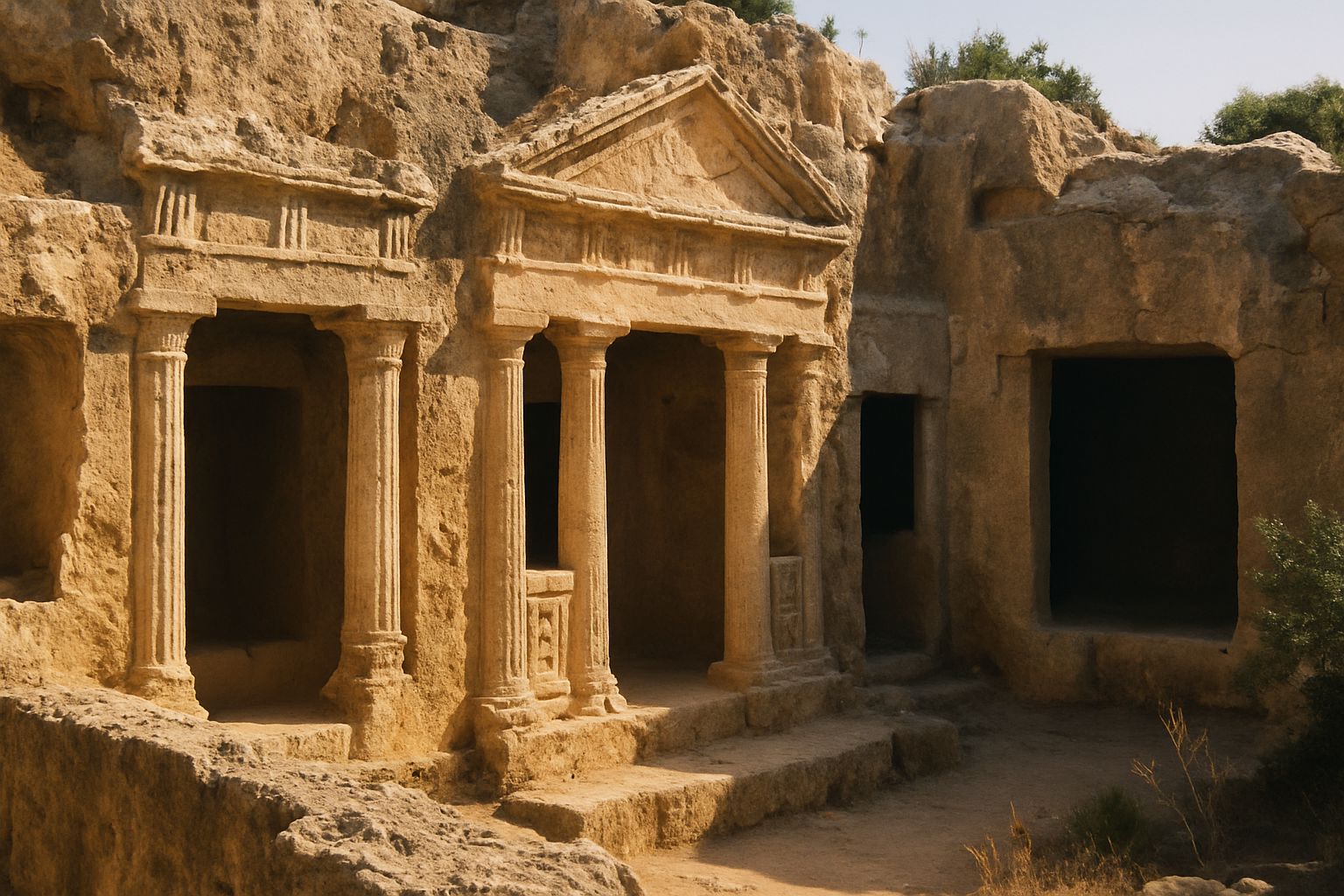
Ancient Cypriots often buried their dead in chambers cut into the island's soft rock, and many of those tombs can still be explored today. The best known is the Tombs of the Kings in Paphos, the necropolis of Hellenistic and Roman Nea Pafos, where courtyards lined with Doric columns were carved into the bedrock from the 3rd century BC. It deserves a visit of its own, and our guide to the Tombs of the Kings walks you through it tomb by tomb. This guide covers the rest: smaller and stranger rock-cut tombs from Paphos to Ayia Napa, some of them free to visit.
Start on Apostolou Pavlou Avenue in Kato Paphos, about a kilometre from the harbour, at the catacomb of Agia Solomoni. Stone steps lead down to a small open courtyard with five chambers cut into the rock around it, a modest group of chamber tombs from the Hellenistic period. Christians later turned it into a shrine. The west chamber has an apse and remnants of 12th-century wall paintings, and the names of 13th-century Crusaders are among the graffiti cut into the plaster. Another chamber, a few steps further down, holds a small spring-fed pool. In the Middle Ages this was a popular pilgrimage site, also known as the chapel of the Seven Maccabees.
The saint is honoured as the mother of the seven Maccabee brothers, and tradition says she hid in the cave from Roman persecution, was walled in, and walked out alive when it was opened 200 years later. On the rock above the catacomb stands an old tree hung with colourful rags, handkerchiefs and pieces of clothing, left by people hoping to be cured of illness, a custom that continues today. The church celebrates its feast day on 1 August.
About 20 km up the coast from Paphos, near Pegeia, the pilgrimage site of Agios Georgios on Cape Drepanon was once an extensive Roman and Early Christian settlement. It was probably a port of call for the ships carrying grain from Egypt to Constantinople, and it flourished under Justinian I, who reigned from 527 to 565 AD. Its necropolis, with tombs carved into the rock, runs along the brow of the steep cliff above the west and north-west shore. The Department of Antiquities also points out an odd case of reuse: an underground Roman tomb, reached by a staircase, was later used to collect the waste water from a bath. The excavated site, with three 6th-century basilicas, costs €2.50 and is open daily, from 08:30 to 16:00 between mid-September and mid-April and from 09:30 to 17:00 in summer, according to the Department of Antiquities.
Just east of Limassol, the ancient city-kingdom of Amathous had two necropoleis, one east and one west of the town, with tombs carved into the rock from the Geometric to the Roman period. British archaeologists A.H. Smith and J.L. Myres excavated many of them in 1893 and 1894, and part of the rich finds is now on display in the Limassol District Archaeological Museum. On the north edge of the acropolis hill, a tomb known as the tomb of Ariadne, probably from the 11th century BC, is the oldest sign of human presence on the site. Its name recalls the myth that Theseus left the pregnant Ariadne at Amathous in the care of local women. In early Christian times, a cave chapel dedicated to St Barbara, the healer, was created at the eastern edge of the East necropolis. The site is open daily from 08:30 to 17:00 in winter and until 19:30 in summer, with the last ticket at 19:00, and entry is €2.50.
In Larnaca, a rock-cut tomb is still a place of prayer. The small Panagia Faneromeni church on Faneromeni Avenue dates from the early 20th century and replaced a medieval church on the same spot. Beneath it lies a cave, originally a tomb cut from the rock, which served as an early Christian church. Its age is disputed: the Larnaka Tourism Board says it is most likely Mycenaean, while in 2012, when sewerage works on the avenue uncovered more tombs of the Phoenician period, from the 6th to the 4th century BC, archaeologists dated the catacomb to the 4th century BC and suggested the new graves might be an extension of it. The place is credited with healing powers: people suffering from headaches or other illnesses walk three times around the church and leave a piece of clothing or a tuft of hair, and women whose partners are overseas come to pray for their safety. A larger, modern church now stands beside the old one.
On Nissi Avenue, at the western end of Ayia Napa, lie the Makronissos tombs. The site has 19 rock-cut tombs from the Hellenistic and Roman periods, plus a small sanctuary, a simple rectangular enclosure of large irregular blocks, and an ancient quarry. Most chambers are almost identical: a rectangular entrance, once sealed with one or two stone slabs, opens onto a chamber with a rectangular trench in the middle and three benches at the sides. The tombs have been looted since 1872, but archaeologists believe the dead were laid in clay sarcophagi covered with three flat tiles, and remains of funeral pyres found on the surface point to Greek burial customs. The site is open daily from 09:00 to 17:00 all year round, and entry is free.
A few practical points. Wear shoes with a good grip for the rock-cut steps, and carry water and a hat outside the winter months. Agia Solomoni and Panagia Faneromeni are working shrines, so dress modestly and keep your voice down if people are praying. Department of Antiquities hours differ on public holidays, so check its website before a special trip.
In Cyprus, a tomb more than two thousand years old can sit beside a busy avenue, as Agia Solomoni and Panagia Faneromeni show. If you are thinking of making the island your home, our relocation help can take care of the practical side while you explore.
