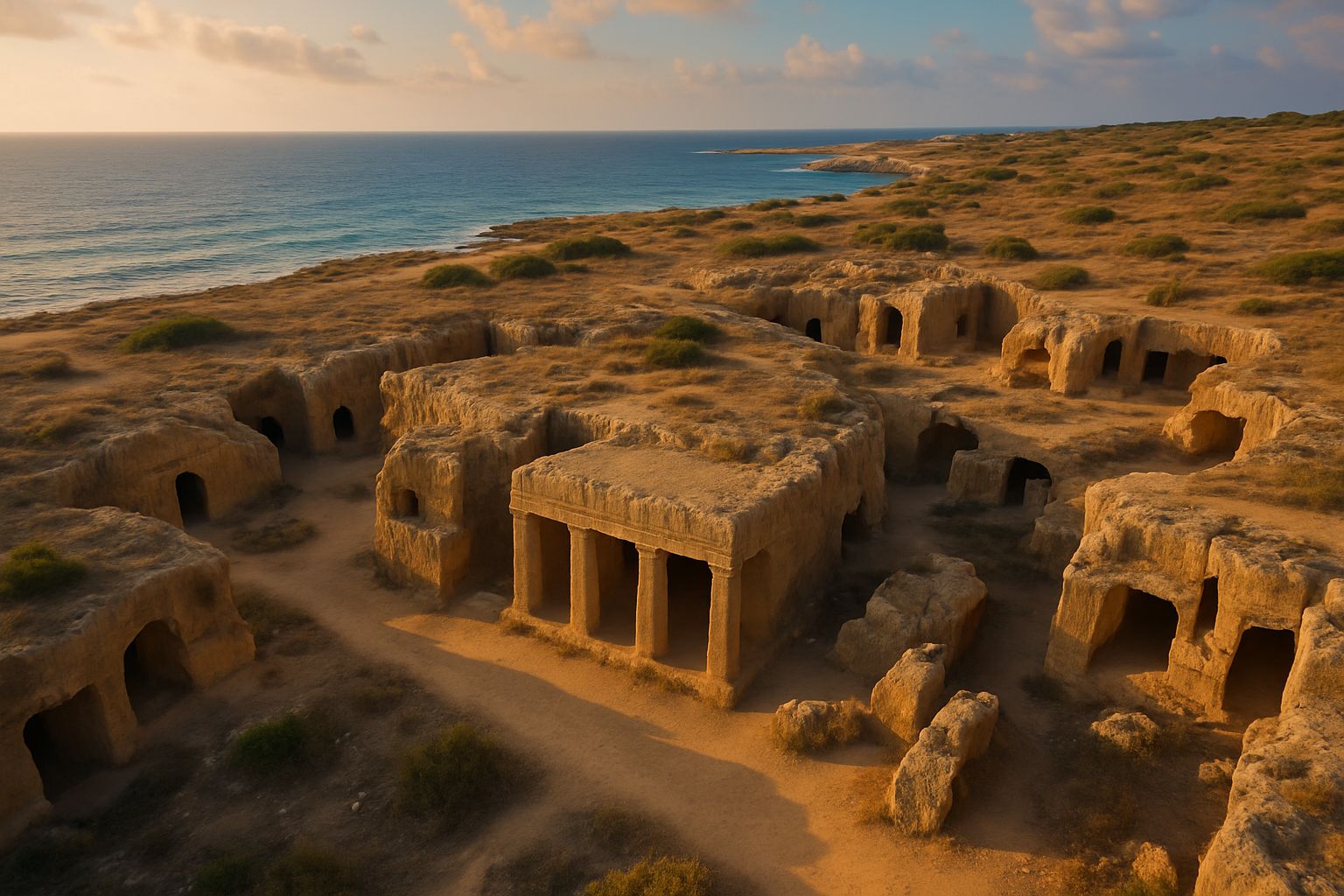
About 2 km north of Paphos harbour lies the Tombs of the Kings, the necropolis where the dead of ancient Nea Pafos were laid to rest in tombs cut straight into the bedrock. Together with the Kato Pafos archaeological park and its mosaics, it belongs to the Paphos UNESCO World Heritage Site, listed in 1980. You do not just look at it from above: stone staircases lead down into sunken courtyards carved more than 2,000 years ago.
Despite the name, the tombs were not built for kings. The island's city kingdoms were abolished in 312 BC, and the necropolis was laid out in the Hellenistic period, from the 3rd century BC, for the newly founded city of Nea Pafos. According to the Department of Antiquities, it held senior administrators and distinguished figures of the Ptolemaic state, which ruled Cyprus from Alexandria, together with their families. The royal name simply reflects the size and splendour of the monuments. Burials continued through the Roman period until the beginning of the 4th century AD.
The grandest tombs copy the houses of the living. A stepped passage, the dromos, leads down to an open courtyard sunk into the rock and surrounded by porticoes on Doric columns or pillars, with burial chambers and niches cut into the walls behind them. The design follows Hellenistic models from Alexandria, Delos, Pergamon and Priene, and the closest parallels are the tombs of the Mustafa Pasha necropolis in Alexandria. Look closely in Tombs 1, 3 and 7 and you will find traces of the coloured plaster that once covered the walls, so that plain stone would pass for costly marble.
Water is part of the story here, but as ritual, not plumbing. Most of the big tombs have their own well: in Tomb 3 it is on your left at the foot of the stairs, in Tomb 5 it sits in the middle of the courtyard, and in Tomb 6 nine steps lead down to it. The Visit Cyprus audio guide explains its two roles. The water stood for the passage of the dead from the world above to the underworld, the crossing of the river Acheron in Greek myth, and mourners washed before leaving the tomb after a burial, a custom still kept at Orthodox cemeteries in Cyprus. Coins found in the tombs were most likely the fare for Charon, the ferryman of the dead.
Families also brought offerings of milk, honey, water and wine, and in some tombs archaeologists found ashes from ritual fires. After a burial the relatives shared a funeral meal, the perideipnon, at the tomb itself. In burials that escaped the looters, the offerings included amphorae from Rhodes, stamped by their makers.
A few tombs deserve extra time. Tomb 3 has a restored Doric courtyard where the triglyphs and metopes above the columns are easy to pick out. Tomb 6 has what the official audio guide calls the longest dromos ever excavated in Cyprus, with roughly 20 metres of it covered by a vault. Tomb 7, the northernmost, was turned into a church and is known as Palioekklisia. In Tomb 8, two limestone birds, most probably eagles, the royal emblem of the Ptolemies, were found in front of the central burial niche, which has led to the idea that a Ptolemaic king who died in Cyprus was buried there; if the birds are falcons instead, they may stand for the Egyptian god Horus.
The necropolis never really fell silent. Early Christians buried their dead here, the site served as a quarry for centuries, and in the Middle Ages squatters moved into some of the tombs and altered them; a medieval pottery kiln was even built in one corner of Tomb 5. In the late 19th century Luigi Palma di Cesnola, the American consul, looted the tombs, and systematic excavation only began in 1977, when the Department of Antiquities uncovered the eight large tomb complexes you visit today.
The Department of Antiquities opens the site daily from 08:30 to 17:00 between 16 September and 15 April, and from 08:30 to 19:30 between 16 April and 15 September, with the last ticket at 19:00. Entry is €2.50, and Visit Cyprus lists closures on Christmas Day, New Year's Day and Orthodox Easter Sunday. The ticket area and the site are wheelchair accessible, with the tombs viewed from above. To see the kind of house these tombs imitate, visit the House of Dionysos in the Kato Pafos archaeological park by the harbour, which our guide to Cyprus' ancient mosaics covers.
Finish at the Archaeological Museum of the Pafos District on Griva Digeni Avenue in Ktima, upper Paphos, where some of the finds from these tombs are kept. Its galleries run from the island's earliest settlements to the Roman city, including the Hellenistic and Roman burial customs of Pafos, with sarcophagi, Greek-style stelae and funerary statues. Entry is free, Tuesday to Sunday from 09:00 to 16:30; the museum is closed on Mondays and public holidays.
If living with this much history on your doorstep appeals, Paphos is an easy place to settle. For anyone planning the move, relocation help is available, so you can spend your weekends exploring sites like this one.
