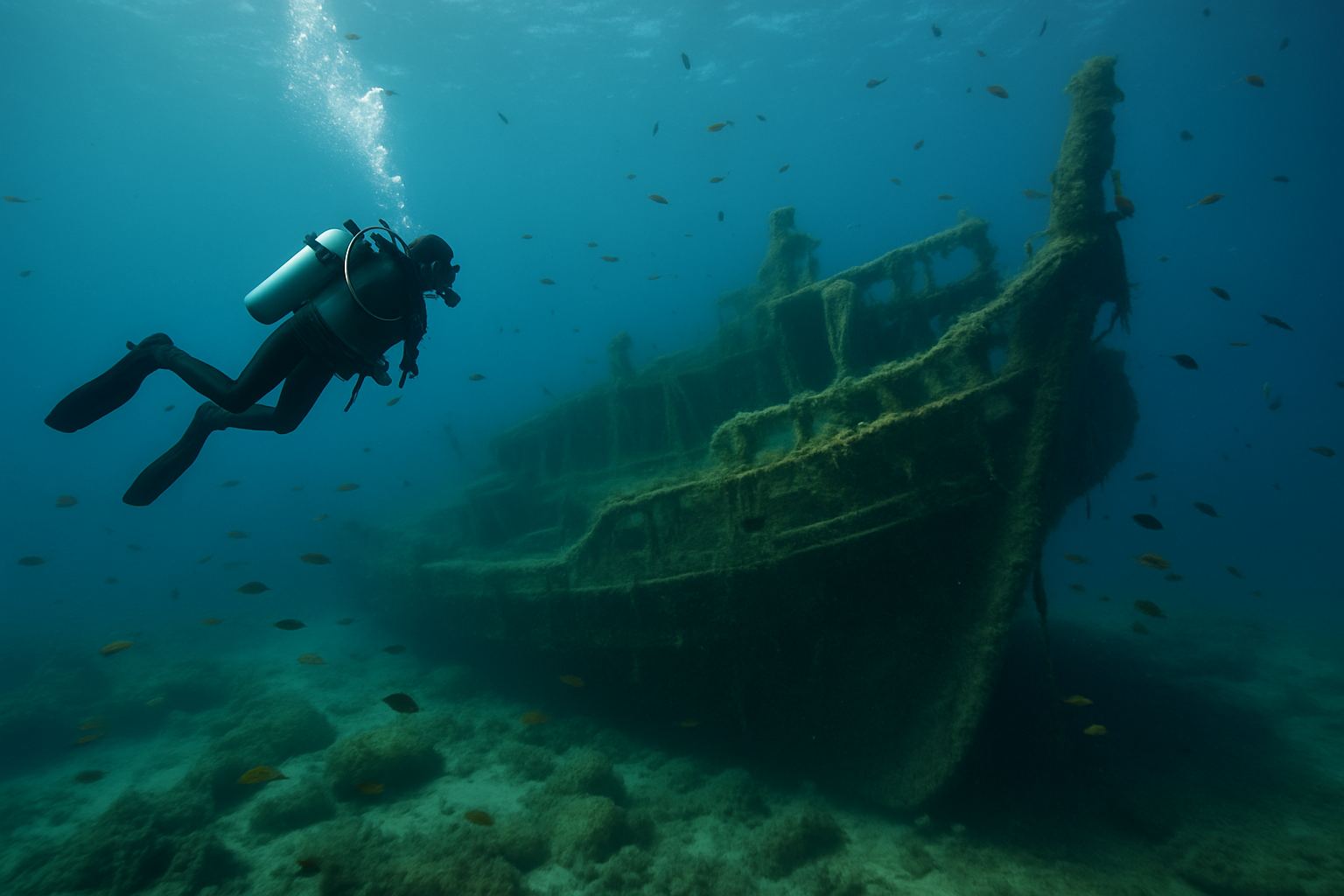
The waters around Cyprus have carried traders for thousands of years, and not every ship made it home. Ancient wrecks lie off the island's south and east coasts, from a Greek merchant ship of the 4th century BC to late Roman cargoes, and together they tell the story of an island at the crossroads of Mediterranean trade. The catch for divers is that these ancient wrecks are protected archaeological sites, so the real treasure hunt runs through one remarkable underwater park, one famous modern wreck and the museums that hold the ancient ships.
The most important ancient wreck still on the seabed is the Mazotos shipwreck, a Greek merchant ship that sank around the middle of the 4th century BC about 1.5 nautical miles off the south coast near the village of Mazotos, in the Larnaca district. It lies at 45 metres with a cargo of around 800 amphorae, most of them made on the Aegean island of Chios to carry wine. The Maritime Archaeological Research Laboratory (MARELab) of the University of Cyprus has been excavating it since 2007 under Dr Stella Demesticha, working with the Department of Antiquities. It is a research site, not a recreational dive: public access has been limited to supervised visits, such as the 28 local divers taken down during an outreach project in October 2019, and finds stored on the seabed are wrapped and covered to protect them from looting.
For a wreck dive you can actually book, head for the Zenobia off Larnaca. She is not ancient at all: this Swedish-built roll-on roll-off ferry capsized and sank in Larnaca Bay in the early hours of 7 June 1980, on her maiden voyage from Malmö to Tartus in Syria, without loss of life. She lies on her port side about 1.5 kilometres offshore in roughly 42 metres of water, still carrying more than 100 lorries, and The Times once listed her among the ten best wreck dives in the world. The shallowest parts start at about 16 metres, while her car decks and engine room are only for very experienced, wreck-trained divers.
Ancient history is easier to reach at Amathus, on the coast east of Limassol, where Cyprus opened its first underwater archaeological park in 2022. The harbour of the ancient city-kingdom was built between about 312 and 294 BC, when Alexander the Great's successors were fighting over Cyprus, probably as a naval base, and is usually credited to the Macedonian king Demetrius Poliorcetes. Its submerged breakwaters lie only about 2 metres down and up to 60 metres from the shore, so snorkellers can explore them as well as divers. The park was created by MARELab with the Departments of Antiquities and of Fisheries and Marine Research, and four information boards on the seabed, boards along the coastal path and the Amathus Harbour app explain what you are looking at.
Other ancient wrecks are known but are not open to divers. Off the Akrotiri peninsula, underwater surveys for the University of Leicester's Ancient Akrotiri Project found around 800 Roman amphorae from the end of the 6th or the 7th century AD scattered off the ancient port at Dreamer's Bay, the sign of a large shipwreck; the bay lies inside RAF Akrotiri, in the British Sovereign Base Area, where access is restricted. In 2019 volunteer divers working with the University of Cyprus found a Roman wreck off Protaras, loaded with amphorae most probably from Syria and Cilicia, which the Department of Antiquities called the first undisturbed Roman shipwreck ever found in Cyprus.
To see an ancient ship up close, go to the museums. The Kyrenia ship, a Greek merchant vessel that sank around 300 BC, is on show in the Shipwreck Museum inside Kyrenia Castle; Kyrenia lies in the Turkish occupied north, so a visit means crossing at one of the official checkpoints with your passport or ID. In Ayia Napa, the Thalassa Municipal Museum of the Sea has Kyrenia II, a full-size sailing replica of her, as its centrepiece. Our guide to the island's maritime museums has the opening hours and more on both.
If you're contemplating making Cyprus your more permanent home, exploring its underwater wonders can be a compelling part of your life here. As you consider such a move, remember that relocation help is available to make the transition as smooth as possible. Cyprus' history and culture are not just for visitors to admire; they are for residents to embrace and live by. Dive in and let the island's past enrich your present.
