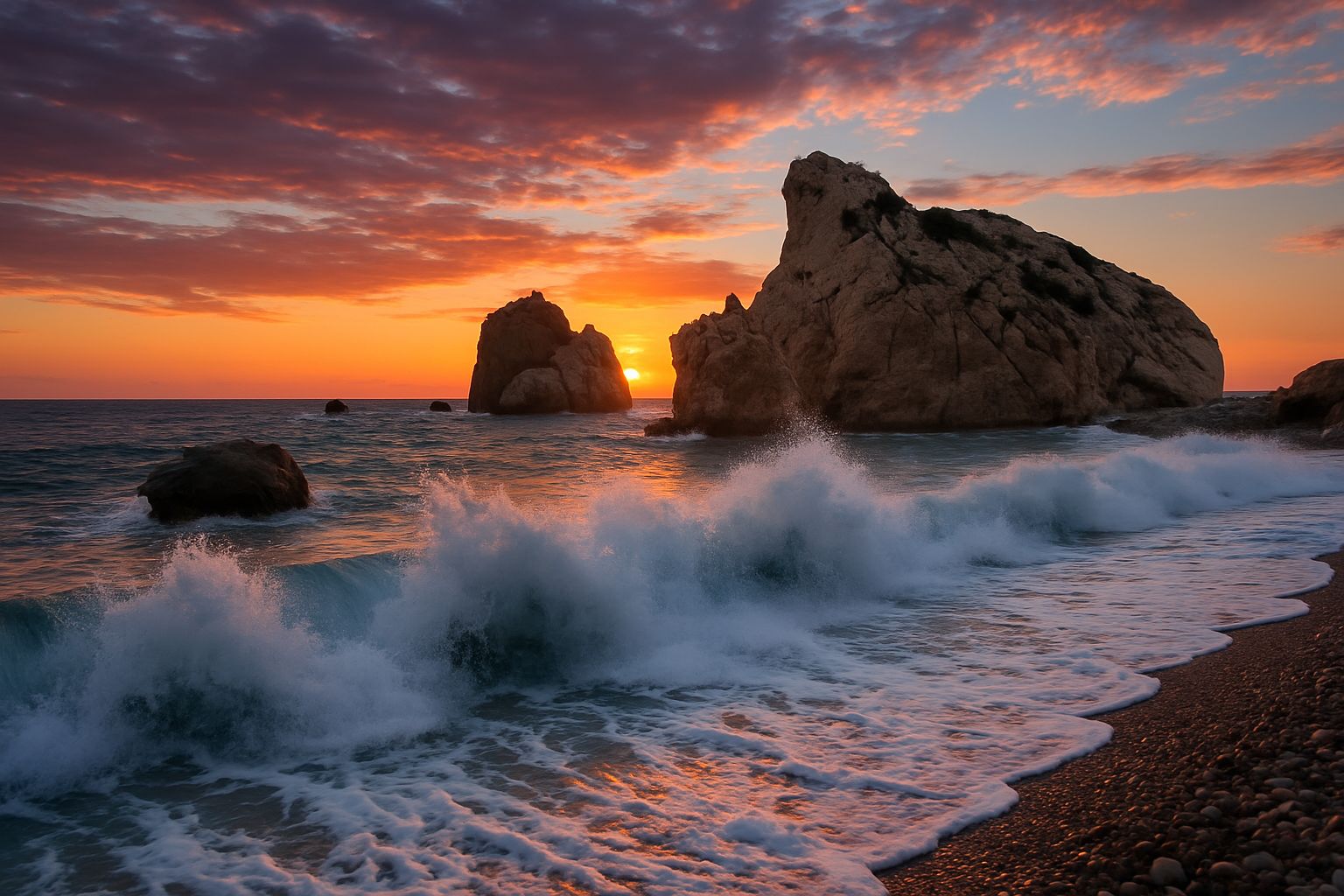
Petra tou Romiou, better known as Aphrodite's Rock, is a group of huge rocks lying partly in the sea and partly on the shore, on the south-west coast of Paphos district. It sits beside the old Paphos to Limassol road, the B6, inside the boundary of Kouklia, a village 16 km east of Paphos. By our estimates from OpenStreetMap routing, the main car park is about 25 km and 22 minutes' drive from central Paphos (most of it on the A6 motorway), about 29 km from Paphos harbour, about 45 km and 40 minutes from Limassol, and about 8 km from Kouklia village. The stretch of the B6 beside the rock reopened on 8 August 2025 after landslide stabilisation works that cost 3,292,300 EUR before VAT.
Visit Cyprus calls it Aphrodite's mythical birthplace: according to the legend, the goddess of love and beauty was born of the sea foam here, rose from the waves and was carried to this beach on a shell. The ancient poets are less exact. Hesiod's Theogony has her grow from white foam, come first to Cythera and then to 'sea-girt Cyprus', while the Homeric Hymns and Homer's Odyssey send her to Paphos, 'where her precinct is and fragrant altar'. That precinct is the Sanctuary of Aphrodite at Palaipafos, in today's Kouklia, where her cult lasted until the 4th century AD.
The name tells another story. Petra tou Romiou means 'rock of the Greek', and Visit Cyprus ties it to a later legend: the Byzantine hero Digenis Akritas is said to have heaved the giant rocks here to keep the Saracen Arabs at bay, at the time of their raids of the 7th to 10th centuries. Visit Cyprus also passes on the popular belief that swimming around the rock three times brings blessings such as eternal youth and beauty, good luck, fertility and true love. Read the next paragraph before you try it.
The beach is pebbles and has no lifeguard. The state's standing position, as the public broadcaster RIK reported in August 2024, is that the Petra tou Romiou beach cannot become an organised bathing beach and cannot have a lifeguard tower on the shore. Waves can be strong here and drownings are on record: a 29-year-old man died in July 2023 after strong waves dragged him away, and a man was found drowned after a night swim in July 2024. Swim only when the sea is calm and stay close to the shore. The water is one of Cyprus' officially monitored bathing waters, all of which were rated excellent in the EU's 2025 assessment; in September 2026 the authorities said they were investigating photos posted by an environmentalist that appeared to show sewage in the sea near the rock.
A car park lies on the inland side of the B6, and a pedestrian underpass leads from it under the road to the beach. Visitors report that parking is free and that the car park has toilets, free changing rooms, showers for a small fee and a shop selling snacks, ice cream and souvenirs. On the hillside just east of the rock is the restaurant that Visit Cyprus lists as the Petra tou Romiou Tourist Pavilion (+357 26 999005); we could not confirm its current hours, so call ahead. Lay-bys with parking on the B6 further east give the classic view from above.
Without a car, take Paphos bus 631 from Harbour Station: it runs via the Kouklia archaeological site to a stop by the car park entrance in about 40 to 50 minutes. From April to November there are 10 departures a day from the harbour, from 07:25 (06:30 on Sundays and public holidays) to 22:35, and the last bus back leaves the rock at 23:15; from December to March there are 7. A single ticket costs 2 EUR (3 EUR after 21:00) and a day ticket 6.50 EUR, sold on the bus. Village route 630 from Paphos to Pissouri also stops at the rock, three times a day from Monday to Saturday, but the intercity buses between Paphos and Limassol do not.
Combine the rock with Palaipafos in Kouklia, about 8 km and 10 minutes' drive away, where bus 631 also stops. Palaipafos and Nea Pafos became the first Cypriot sites on the UNESCO World Heritage List in September 1980, and the Department of Antiquities calls the Sanctuary of Aphrodite one of the most important sanctuaries of the goddess in the ancient world; its first shrine was built in the Late Bronze Age. The local museum, in the Ottoman-period east wing of the 13th century Lusignan manor house, displays the conical stone that served as the cult idol and the original Leda and the Swan mosaic from the House of Leda. The site opens Tuesday to Sunday, 08:30 to 17:00, and is closed on Mondays; entry costs 4.50 EUR including the museum (+357 26 432155). On 17 October Kouklia also holds its large annual fair for its church of the Apostle Luke.
The rock is best known at sunset, but where the sun goes down depends on the season. By our calculation from the shoreline and the sun's path, from about late August to mid-April the sun sets into the open sea as seen from the beach, while from mid-April to late August it sets behind the coast towards Kouklia and Paphos. Sunset in Paphos is at 18:18 on 13 October 2026, and after the clocks go back on 25 October it comes just after 17:00. The coast from Cape Aspro to Petra tou Romiou is the Natura 2000 site CY5000005, protected for its birds and habitats, and about 350 hectares of land around the rock form the Petra tou Romiou National Forest Park, so leave the pebbles where you find them.
Thinking of living near Paphos rather than visiting? Our relocation help takes care of residency, GeSY healthcare registration and the rest of the paperwork.
