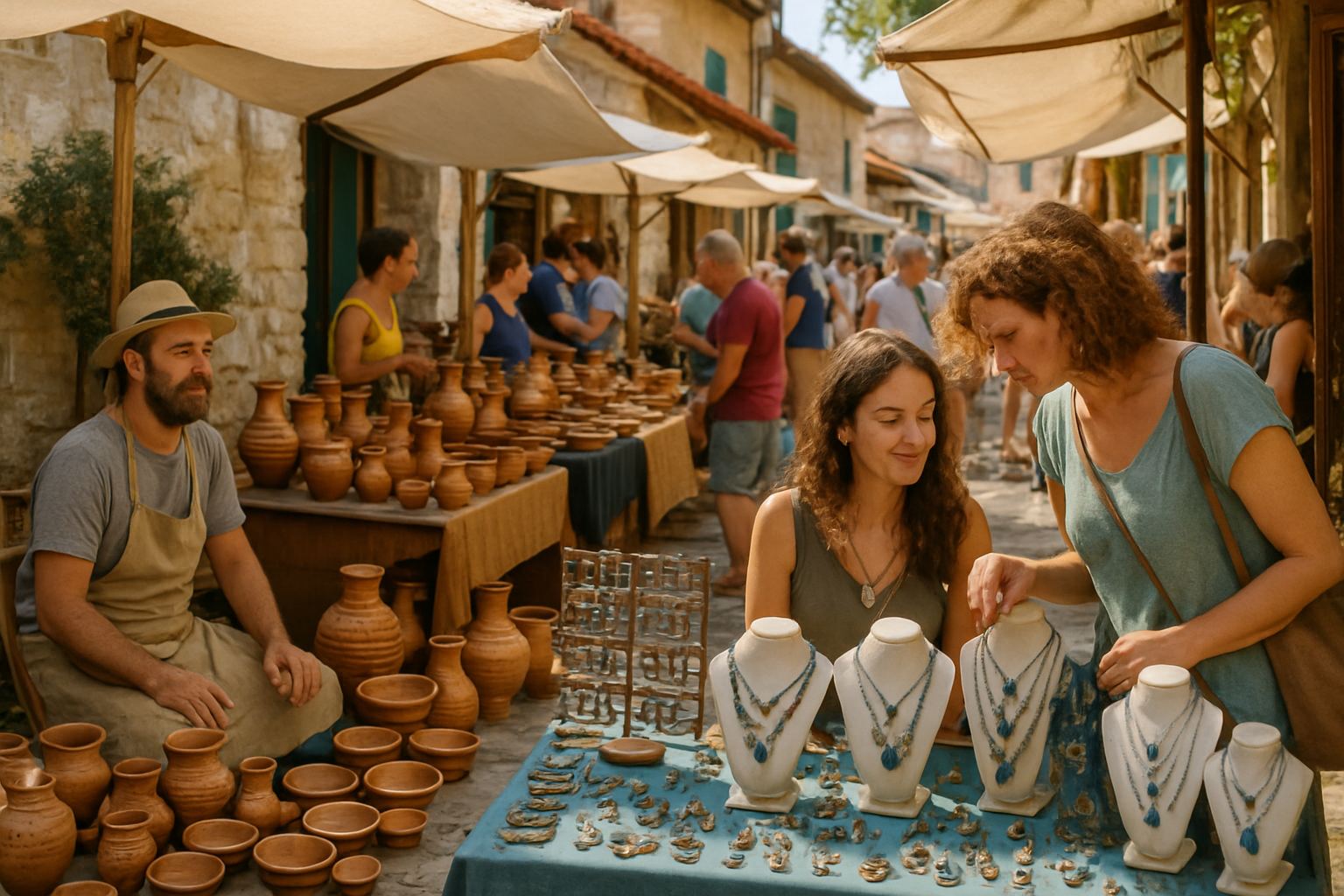
Cyprus is not only beaches and ancient ruins. Its traditional crafts are still very much alive, from lace and filigree silver in the hill villages to weaving, pottery, woodcarving and basketry, and there are a handful of places where you can watch the makers at work and buy straight from them. Here is where to find the real thing.
Start in Lefkara, the hill village in the Larnaca district, 650 metres up and 43 km from Larnaca, that is world-renowned for its lace embroidery and filigree silver. Its lace, Lefkaritika, was added to UNESCO's list of the intangible cultural heritage of humanity in 2009, and the tradition goes back at least to the fourteenth century, mixing local craft with the embroidery of the Venetian courtiers who ruled Cyprus from 1489 and ancient Greek and Byzantine geometric patterns. There is no single lace market here: you buy from the lace and silver shops along the village's narrow streets, where women have long worked their lace together in the lanes and on covered patios. Our guide to the lace villages has more on the craft itself.
You can watch lace and silver being made at the Lefkara Handicraft Centre and in various workshops around the village. To see what the old pieces looked like, visit the Local Museum of Traditional Embroidery and Silversmith-work in the House of Patsalos, a village mansion of the 19th and early 20th centuries: the upper floor has period furnishings, traditional costumes, jewellery, silverwork and a large collection of old Lefkara embroidery, and a separate building holds a reconstructed smithy. It opens 08:30 to 16:00 from 16 September to 15 April and 09:30 to 17:00 in summer (+357 24 342 326).
In Nicosia, the best single stop is the Cyprus Handicraft Centre at 186 Athalassas Avenue in Strovolos, run by the state Cyprus Handicraft Service, which was set up after 1974 to preserve the island's crafts and give work to displaced artisans. You can watch craftspeople at work on embroidery, lace-making, tapestry, weaving, basketry, woodcarving, pottery and metalwork, see its exhibitions and buy authentic handmade Cypriot pieces in the shop. Entry is free; it opens 08:30 to 17:30 on Mondays, Tuesdays, Thursdays and Fridays, 08:30 to 15:00 on Wednesdays and 09:00 to 13:00 on Saturdays (+357 22 305 024).
For a more contemporary take, walk to the Chrysaliniotissa Crafts Centre in the old town, on the corner of Dimonaktos and Ipponaktos streets. Eight workshops sit around a central courtyard laid out like a traditional inn, with makers giving traditional crafts a modern twist, and there is a coffee shop. Entry is free; it opens 10:00 to 17:00 on weekdays and 10:00 to 13:00 on Saturdays, and it is worth calling ahead (+357 22 347 465).
In Paphos, the covered Municipal Market, the Agora, in the old town centre sells souvenirs, lace, ceramics, local specialities and fresh fruit. Stock and quality vary from stall to stall, so ask where and by whom a piece was made before you buy.
Two things are worth knowing before you shop. Genuine Lefkara lace is made by hand in cotton thread on linen, built from four basic elements: hemstitch, cut work, satin-stitch fillings and needlepoint edgings. And if you can time your visit, the annual Lefkara Festival each August brings music, dance, theatre and handicraft exhibitions to the village.
Whether you're an art enthusiast, a curious traveller, or someone looking to relocate to this captivating island, the artisan craft markets of Cyprus offer something special. They are a reminder that the island's true treasures are not just its scenic landscapes and historic sites but the creativity and passion of its people. If you're considering making Cyprus your home, these markets are a wonderful introduction to the local culture and community. And if you need relocation help, Cyprus Decoded is here to guide you every step of the way.
