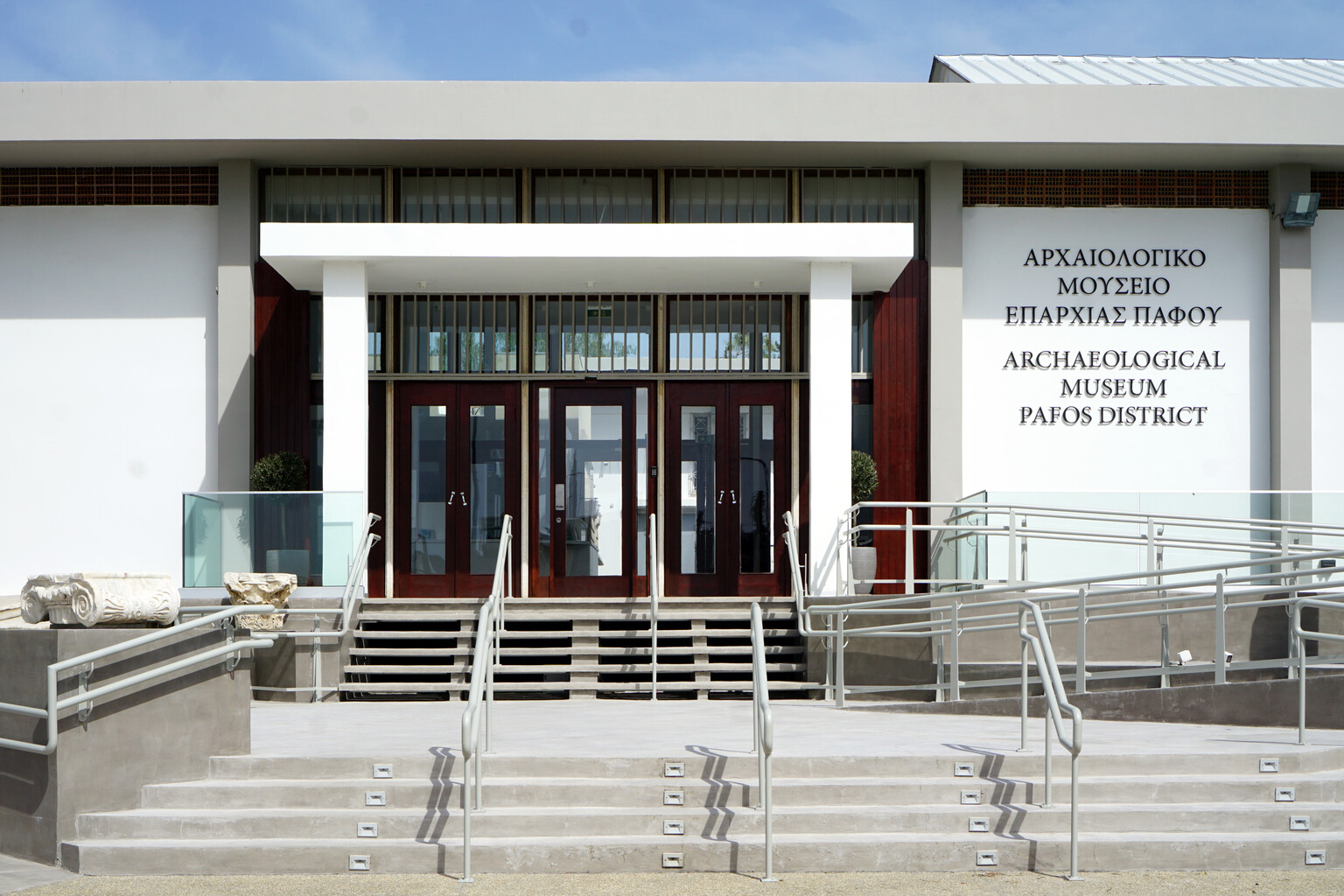
On Griva Digeni Avenue in the Ktima area of Paphos, the Department of Antiquities keeps finds from excavations across the district under one roof, from a hunter-gatherer settlement of the 11th to 10th millennium BC to the Roman period at Nea Pafos. The Department calls it the Archaeological Museum of the Pafos District. It reopened in February 2021 after an upgrade that had kept it shut since 2016, entry is free, and it opens from Tuesday to Sunday all year.
From two rooms in 1964 to the 2021 reopening
The museum first opened to the public in 1964, shortly after independence, with two rooms, and was extended in 1965, 1977 and 1987, according to the Department. It closed in 2016 for an upgrade that was repeatedly delayed: when it reopened in February 2021, the Cyprus Mail reported, the Department blamed the delay on the late delivery of the new display cases from abroad. The Department says the museum was entirely reorganised, with co-funding from the European Regional Development Fund under the Operational Programme Competitiveness and Sustainable Development for 2014 to 2020.
The new display follows the periods in order, each marked by its own colour, with themed sections on what set each apart, and the Department describes it as running from the Epipalaeolithic to the Roman period. Visit Cyprus's page on the museum describes five rooms with finds from the Neolithic to 1700 AD; we follow the Department's description, which covers the reorganised display.
Hunter-gatherers, early wells and picrolite figurines
The route starts with the oldest finds, from the Epipalaeolithic (10,500 to 9000 BC) and the Neolithic (9000 to 3900 BC). Recent excavations, the Department says, have brought to light some of the earliest settlements in Cyprus, such as a mountain settlement of hunter-gatherers at Agios Ioannis-Roudias, of the 11th to 10th millennium BC, and the wells of Kissonerga-Mylouthkia, of the 9th millennium BC, which it says are considered among the earliest in the world.
The Department calls the Chalcolithic period (3900 to 2500 BC) crucial for the development of civilisation in the Paphos area and in Cyprus. Its finds come from settlements and cemeteries at sites such as Lempa, Kissonerga-Mosfilia and Souskiou, among them what the Department describes as the earliest copper-based objects ever excavated in Cyprus and the characteristic cross-shaped picrolite figurines of the period. At Souskiou-Laona excavators found a workshop where such figurines were made, a discovery the Department calls unique. A reconstruction of the so-called House of Pithos at Kissonerga-Mosfilia, from the Late Chalcolithic, gives evidence, in the Department's words, of social differentiation, economic organisation and increasing overseas contacts.
Palaipafos, the city-kingdoms and the syllabic script
From the Early and Middle Bronze Age (2500 to 1650 BC) come finds from the settlement at Kissonerga-Skalia and pottery from two cemeteries at Kissonerga, a period of more intensive copper working, farming and crafts such as spinning and weaving. In the Late Bronze Age a settlement was established at Palaipafos, in today's village of Kouklia, which the Department describes as an important urban centre that controlled the production and trade of copper in the area and had the most important sanctuary of Aphrodite on the island; our Aphrodite's Rock guide has more on visiting the sanctuary. At the end of the 13th century BC a new fortified settlement was founded at Maa-Palaiokastro, the headland covered in our Maa-Palaiokastro guide.
Two reconstructed burials of the Cypro-Geometric and Cypro-Archaic periods, from the 11th to the 8th century BC, show the luxury and prestige objects of the elite, and Aegean influences show in the burial customs of the Cypro-Geometric period, which bear similarities, the Department says, to Homer's descriptions. The Iron Age (1050 to 310 BC) was the time of the city-kingdoms, and Palaipafos was the seat of one. The city-kingdoms are known from excavations, inscriptions and coins, which began to be issued at the end of the 6th century BC, and the Department says the mint of Paphos issued coins in various metals and denominations naming kings who are often missing from the ancient sources. In the museum the kingdom is represented by pottery, a series of male statues dedicated at the sanctuary of Palaipafos and the mostly clay votive figurines from the rural sanctuaries in its territory. Dedicatory inscriptions were written in the Cypro-syllabic script, which came from the Cypriot script known as Cypro-Minoan and was used to write Greek until the Hellenistic period, when the alphabet gradually took its place.
Nea Pafos: statues, trade and a reconstructed kitchen
At the beginning of the Hellenistic period, in the 4th century BC, Nea Pafos was founded. It became the new financial and administrative centre of the island and one of the largest ports of the eastern Mediterranean, the Department says, and the many amphorae found show how widely the city traded across the Mediterranean. The wealth of the city's elite and merchants shows in works of art from its houses and public buildings, among them marble statues of Aphrodite and of other mythological figures, and in fine pottery, glass, jewellery and small objects of precious metals and ivory. Lead sling bullets and an iron sword may have been used by the guards of the Agora, and lead weights and a scale by traders in the market.
Hellenistic and Roman burials are represented by sarcophagi, grave stelae and funerary statues. Wall paintings of the Muses, possibly around the god Apollo, come from the House of Aion, a 4th-century AD house in Nea Pafos whose mosaics our guide to Cyprus's ancient mosaics covers, and a reconstructed kitchen of a Hellenistic or Roman house is set out with its cooking pots and utensils.
Doctors' instruments and clay hot-water bottles
The display also includes metal medical instruments found in the tombs of doctors or surgeons, and clay hot-water bottles shaped like parts of the human body, which were used to treat patients. Together, the Department says, they show that Paphos was an important medical centre in the Roman period. The last exhibit, on the way out, is what the Department calls the largest inscription ever found in Paphos: an honorary inscription to the emperors Antoninus Pius and Marcus Aurelius, from the 2nd century AD, which the Department connects with the city's theatre. The theatre itself is older: the Department dates it to the founding of the city, with alterations in the Roman period, and Craig Barker of the University of Sydney team that has excavated it since 1995 has written that a dedicatory inscription of the emperors' time acknowledges them for supporting its renovations. Our ancient theatres guide covers the theatre.
Opening hours, entry and closures
The Department of Antiquities and Visit Cyprus give the same hours: Tuesday to Sunday, 09:00 to 16:30, all year, and closed on Mondays. Entry is free. The museum is closed on public holidays, and the Department's holiday table lists it as shut on 24, 25 and 26 December, 1 and 6 January, Green Monday, 25 March, 1 April, Good Friday, Easter Saturday, Easter Sunday, Easter Monday, 1 May, Whit Monday, 15 August, 1 October and 28 October. Green Monday, Good Friday, Easter and Whit Monday follow the Orthodox calendar: in 2027 Easter Sunday falls on 2 May. The phone number is +357 26 955 801. The Department lists ramps at the entrance, a wheelchair-accessible toilet and a marked parking space. When we checked on 15 November 2026, neither the museum's page nor the Department's announcements carried a closure notice.
Getting there
The bus stop called Archaeological Museum is about 60 m from the building in a straight line, or about 180 m by OSRM's walking route; we checked the timetables of all seven public bus operators published on the Motion bus card site. Route 603 of OSYPA, the Paphos district operator, calls there ten times a day, every day, on its way from Karavella Bus Station to the Tombs of the Kings Bus Station. In the timetable for the week from 16 November 2026 it leaves Karavella at 06:00, 07:10, 07:45, 08:10, 09:15, 10:30, 12:00, 13:05, 14:10 and 15:15 and reaches the museum 8 to 11 minutes later; the last call at the museum is at 15:23. Route 613 to Paphos airport also calls at the museum stop, 12 times a day, a minute or two after leaving Karavella. On foot, Karavella Bus Station is about 1.4 km, or 19 minutes, away.
From Kato Paphos, route 603 leaves the Tombs of the Kings Bus Station at 06:40, 07:40, 08:20, 08:45, 09:50, 11:05, 12:35, 13:40, 14:45 and 15:50 and calls 13 to 23 minutes later at the stop the timetable names Georg. Griva Digeni Ave. and Lordou Vyronos, about 300 m on foot from the museum. After 15:23, the bus back to the Tombs of the Kings is route 603B, from the stop the timetable names Stratigou Alex. Papagou and Kritis, about 600 m on foot from the museum, at 16:04, 17:04, 18:04, 19:04, 20:04, 22:04 and 23:04, and a last bus at 00:05. Intercity buses from Limassol (route 56, 18 a day on weekdays, 13 at weekends) and from Nicosia (route 26, 14 on weekdays, 9 at weekends) stop at Pafos District Courthouse, about 600 m from the museum on foot, just before they end at Karavella; from Limassol's New Port the ride to that stop takes about 1 hour 20 minutes. By car, the museum is about 4.4 km and 9 minutes from Paphos Castle at the harbour by OSRM's routing estimate without traffic, and about 68 km and 58 minutes from Limassol Castle, about 60 km of it on the A6 motorway.
Nearby
Route 603 ends at the Tombs of the Kings Bus Station, about 800 m, or 10 minutes, on foot from the ticket office of the Tombs of the Kings, which the Department opens daily, 08:30 to 17:00 until 15 April, for 2.50 EUR; our Tombs of the Kings guide covers it. The House of Aion is in the Kato Paphos Archaeological Park, open daily, 08:30 to 17:00 until 15 April, for 4.50 EUR, the Department says. Both close on 25 December, 1 January and Easter Sunday.
The facts in this guide were checked on 15 November 2026. If days out like this are part of why you are thinking of moving to Cyprus, our relocation help can take the paperwork off your hands.

