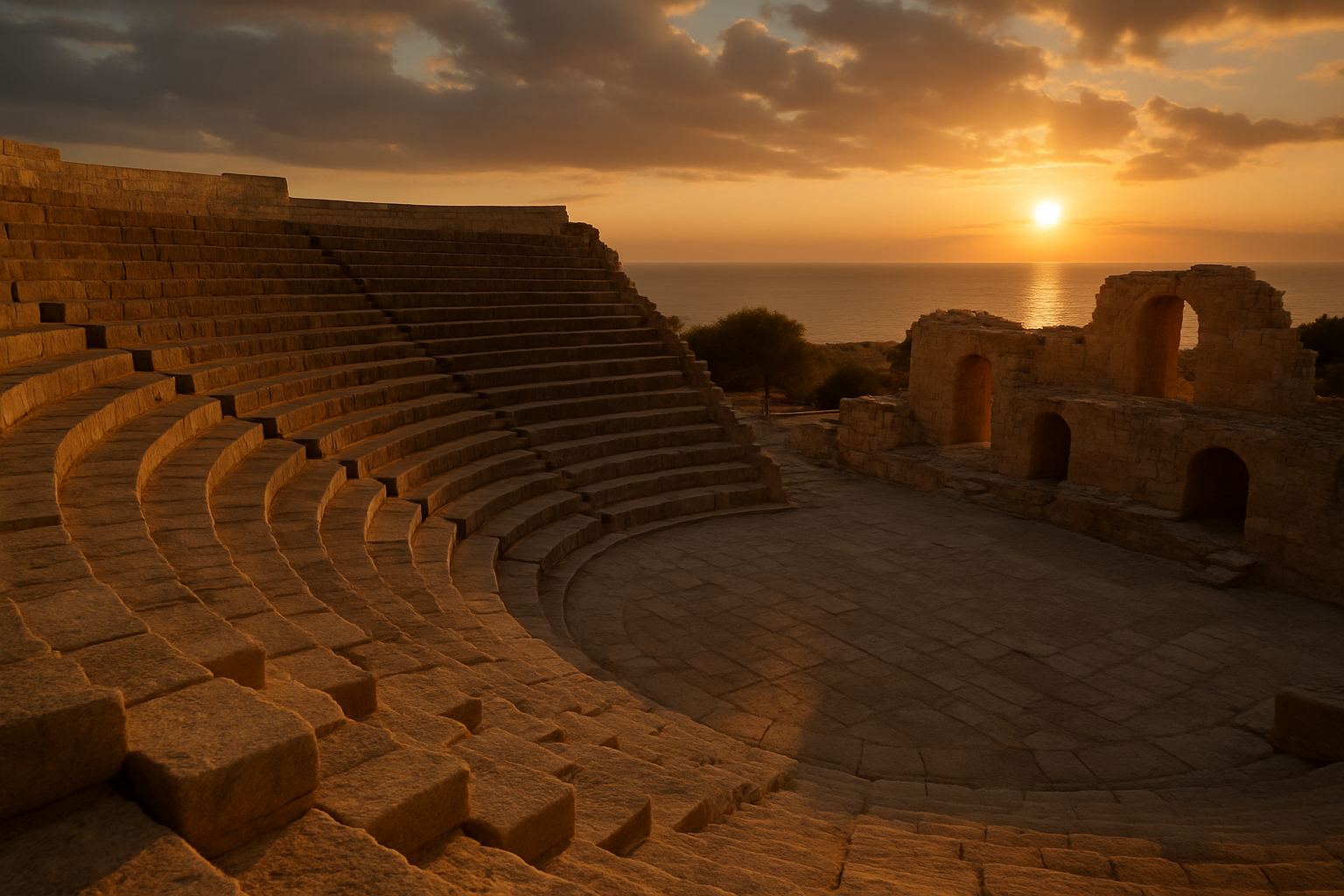
Cyprus has five ancient theatres you can still see: Kourion, on its hill above the sea near Limassol, the Fabrika hill theatre and the Roman Odeon in Paphos, and Salamis and Soloi in the Turkish occupied north. Kourion and the Paphos Odeon are working stages again, with ancient drama every summer. For the island's other excavated cities, see our guide to the archaeological sites beyond Paphos and Kourion.
The best known is the theatre of Kourion, at the southern end of the hill on which the ancient city stands, about 19 km west of Limassol. It was first built on a smaller scale at the end of the 2nd century BC and reached its present size in the 2nd century AD, with room for about 3,500 spectators. At the start of the 3rd century it was turned into an arena for fights with wild animals, and by the end of that century it was a theatre again. The University of Pennsylvania Museum began digging at Kourion in 1933 and, with a break for the war, carried on until 1954; the Department of Antiquities rebuilt the auditorium in 1961, and the theatre is now one of the venues of the International Festival of Ancient Greek Drama every summer.
The theatre of Salamis, about 7 km north of Famagusta's walled city, was built on a far bigger scale. It probably dates from the reign of Augustus and could hold about 15,000 spectators, and it stood in the Roman city's cultural quarter alongside the gymnasium, baths, amphitheatre and stadium. It was ruined in the 4th century; much of its seating has since been restored, and some of the statues now in the gymnasium court were moved there from the theatre after a 4th-century earthquake. Salamis lies in the Turkish occupied north, so a visit means crossing at one of the official checkpoints with a passport or ID; Deryneia is the nearest by road, about 17 km away. The Turkish Cypriot antiquities department, which runs the site, charges 150 Turkish lira (about €3) and opens it from 08:00 to 19:00 until 31 October 2026; last winter it closed at 16:30.
The north has a second Roman theatre at Soloi, on Morphou Bay near Lefka. It held about 3,500 people, and what stands today is largely a reconstruction of 1962 to 1964, built to plans by John Travlos after the Swedish Cyprus Expedition excavated the theatre. The nearest crossing is Apliki-Lefka, about 10 km away by road.
Paphos has two ancient stages. The older is the theatre cut into the southern slope of Fabrika hill, in the north-east of the ancient city. Built around 300 BC, when Nea Paphos was founded, it is the oldest permanent theatre in Cyprus, and it stayed in use for more than six centuries, until an earthquake in the 4th century AD brought it down. At its largest, under the Antonine emperors of the 2nd century AD, it could seat more than 8,500 people. A University of Sydney team has excavated it since 1995, most recently in April and May 2023. The dig itself is fenced, but the project has said a viewing platform at the top of the hill is open all year: the theatre lies just behind the Agia Solomoni catacomb on Apostolou Pavlou Avenue, about 15 minutes on foot from the archaeological park's ticket office.
The other is the Odeon, a small Roman theatre inside the UNESCO-listed Paphos Archaeological Park; the Department of Antiquities dates it, with the rest of the agora, to the 2nd century AD. Twelve rows of seats were found when it was excavated, and the department partly restored it in the 1970s. It is once again a stage for music and drama, including the International Festival of Ancient Greek Drama, which put on Euripides' Hecuba there on 10 and 11 July 2026. The park opens daily from 08:30 to 17:00 from 16 September to 15 April and from 08:30 to 19:30 from 16 April to 15 September, and entry is €4.50.
Kourion keeps the same hours: 08:30 to 17:00 from 16 September to 15 April (last ticket 16:30) and 08:30 to 19:30 from 16 April to 15 September (last ticket 19:00). Entry is €4.50, almost all of the site is wheelchair accessible, and both Kourion and the Paphos park close only on 1 January, Orthodox Easter Sunday and 25 December. By bus, EMEL routes 16 and 18 from Limassol stop at Agios Ermogenis at the foot of the hill, about 1.5 km below the theatre by road. The local museum in Episkopi village is a separate building and has been closed since 1 August 2026 for upgrade works.
To see a play, watch for the International Festival of Ancient Greek Drama, organised by the Deputy Ministry of Culture with the Cyprus Centre of the International Theatre Institute: it ran for the 29th time from 3 July to 8 August 2026, mostly at Kourion. Performances start at 21:00 with Greek and English surtitles, and 2026 tickets cost €16, or €10 for concessions, from soldoutticketbox.com and Stephanis stores. Shakespeare at Kourion, a volunteer company founded in 1962 and now run by Performing Arts for Cyprus Charities, brings Richard III to the theatre on 17, 18 and 19 June 2027, and the organisers' advice is to bring a cushion.
Thinking of moving to Cyprus? Our relocation help takes care of residency, GeSY healthcare registration and the rest of the paperwork.
