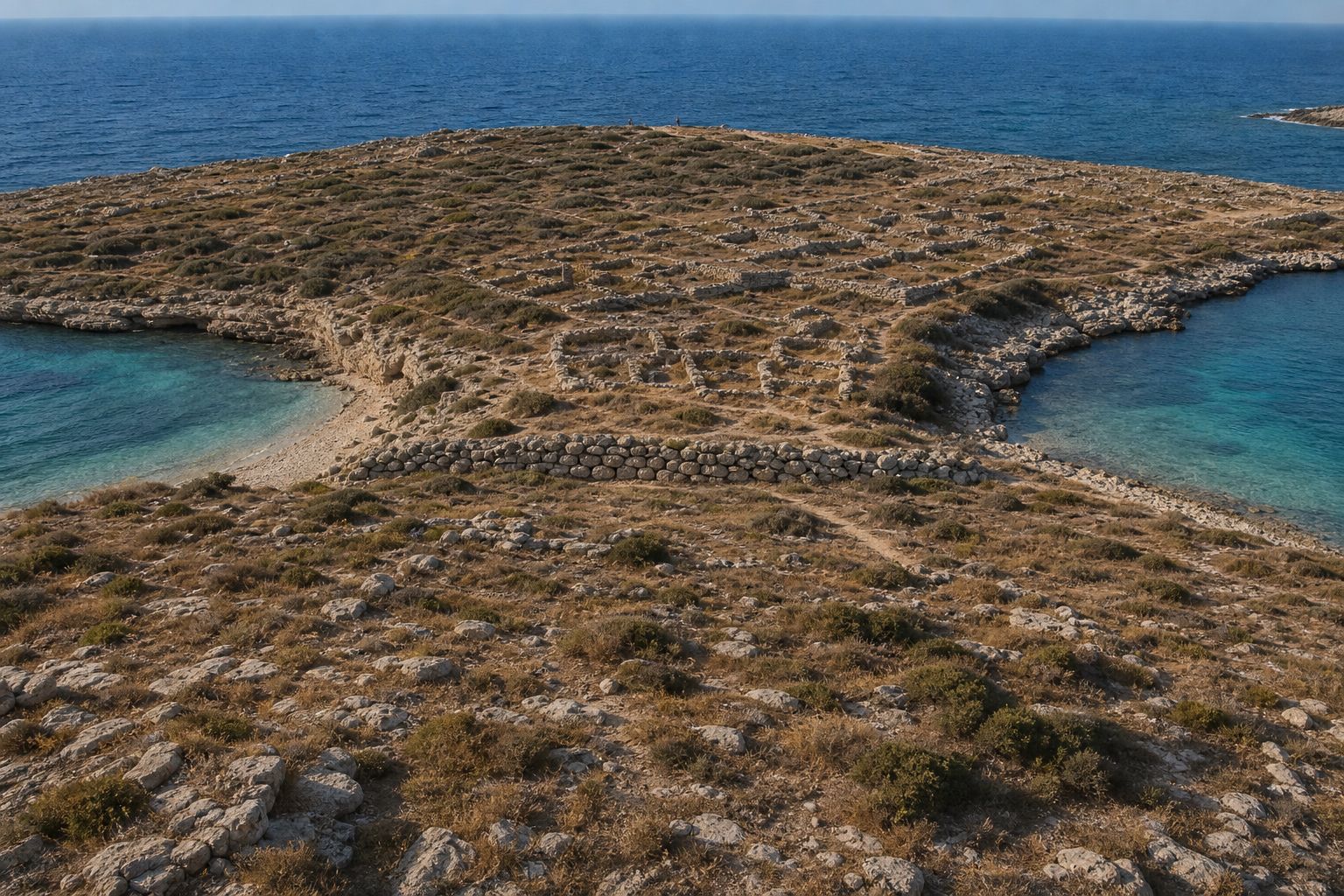
Maa-Palaiokastro (Μάα-Παλαιόκαστρο, also spelled Maa-Palaeokastro or Maa-Paleokastro) is a fenced Department of Antiquities site on the rocky headland between Coral Bay beach and Laourou beach in Pegeia (Peyia), which has been part of the new Akamas Municipality since July 2024. It is 12.5 km by road from Kennedy Square in Paphos, about 20 minutes by car. Visit Pafos describes a long promontory with steep sides, easy to fortify, with a sheltered anchorage in the bay on either side and a spring nearby. Palaiokastro means "old castle", and according to Visit Cyprus the name comes from the defensive walls, which were always visible.
A settlement that lasted two generations
People settled the bare headland around 1200 BC; a 2016 study puts the founding in the final decades of the 13th century BC. Two walls protected the settlement, one across the neck of the promontory on the land side and one along its seaward edge, built in the Cypriot version of Cyclopean masonry: large unworked boulders with a mudbrick superstructure. The excavators call the earlier and better-preserved phase Floor II. It ended in a fire, which the Department of Antiquities dates to about 1175 BC and puts down, probably, to pirates. The same people rebuilt promptly but more poorly, in the phase called Floor I, and left for good around 1150 BC.
The Department of Antiquities and the tourism pages link Maa with the arrival of Aegean settlers, Mycenaean Greeks in Visit Cyprus's words, and with the hellenisation of the island around 1200 BC. Some archaeologists now question that reading. The excavators themselves noted that much of what they found, from the local pottery and the ashlar masonry to most of the small finds, has parallels at other Late Bronze Age sites in Cyprus, and, as one archaeologist has pointed out, the site has none of the texts, burials or cult buildings that would show who its people were. The most Aegean-looking feature, according to Visit Pafos, is the megaron, a hall with a built hearth in the centre.
What the excavations found
Porphyrios Dikaios dug a small part of the site, including part of the rampart, in the 1950s (the Department of Antiquities gives 1952, a 2016 study 1954). Vassos Karageorghis, then director of the Department of Antiquities, led systematic excavations from 1979 into the mid-1980s, published in 1988 as Excavations at Maa-Palaeokastro 1979-1986, which he edited with Martha Demas. The buildings stood on either side of a street, on foundations cut deep into the bedrock.
Building I, partly of ashlar masonry, is read as an official residence. Buildings II and IV each have a large room with a hearth in the centre and smaller rooms that were possibly storerooms, and the Department links both with food production and with eating and drinking by many people. Building III had long, narrow rooms lined with large storage jars and may have been an "administrative" storehouse; many fragments of its jars carry friezes pressed with cylinder seals, such as goats nibbling at trees. Copper and lead slag, pot bellows and tuyeres show that metal was worked here, and pottery was made too. Much earlier, in the Early Chalcolithic period, people had lived on the headland in houses formed from cavities in the rock with light timber superstructures, according to the Department.
The underground museum
A small museum opened on the site in August 1996, paid for by the A.G. Leventis Foundation and designed by the Italian architect Andrea Bruno. It is built underground, so that only a green metal dome shows above the scrub, with one round exhibition room beneath it, lit by daylight through openings around the dome and a mirror angled to the sky. Its displays, as described in 2011, used copies of the finds rather than originals, arranged around eight themes, from copper and trade to writing and religion. The Department of Antiquities' pages say, without a date, that the museum's content is being redesigned, and the Department has announced no closure or reopening since the site shut for ten days of electrical work in October 2023. If the museum is your reason for going, ring the site first on +357 26 652761.
Opening hours and tickets
The site and museum open every day, 08:30 to 16:00 from 16 September to 15 April, with last admission at 15:30, and 09:30 to 17:00 from 16 April to 15 September, according to the Department of Antiquities and the board at the gate. Visit Cyprus still lists weekdays only, which matches a 2016 notice and is out of date. The site closes on public holidays, including 28 October, 24, 25 and 26 December, 1 and 6 January, and the Easter holidays. A ticket costs 2.50 EUR, groups of more than ten get 20 percent off, and the Department's passes for all its sites and museums cost 8.50 EUR for one day, 17 EUR for three and 25 EUR for seven. Holders of the European Disability Card and their assistant go in free. The site is not wheelchair accessible.
Getting there by bus
Paphos buses route 615 runs from the Tombs of the Kings bus station to Coral Bay every 10 to 15 minutes for most of the day, then in the evening every 20 minutes from April to November and every 30 minutes from December to March, until around midnight. From the Karavella bus station or Kennedy Square take route 618 to the Tombs of the Kings station, and from the harbour in Kato Paphos take route 611 to the same station. Get off at the Coral Beach Hotel 1 stop, about 350 m and 5 minutes on foot from the gate along Coral Bay Avenue and Palaiokastrou Street; the Coral Bay terminus is about 550 m away. A single ticket costs 2.00 EUR, or 3.00 EUR after 21:00, and a day ticket 6.50 EUR.
Coral Bay and nearby
Coral Bay beach, about 500 m of sand between two limestone headlands, flies a Blue Flag in 2026 under the name Coral Bay (Maa), and so does Laourou beach on the other side of the site. The Deputy Ministry of Tourism lists Coral Bay among its accessible beaches for 2026, with a Seatrac and a floating wheelchair. The beach shrank in summer 2026: in August the Cyprus Mail reported that the number of sunbeds had been halved, and the Akamas mayor said the beach had recovered to about 80 percent. Routes 616 and 616B continue from Coral Bay to Agios Georgios, where three 6th-century basilicas stand above the fishing harbour, covered in our guide to Cyprus's archaeological sites; the hours of every Department of Antiquities site are on our historic sites page. If the Paphos coast has you thinking about a move, our relocation help is here when you need it.
