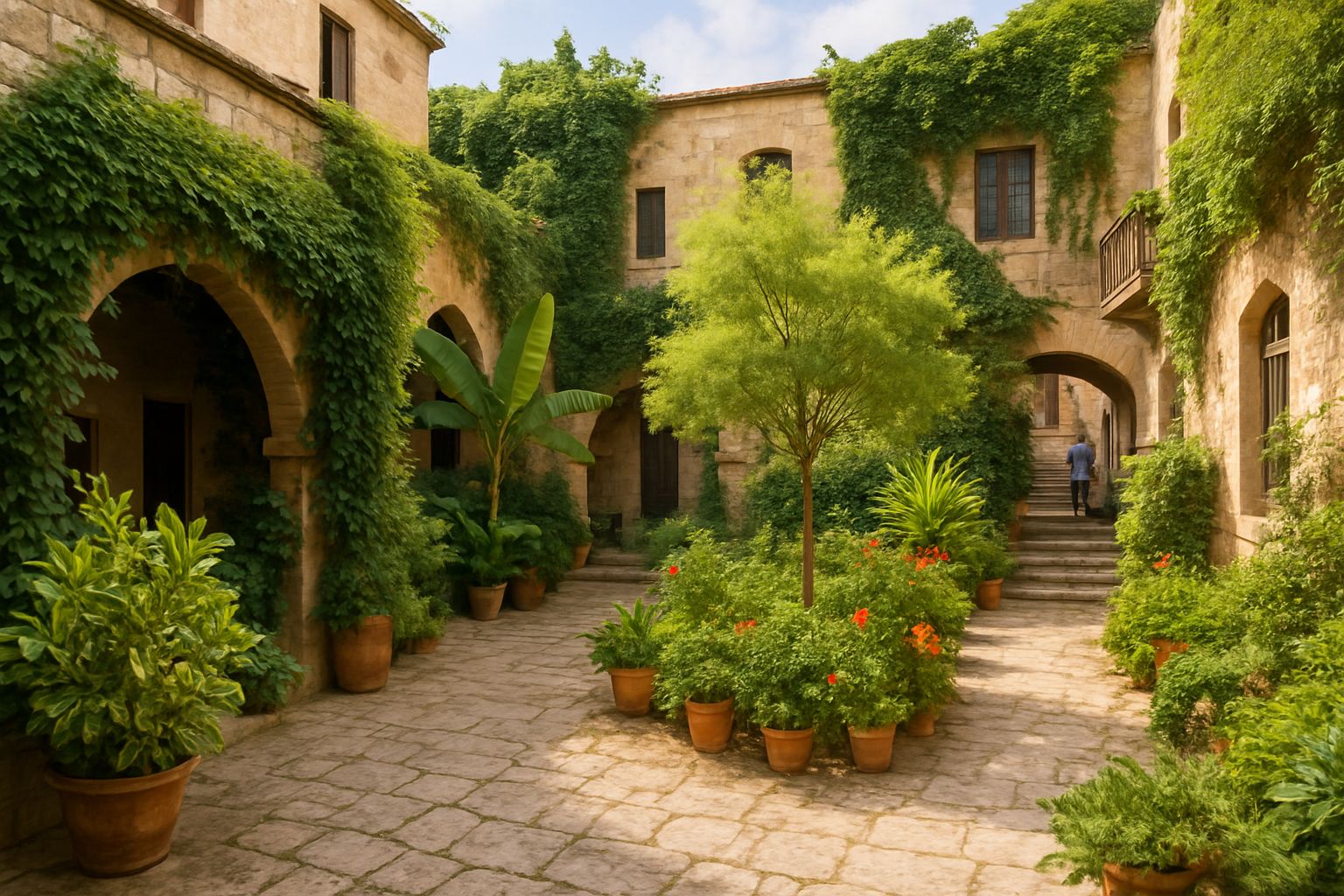
Three of old Nicosia's finest buildings are set around open courtyards. South of the Green Line stands the mansion of Hadjigeorgakis Kornesios, built in 1793, which houses the Ethnological Museum but has been closed to visitors since 1 September 2026. Just north of the Ledra Street crossing, about a kilometre's walk from the mansion, are the city's two Ottoman caravanserais, Büyük Han of 1572 and the smaller Kumarcilar Han.
Hadjigeorgakis Kornesios was the most prominent dragoman of Cyprus: for thirty years from 1779 he was the official interpreter and go-between for the island's Ottoman rulers and its people. It was one of the most prestigious titles the Ottomans gave to local Christians, and it made him rich and powerful, until his enemies had him beheaded in Istanbul on 31 March 1809. The office itself was abolished in 1821, with the Greek War of Independence. The Department of Antiquities calls his house the most important surviving example of urban architecture from the last century of Ottoman rule in old Nicosia.
The house is two storeys of local block-cut sandstone set around a garden courtyard with a fountain and a private hammam of three rooms, and the owner's monogram and the date appear on a marble tablet inside the entrance. The servants' quarters and the kitchen were on the ground floor, and roofed wooden stairs on a stone base climb from the courtyard to the first-floor hall. At the end of the east wing is the onda, the official reception room, whose carved, gilded and painted woodwork compares with reception rooms in mansions across the Ottoman Empire. The furniture is not the family's own: it dates from the late 19th and early 20th centuries and was given by the last owner. Its restoration by the Department of Antiquities won a Europa Nostra award in 1988.
The museum is at 20 Patriarchou Grigoriou Street, near the Archbishopric in the Agios Antonios neighbourhood, where the Greek community's wealthy families traditionally lived. It has been closed to the public since 1 September 2026, until further notice, because of technical problems, so check Visit Cyprus or the Department of Antiquities before you go. When it reopens, entry is free and the published hours are Tuesday to Friday from 08:30 to 15:30 and Saturday from 09:30 to 16:30, closed on Sundays, Mondays and public holidays. The house is not wheelchair accessible, and the phone number is +357 22 305316.
From the mansion it is about 660 m, a nine-minute walk, to the Ledra Street checkpoint at the north end of Ledra Street, which is open to pedestrians only. Büyük Han and Kumarcilar Han lie beyond it in the Turkish occupied north, so a visit means crossing there with your passport; citizens of the EU, the EEA and Switzerland can use a national identity card instead.
Büyük Han, the Great Inn, is the largest caravanserai in Cyprus. The Ottomans built it in 1572, the year after they took the island from the Venetians, on the model of the Koza Han in Bursa, and at first it was called Yeni Han, the New Inn. It became the Great Inn in the 17th century, once the smaller Kumarcilar Han had been built nearby. It was the Central Prison of Nicosia under British rule from 1892 to 1903, an inn again until 1947, and cheap lodgings for poor families from 1947 to 1962. It spent most of the 1990s under restoration.
The inn is roughly square, about 51 by 45 m, with 68 rooms on two floors behind cross-vaulted arcades: the ground-floor rooms were for trade and the upper ones for lodging, and each room has a fireplace with a hexagonal or octagonal stone chimney. In the middle of the courtyard stands a small masjid with a fountain for ablutions, a type also found in Anatolian inns such as the Koza Han. Evkaf, the Turkish Cypriot religious foundation, lets the rooms on condition that tenants sell only what they make themselves, so most of the shops are handicraft workshops, and there are cafés in the courtyard. The main gate opens east onto Asmaaltı Square, about 275 m or four minutes on foot from the Ledra Street checkpoint. Shop and café hours vary.
Kumarcilar Han, the Gamblers' Inn, is a short walk away on Asmaaltı Street. It is thought to date from the end of the 17th century and is much smaller and plainer: two storeys around an open courtyard, originally with 56 rooms, with travellers upstairs and their animals and goods below. Lack of money held up its rescue for years, but it was fully restored by January 2018 and now holds a café restaurant and small shops selling local goods. Selimiye, the former cathedral of St Sophia, is about 170 m east of Büyük Han: our guide to Cyprus' historic mosques has its visiting rules, and our guide to Nicosia's Ottoman hammams covers Büyük Hamam in the same quarter.
Thinking of moving to Nicosia? Our relocation help takes care of residency, GeSY healthcare registration and the rest of the paperwork.
