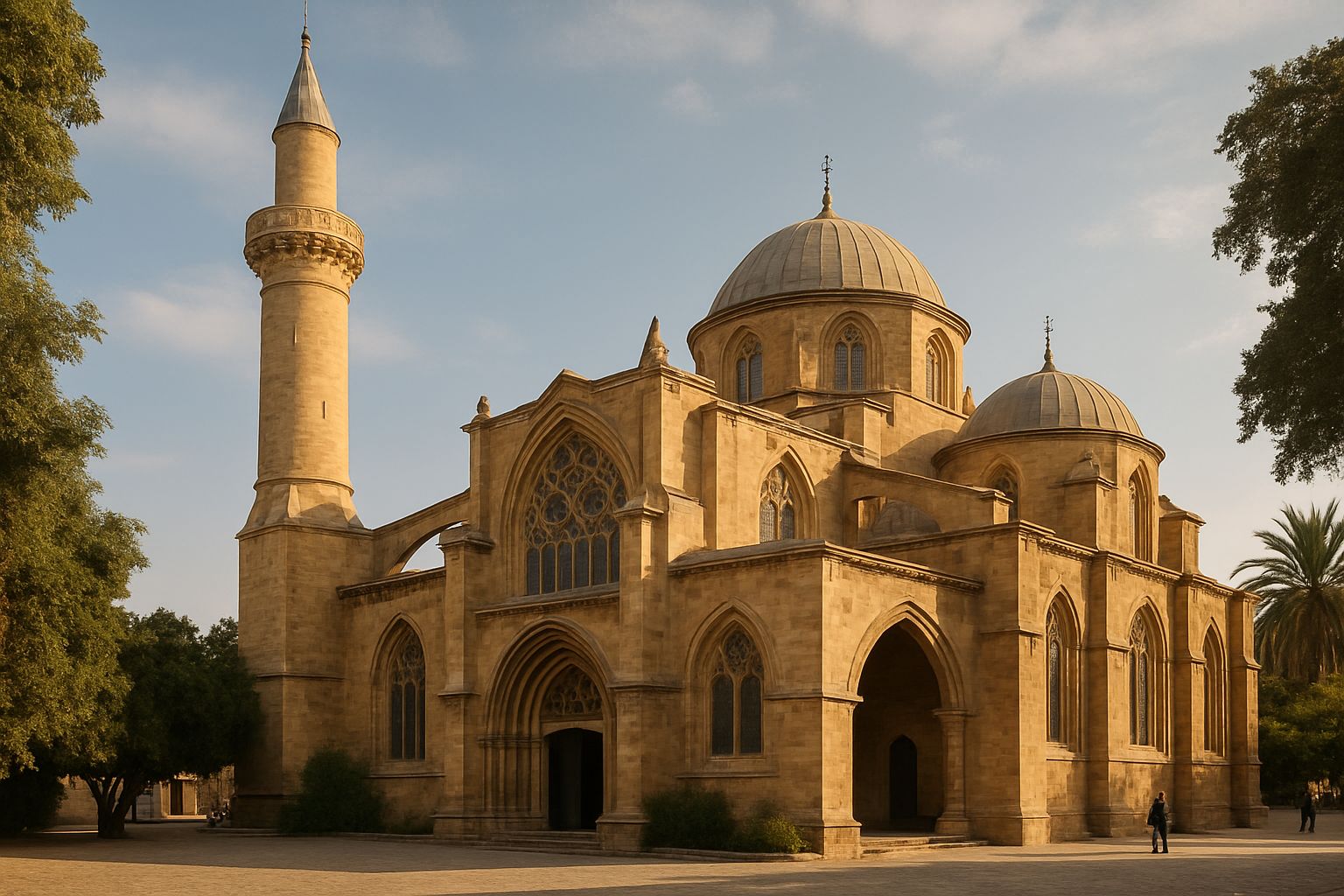
Hala Sultan Tekke stands in a garden on the west bank of the Larnaca Salt Lake, about 7 km by road from Agios Lazaros church in the centre of Larnaca and 2.5 km from the airport terminal. The Department of Antiquities, which looks after it, calls it the main Muslim pilgrimage site of Cyprus. According to Muslim tradition, the tomb at its heart is that of Umm Haram, a companion and relative of the Prophet Muhammad, who came to Cyprus with the first Arab raid around 649 and died after a fall from her mount.
The complex grew in stages around the grave: a tomb in 1760, a first mosque just before 1787 and the present mosque, completed in 1816, with its minaret, an ablution fountain and the former lodge buildings around a courtyard. It is still a working mosque with its own imam. Entry is free, and it opens daily from 08:30 to 17:00 between 16 September and 15 April and from 08:30 to 19:30 in summer. It closes on 25 December, 1 January and Greek Orthodox Easter Sunday, and on days of organised pilgrimages, as it did on 30 May 2026, so check the Department of Antiquities notices before a special trip.
From November to March thousands of flamingos winter on the salt lake beside it. The ground nearby also holds a much older town: a Late Bronze Age harbour city of at least 25 hectares, founded around 1650 BC and abandoned around 1150 BC, which grew rich exporting copper from the Troodos. In 2025 a University of Gothenburg team led by Professor Peter Fischer excavated two chamber tombs in its cemetery, which held lapis lazuli from Afghanistan and amber from the Baltic. Bus 429 calls at the mosque, at the stop named Umm Charam Mosque Tekke, on its way into Larnaca via the airport.
In Larnaca itself, the Grand Mosque, also called the Kebir or Büyük Mosque, stands opposite the medieval fort on Athinon Avenue. It began as a Catholic church of St Catherine, built in the 13th or 14th century, and may be the first Ottoman mosque in Cyprus: the oldest record of it is a 1747 document in which Bekir Pasha, who built the town's aqueduct, ordered water for its public fountain, which still stands outside. It still serves Larnaca's Muslims, and Visit Cyprus says visitors may come in at any reasonable hour outside prayer times. Entry is free.
In Nicosia's walled city, the Omeriye Mosque is the 14th century Augustinian church of St Mary itself, not a new building on its site: its main doorway is original, and inscribed tombstones from the Lusignan period paved its floor until 1940. Ottoman cannon fire destroyed the roof during the siege of 1570, and in 1571, a year after the city fell, Lala Mustafa Pasha had it converted into a mosque with a wooden roof and a minaret. The name recalls a legend that Caliph Omar once rested here. It is a working mosque with Friday prayers from 12:30 to 13:30 and is free to visit at other times. It faces the Hamam Omerye across Plateia Tyllirias, the Ottoman bath in our hammam guide.
On the other side of the Green Line, the Selimiye Mosque was built as the Latin cathedral of St Sophia: begun in 1209 and consecrated in 1326, it was where the Lusignan kings of Cyprus were crowned. It became a mosque when the Ottomans took Nicosia in 1570, and its two minarets were added that year; it was named after Sultan Selim II in 1954 and reopened in May 2025 after five years of restoration. It lies in the Turkish occupied north, about 450 m or six minutes on foot from the Ledra Street checkpoint, which is open to pedestrians only. Everyone is checked at the crossing, and you need a passport, or a national identity card if you are an EU citizen.
Famagusta's Lala Mustafa Pasha Mosque, also in the occupied north, was the cathedral of St Nicholas, built between 1298 and 1312 and consecrated in 1328, where the Lusignan kings were crowned kings of Jerusalem. It became a mosque after Famagusta fell in August 1571 and has carried the Ottoman commander's name since 1954. It has been closed to worship and visitors since 3 April 2026 for a restoration that Evkaf, the Turkish Cypriot religious foundation, expects to take three to four years, so its interior cannot be seen for now. The walled town of Famagusta is about 7 km by road from the Deryneia checkpoint; check your car insurance first, as hire cars from the Republic are often not covered in the north and you will not be let through without the right documents.
Whichever mosque you visit, dress modestly with shoulders and knees covered, take your shoes off before entering the prayer hall, keep your voice down and ask before taking photographs. Avoid Friday around midday, when the working mosques hold their main weekly prayers. If you are thinking of making Cyprus home, our relocation help covers the practical side of the move.
