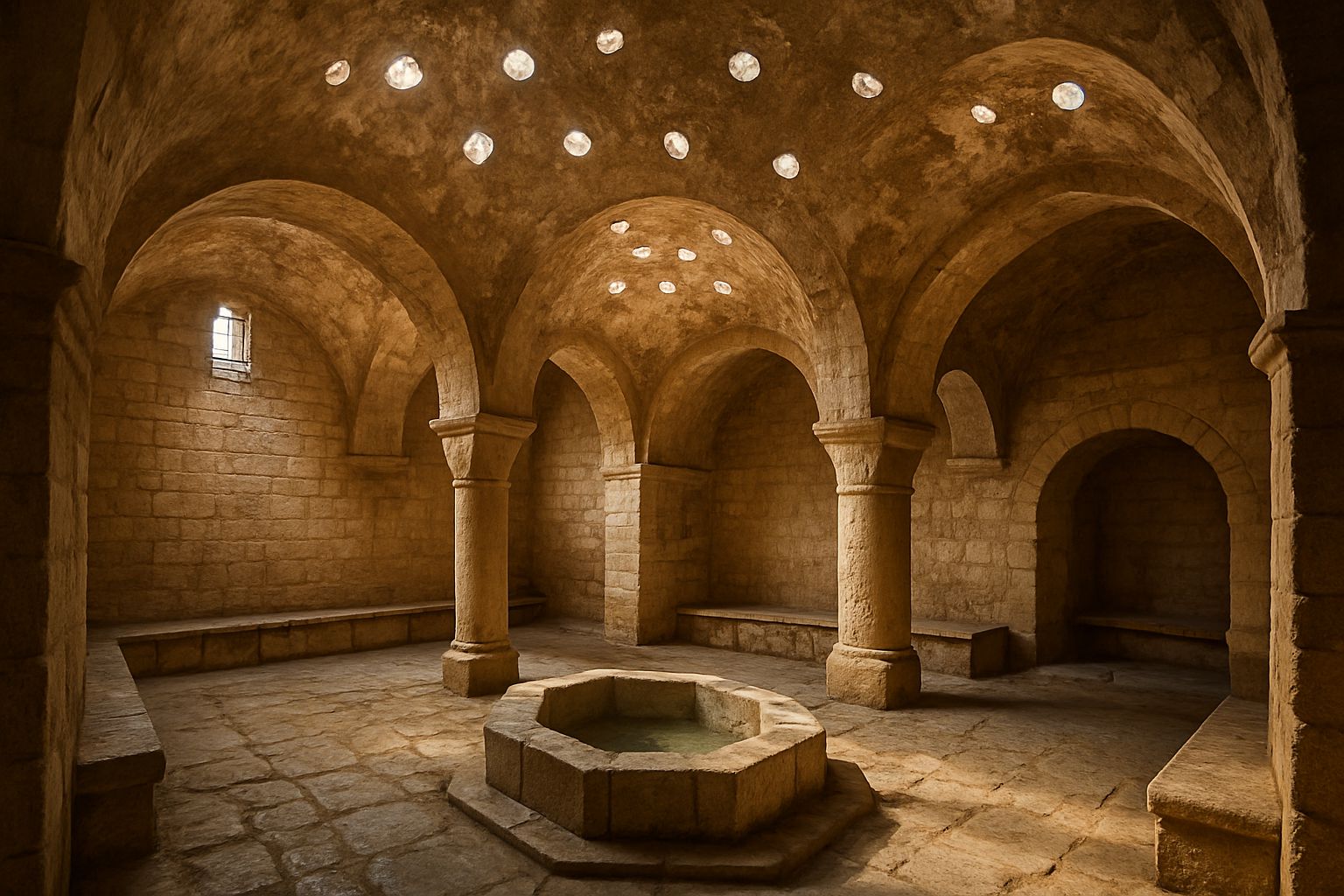
Old Nicosia has two Ottoman bathhouses that still work as hammams, one on each side of the Green Line. Both date from the first decades of Ottoman rule, which began when the Ottomans took the island in 1570 and 1571, both have been restored, and both still follow the old sequence of heat, scrub, foam wash and rest.
Hamam Omerye stands on Tyllirias Square in the walled city. Lala Mustafa Pasha, the Ottoman commander who conquered Cyprus, built it around 1570 to 1571 as a gift to the city and dedicated it to the caliph Omar, who gave the Omeriye quarter its name. Across the street, the Omeriye Mosque stands on the site of the 14th-century Augustinian monastery of St Mary, which Lala Mustafa turned into a mosque in 1571 in the belief that the caliph had rested on that spot. After a long period of closure the baths were restored and kept in use as a hamam, and in 2005 the project won a Europa Nostra prize for safeguarding the building's authenticity while adapting it to contemporary needs.
Inside, the bath's central area has warm marble slabs, kept at 40 to 43°C depending on the season with humidity of 80 to 90 per cent, and is surrounded by four smaller rooms. There is no pool, sauna or separate steam room: the warm, humid hamam itself is the bath. Bath use costs 38 EUR for 25 minutes (65 EUR for two people, 88 EUR for three) and comes with an exfoliating glove and soap, then tea and Turkish delight in the garden or the rest area. Scrubs, a traditional Ottoman foam massage and other massages are booked on top, and packages that combine them run from 109 EUR (bath, body scrub and massage) to 249 EUR for a four and a half hour deluxe day.
The hamam is closed on Mondays, and Thursdays are for women only; on the other days men and women bathe together. Its online booking page lists 09:30 to 20:30, Tuesday to Sunday, and only over 18s are admitted. For the bath alone you can turn up without booking, but treatments are best booked ahead online, by phone on +357 22 460006 or by email. There is a municipal car park directly opposite.
Büyük Hamam, the Great Bath, lies in the Turkish occupied north of the city, so a visit means crossing at one of the official checkpoints with your passport or ID. From the Ledra Street crossing it is about a five minute walk to İrfan Bey Sokak, the street just behind Büyük Han, the Ottoman caravanserai of 1572. The bath was created between 1571 and 1590 on the site of the Lusignan church of St George of the Latins, and the carved Gothic stonework of its entrance survives from the medieval building. The streets around it have risen over the centuries, so its door now sits about two metres below street level. Under the Ottomans it was a busy social centre where women met, exchanged news and ate, and the building still belongs to the Evkaf foundation.
Inside are the classic three stages: a cooling hall with a fountain and timber galleries, where you change and rest, a warm room, and the hot room under the largest of its seven domes, where daylight falls through small star-shaped and round glass openings onto the göbek taşı, the heated marble platform at the centre. Marble basins stand around the walls, and there is also a sauna and a steam room. Büyük Hamam is open every day from 08:00 to 22:00. The basic package costs 40 EUR for 50 minutes (hot room, kese scrub, foam wash, clay face mask, then coffee and tea), with longer rituals at 60 and 80 EUR. Booking is by WhatsApp on +90 533 886 02 06, a peştemal, the traditional cotton wrap, is provided, and you pay at reception by card or in cash in euros, Turkish lira, US dollars or sterling.
Both baths follow the same basic ritual: time in the heat to open the pores, a scrub with a coarse kese mitt, a foam wash, then rest with a hot drink. Hamam Omerye suggests 30 to 60 minutes in the warm room, asks guests to avoid alcohol and large meals beforehand and advises against bathing in pregnancy or with a heart condition; if you have high blood pressure, check with your doctor first. Bring a swimsuit and flip-flops if you like, since towels and disposable underwear are provided.
An afternoon in a working Ottoman bath is one of the more unusual things to do in the capital, whether you are here for a weekend or settling in for longer. If you are thinking of making Cyprus home, Cyprus Decoded offers relocation help to make the move as smooth as possible.
