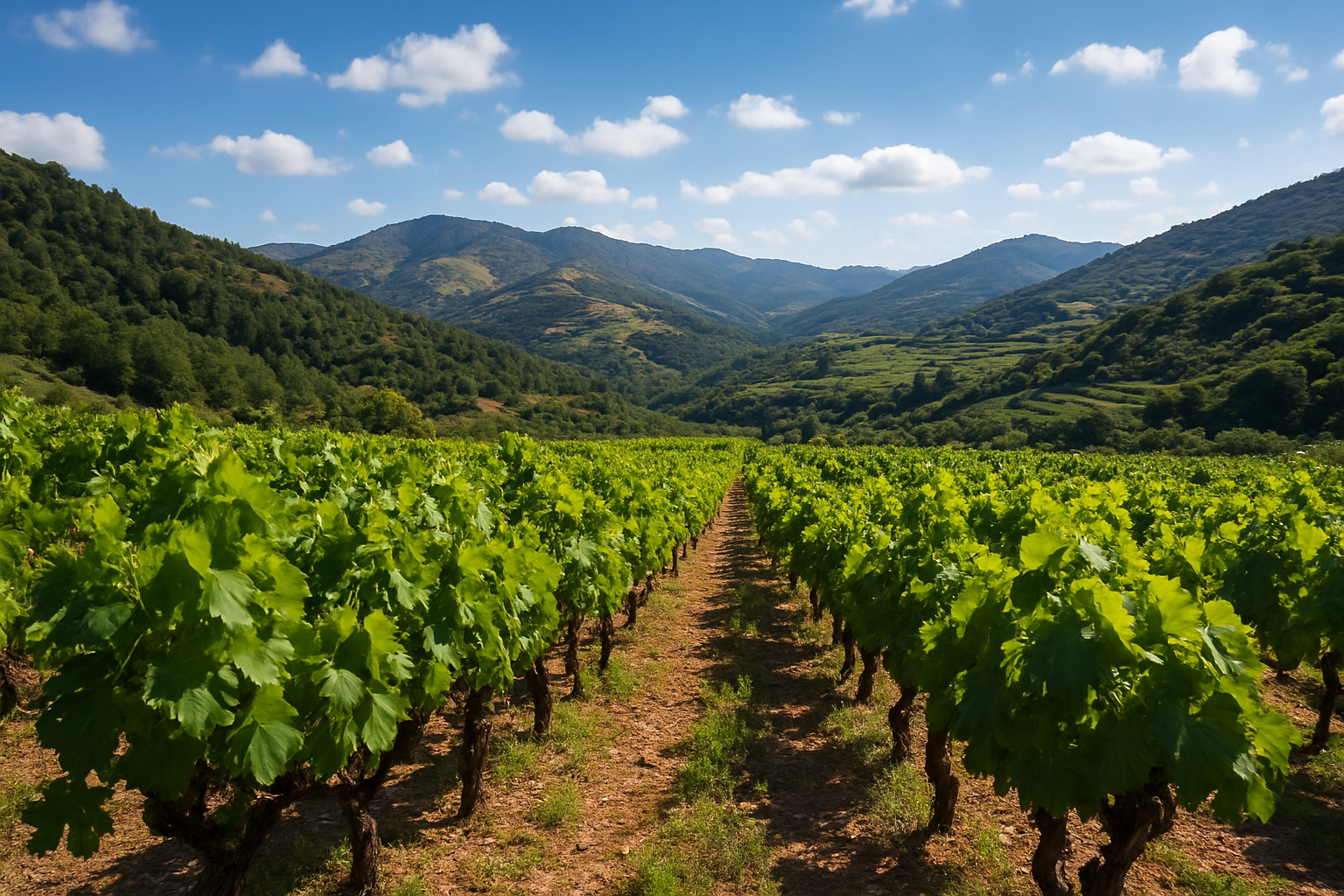
Wine country in the Troodos is not one place but several on the same mountains. The Krasochoria of Limassol climb the southern slopes up to Platres, the 14 Commandaria villages sit lower in the southern foothills, Pitsilia covers the eastern Troodos, where the protected Pitsilia designation allows vineyards from 600 to 1,400 metres, and on the north side the Marathasa valley is being replanted. Visit Cyprus has seven signposted wine routes, and the Krasochoria, Commandaria and Pitsilia routes all lead into these hills. The roots are old: residues in jars from Erimi, near Limassol, suggest Cypriots were making wine by about 3500 to 3000 BC. The cellar doors are younger. Tsiakkas, one of the first small family wineries in the hills, opened in 1988, and in 2024 the agriculture ministry counted about 130 wine producers on the island, even as its vineyards had shrunk to about 7,000 hectares.
Why the hills taste different
Height changes the climate. The Department of Meteorology puts the average July and August maximum at 27°C on the Troodos against 36°C on the central plain, and snow falls above 1,000 metres every winter, usually between early December and mid April. The official file for the Pitsilia designation describes terraced vineyards on volcanic, stony and barren soils, with an average of 7.6 hours of sunshine a day and the heaviest rain from December to March. Local Mavro and Xynisteri make up almost all of the planting there, with some Maratheftiko and Ofthalmo. Wineries are also bringing back rarer native grapes: Tsiakkas is reviving Yiannoudi and Promara, and LionSpirit grows Vasilissa and Promara next to Xynisteri, Maratheftiko and Mavro. International grapes such as Chardonnay and Cabernet Sauvignon are grown too.
Pitsilia: Tsiakkas and Kyperounda
Tsiakkas Winery stands just outside Pelendri at about 1,000 metres. Kostas and Marina Tsiakkas started it in 1988 with 500 bottles of a red called Thyrsos; today the family works more than 18 hectares of its own and partner vineyards, organically since 1995, with vines up to 1,500 metres, and makes about 200,000 bottles a year. The tasting room takes walk-ins, though booking is recommended, especially on Saturdays. From 1 November it opens Monday to Friday 10:00 to 16:00 and Saturday 11:00 to 17:00, and it is closed on Sundays and public holidays. A two-hour guided tour and tasting runs on weekdays at 13:00 and 15:00 and on Saturdays at 11:00, 13:00 and 15:00, from €15 per person for three wines, with a minimum of four guests (+357 96 844111). In the same village, Pelendri's Timios Stavros church is one of the Troodos painted churches on the UNESCO list. Higher up, Kyperounda Winery in Kyperounta sits at 1,200 metres, and its own website calls it Europe's highest winery. It publishes no visiting hours, so ring before you go (+357 25 532043); our wine cellars guide has more on it.
Platres and Pera Pedi
At the top of the Krasochoria, LionSpirit in Kato Platres is the winery once known as Lambouri. The family says it has made wine there for more than 350 years, and it opened a distillery beside the cellars in 2018. A three-wine introduction costs €10 and takes about 25 minutes without booking, a six-wine selection is €18, and a 75-minute tour of the cellars and still with six wines is €25, booked at least a day ahead; the wine tastings come with village bread and the estate's own olive oil. From 1 November to 30 April it is open Sunday to Thursday 10:00 to 18:00 and Friday and Saturday 10:00 to 20:00 (+357 25 422525). Just below Platres in Pera Pedi, Costas Constantinou founded Constantinou Winery in 1992, first making liqueurs, and produced his first dry white, Ayioklima, in 2000. The winery shows visitors its production areas and pours its wines Monday to Friday 09:00 to 16:00 and Saturday 09:00 to 13:00 (+357 25 470370). Our Platres guide covers the village itself.
Omodos, at 800 metres and 42 km from Limassol, is the best-known wine village on the southern slopes, and its medieval wine press, the Linos, is protected by the Department of Antiquities as an ancient monument. Ktima Gerolemo is about 1 km outside the village at 900 metres, and Argyrides in Vasa grows vines at 950 to 1,100 metres. Our guide to the Limassol wine villages gives opening hours for both, and for the wineries of Koilani and Agios Amvrosios.
The Commandaria villages
Commandaria, the sweet wine made from sun-dried Xynisteri and Mavro grapes, comes only from 14 villages in the southern foothills, between about 500 and 900 metres. Cyprus's tourism ministry bills it as the world's oldest named wine still in production, Guinness World Records lists it as the oldest manufactured wine, and in 2025 UNESCO added it to its Representative List of the Intangible Cultural Heritage of Humanity. In Agios Mamas, Revecca Winery makes nothing but Commandaria in a restored family house just below the church, with a small folk museum. It opens Wednesday to Sunday 10:00 to 16:00, groups of up to four need no booking, tastings start at €10, and the house is not wheelchair accessible (+357 97 536910). In Zoopigi the Commandaria Museum fills four themed halls and offers a guided tour and tasting, by booking only (+357 99 284578 or +357 99 254919), and Visit Cyprus lists an old wine press and a Commandaria storage museum in Laneia.
Over the top: Marathasa
On the north side of the mountains, Marathasa Wines at Oikos has been buying and replanting the valley's abandoned vineyards since 2014 and uses only its own grapes, grown on north-facing slopes up to 1,125 metres. It opens Tuesday to Sunday 11:00 to 18:30 and is closed on Mondays; a group tour with a tasting of three wines costs €25 and starts at 11:15 and 16:15 on opening days, and weekend visits need a reservation (+357 22 008500). The winery warns drivers coming from Limassol not to let a satnav send them onto the unmaintained dirt road via Agios Nikolaos tis Stegis near Kakopetria, but to carry on past Evrychou and turn left at the junction for the Marathasa valley and Kalopanagiotis.
When to go
Autumn is the season. The official 2026 village festival list starts its grape, wine and zivania feasts at the end of August and runs them into November, with none in spring, and the Limassol Wine Festival fills the town's Municipal Garden at the turn of September and October (26 September to 4 October in 2026). On Sunday 25 October 2026 Alona and Pedoulas had their zivania festivals and Agios Dimitrios its Veriko grape festival. A grape festival in Platanistasa follows on 1 November and the zivania festival at Pelendri's cultural centre on 7 and 8 November.
Getting round
By car, allow about 50 minutes from Limassol to Omodos or Pelendri and about an hour to Kyperounta. EMEL buses reach the hills, route 40 to Omodos, 60 to Pelendri (Tsiakkas asks you to request a stop from the driver), 65 to Agios Mamas and 64 through Pera Pedi and the Platres villages, but there are only a few buses a day, and fewer at weekends. For a day of tastings, a driver or an organised tour is the sensible choice: the legal limit is 22 micrograms of alcohol per 100 ml of breath, and 9 micrograms for anyone who has held a licence for less than three years, learners and motorcyclists. On the way back to the coast, the Cyprus Wine Museum in Erimi, on the old Limassol to Paphos road, opens daily from 10:00 to 17:00 and charges €5 for entry or €15 with four wines, Commandaria, three zivanias and a small plate of pairings. If the hills tempt you to stay longer, our relocation help can take the paperwork off your hands.
