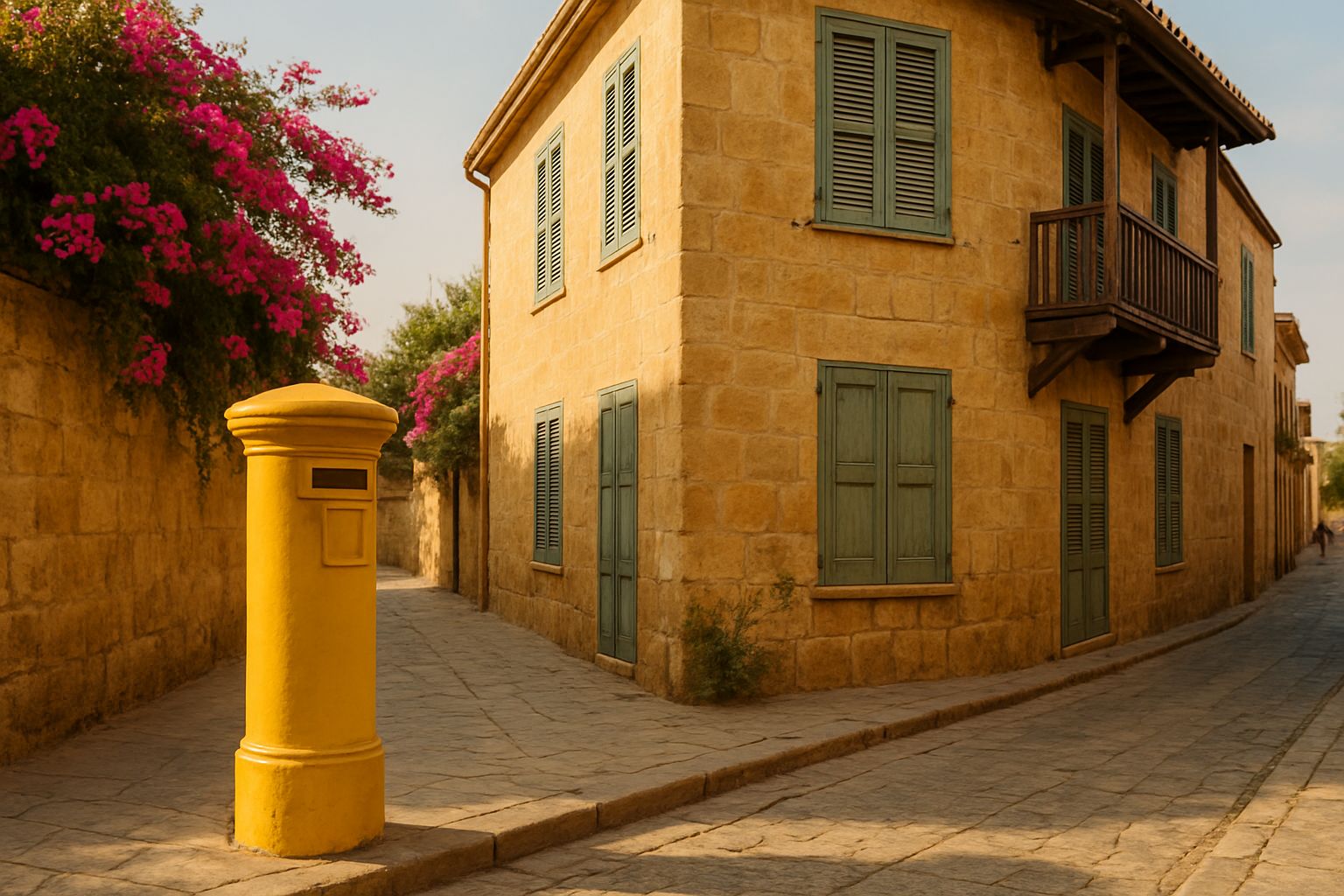
The Department of Postal Services, today Cyprus Post, opened its Postal Museum on 21 October 1981, so it turned 45 in October 2026. It fills the ground floor of an old two-storey mansion at Agiou Savva 3B, inside Nicosia's Venetian walls, opposite the church of Agios Savvas and a few minutes from Laiki Geitonia, and it holds the post office's own collection: stamps in date order, postmarks, seals, scales and letter boxes that tell the island's history through its mail. Entry is free, according to Visit Cyprus and the Nicosia Tourism Board, and the person on duty will show you round; Cyprus Post likes to quote a pupil who called it "the only museum where I did not feel bored".
What is in the cases
The halls show Cyprus stamps and postal material in date order. The main hall covers British rule, from the first Queen Victoria stamps overprinted CYPRUS to the 1928 pictorial set described below; the other halls hold the stamps and first day covers issued by the Republic of Cyprus since 1960. Around them are stamp specimens, air letters, envelopes for insured mail, wrappers for posting newspapers and magazines, and reply-paid postcards, with a large collection of postmarks from village and town post offices, the special seals used on insured letters, postmarks of British army camps and slogan cancellations. Exhibits also show how letters and mail bags were sealed, first with sealing wax and later with small sealing devices, and there are postal scales, letter boxes and philatelic books and magazines.
Before the stamps: Venetian seals, an Ottoman post office and the Austrians
Cyprus Post credits the Venetians, who ruled the island from 1489 to 1571, with its first official postal service, and says letters were kept private with sealing wax or a personal seal; the oldest letter its former website cited, sent from Famagusta to Constantinople, is dated 17 August 1353, under the Lusignan kings. An Ottoman post office opened in Nicosia only in 1871, as a branch of the Turkish post office in Damascus; it lasted seven years, marked letters KIBRIS in Arabic script and took just 14 pounds sterling in sales. Merchants preferred the Austrian post, run under the Austrian consulate in the old Larnaca marina from 1846, which used Austrian stamps from 1864 with a "LARNACA DI CIPRO" postmark.
1878 to 1960: the British post and the first Cyprus stamps
The British, who took over the administration of Cyprus in July 1878, organised the postal service in the form it has today. The first post office opened in Larnaca that July, with four Cypriots among its first staff; a contract was signed to carry mail between Nicosia and Larnaca once a day by horse-drawn carriage at six miles an hour, and within a few months there were branches in Nicosia, Kyrenia, Famagusta, Limassol and Paphos. From 1 April 1880 to 30 June 1881 British stamps were overprinted CYPRUS, and on 1 July 1881 came the first stamps printed for the island, with Queen Victoria's portrait, made by Thomas De La Rue in England. Royal portraits of Victoria, Edward VII and George V followed until 1 February 1928, when ten stamps marking 50 years of British rule, printed by Bradbury Wilkinson, replaced the monarch's head with Cypriot subjects: a silver coin of Amathus, the philosopher Zeno of Citium, a map of Cyprus, the discovery of the body of St Barnabas, the cloisters of Bellapais, the badge of Cyprus, the Tekke of Umm Haram, Richard the Lionheart and St Nicholas Cathedral in Famagusta, with King George V kept for the £1 value. Cyprus Post's museum text calls it the first purely Cypriot series.
On the Cyprus Government Railway, which closed in 1951, every station had a letter box with a sign in English, "This box will be cleared 5 minutes before the departure of the train", and the station manager also acted as postmaster. After the 1953 earthquake the district post office of Paphos worked from tents for almost a year.
1960 and 1974: the Republic and the refugee stamp
On 16 August 1960 the new Republic issued a three-stamp commemorative set with a map of Cyprus, alongside the 1955 definitives overprinted "Republic of Cyprus" in Greek and Turkish, so that existing stock was not destroyed; later stamps carried the country's name in Greek, Turkish and English. The post office was renamed the Department of Postal Services, and Cyprus became a full member of the Universal Postal Union in November 1961. In 1974 nearly half of the postal network was lost, and 16 post offices remain in the area under Turkish occupation, which includes Kyrenia and the town of Famagusta.
To support the Special Refugee Fund set up after the invasion, a refugee stamp must by law accompany every item posted. The first, in autumn 1974, was an overprinted 1971 definitive; at the end of 1974 came a design showing a refugee grandmother carrying her grandchild on her shoulders, and in 1977 the black and white design by the Greek engraver A. Tassos of a refugee boy sitting in front of barbed wire. Since 2008 it has cost 2 euro cents, and a 2026 refugee stamp is on sale at that price. Mail for people living in the occupied areas is handed to the United Nations peacekeeping force, UNFICYP, to pass on.
Yellow boxes, postcodes and the euro
Street post boxes in Cyprus are yellow, and stamps are sold at post offices, postal agencies and many hotels, newsstands and kiosks, according to Visit Cyprus. Postcodes arrived on 1 October 1994, the Department took the trade name Cyprus Post in 2006, and the euro, adopted on 1 January 2008, was marked by a joint stamp issue with Malta.
Collecting today
New issues, first day covers, presentation packs and maximum cards are sold through the Cyprus Post e-shop. The 2026 issues so far mark Cyprus's presidency of the Council of the European Union, 200 years since the Exodus of Messolonghi, 75 years of the Cyprus Red Cross, the centenary of the Insurance Association of Cyprus, 100 years of the International Federation of Philately and 70 years of the Europa stamp, alongside traditional Mediterranean mosaics for Euromed 2026 and old cars of 1955 to 1960. In February 2025 Cyprus Post put four motorcycles from the Cyprus Classic Motorcycle Museum on stamps for that museum's 25th year; it is about eight minutes' walk from the Postal Museum (see our post on three small Cyprus museums). The national society, the Cyprus Philatelic Society, was founded in 1959, and Cyprus Post marked its 20th anniversary with a stamp in 1979.
Visiting
The museum is at Agiou Savva 3B, 1015 Nicosia, and opens Monday to Friday 09:00 to 15:00 and Saturday 09:00 to 13:00. It is closed on Sundays, when it can open for groups with notice, and on public holidays: the next are Wednesday 28 October, Friday 25 and Saturday 26 December and Friday 1 January. Cyprus Post's offices also close on 24 December, so ring before a Christmas Eve visit, on 22 304 711 or 22 760 522. No wheelchair information is published; the exhibition is on the ground floor, so ring ahead to ask about the entrance.
On foot it is two minutes from the Leventis Municipal Museum, five from the south end of Ledra Street and seven from Eleftheria Square, the Solomos Square bus terminus and the Ledra Street crossing point. The old-town circular bus, NPT L1, stops at Archangelou Michail, about 40 m away, 16 minutes after leaving Solomos Square. Intercity buses from Limassol (about 1 hour 50), Larnaca (about 1 hour 15) and Paphos (about 2 hours) arrive at Solomos Square; on weekdays the first leave Limassol at 05:25, Larnaca at 05:40 and Paphos at 05:00, and on Saturdays, when the museum closes at 13:00, the early buses arrive at 08:50 from Limassol, 07:45 from Larnaca and 10:15 from Paphos. The nearest municipal car parks are Solonos, two minutes' walk, and the D'Avila moat and the Faneromeni underground car park, both five minutes away.
And if a move to Cyprus is on your mind, our relocation help can take care of the errands, post office runs included.
