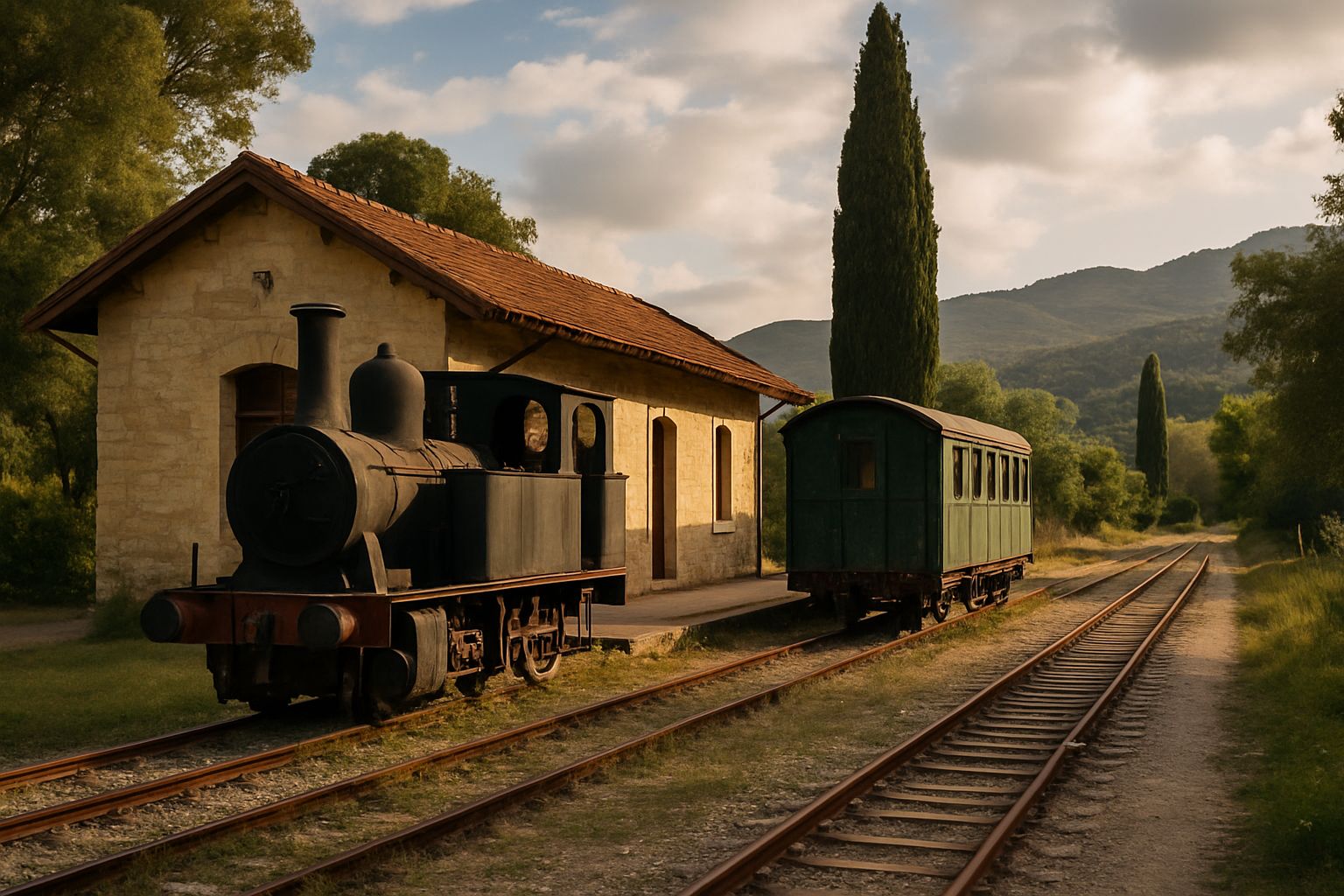
Cyprus has no trains today, but for 46 years it had a railway. The Cyprus Government Railway, a narrow-gauge line with its rails just 2 ft 6 in (762 mm) apart, ran from October 1905 until 31 December 1951. Its 122 km linked the port of Famagusta with Nicosia and then ran west through Morphou to Evrychou in the foothills of the Troodos, with 39 stations, stops and halts along the way. The tracks were lifted long ago, but enough survives to make a rewarding trail across the island.
The line opened in stages. The High Commissioner, Sir Charles King-Harman, inaugurated the first section, from Famagusta to Nicosia, on 21 October 1905; the rails reached Morphou in 1907 and Evrychou on 14 June 1915. Station signs were written in Greek, Turkish and English, and some stations also worked as telephone, telegraph or post offices. The trains carried timber from the Troodos forests, freight through Famagusta harbour, ore for the Cyprus Mines Corporation and the island's mail, and over its lifetime the railway moved more than 7.3 million passengers and almost 3.2 million tons of goods.
It was never fast. According to the museum, the trip from Famagusta to Nicosia took two to three hours, and the lush grass that grew where water dripped from the engines drew sheep and goats onto the line and held trains up. The railway never made a profit. The last five miles to Evrychou were abandoned at the end of 1931, and from 1948 the trains ran west only as far as Nicosia airport. Better roads finished it off: the last train left Nicosia at 14:57 on 31 December 1951 and reached Famagusta at 16:38, and much of the later Nicosia to Famagusta road was built along the old track bed.
Where to see it today
Start at the Cyprus Railways Museum in Evrychou, the agricultural centre of the Solea valley, about 50 km southwest of Nicosia on the northern side of the Troodos. Only the main building of the old terminus survived; the Department of Antiquities restored it and runs it as a museum. Inside are original documents, drawings, photographs and objects from the railway, together with scale models of the main stations and rolling stock. Behind the building the platform and a stretch of track have been rebuilt with original rails, and a freight wagon and a hand-pumped trolley once used to inspect the line stand under a shelter in the yard.
Entry is free. The Department of Antiquities opens the museum every day, from 08:30 to 16:00 between 16 September and 15 April and from 09:30 to 17:00 between 16 April and 15 September, and the ground floor, the garden and the toilets are accessible to wheelchair users. In the village, brown signs lead the way from the main road. From Nicosia, take the B9 towards Troodos; from Limassol, take the B8 towards Troodos and then the B9 down through Kakopetria. Make a day of it in Kakopetria, a few minutes up the valley, where Agios Nikolaos tis Stegis is one of the ten painted churches of the Troodos on the UNESCO World Heritage list.
In Nicosia the line ran through Kaimakli, just outside the old city walls, and the former track bed there became the Kaimakli Linear Park, laid out between 1995 and 1998. Lengths of rail have been put back along the path, with boards of old photographs and timetables, so it makes an easy walk through railway history. The museum's freight wagon, number 152, was first restored for this park in 1995 before it eventually moved to Evrychou.
Much of the old route now lies in the Turkish occupied north, including Famagusta, where the line started at the harbour, and Morphou; a visit means crossing at one of the official checkpoints with your passport or ID. In Famagusta, Locomotive No. 1, a small tank engine built in Leeds by the Hunslet Engine Company in 1904, was kept as a monument when the railway closed and still stands on a plinth in front of the old station building on Polatpaşa Boulevard. When the line was dismantled, ten of its twelve locomotives were sold off with the rails.
Back in the south, Kalavasos, between Larnaca and Limassol, remembers a different railway. From 1938 to 1978 the Hellenic Mining Company ran its own narrow-gauge line from its mines near the village 12 km down to Vasiliko on the coast, carrying copper ore, pyrite and gypsum. One of its locomotives, with ore trucks in tow, has stood since 1997 on the old railway bridge over the Vasilikos river at the entrance to the village.
Together, Evrychou, Kaimakli, Famagusta and Kalavasos trace a chapter of island life that is easy to miss. If Cyprus is pulling you in for longer than a holiday, our relocation help can take care of the practical side of the move.
