Three small museums in three districts, each run on very different lines: a private collection of motorcycles built up by one man inside Nicosia's Venetian walls, two municipal folk museums in Deryneia, about a kilometre from the Green Line crossing, and the town museum of Athienou, between Nicosia and Larnaca, home to the icons of a monk who was born there. All three close on public holidays; the next ones are Wednesday 28 October and Friday 25 and Saturday 26 December. By car they make a loop: old Nicosia to Athienou takes about 41 minutes, Athienou to Deryneia about 57 minutes on the A3 motorway, and Deryneia back to Nicosia about 78 minutes on the A3, A2 and A1. Some sat navs offer a shorter route through the north via two crossing points, so check the route before you set off.
Cyprus Classic Motorcycle Museum: one collector's machines
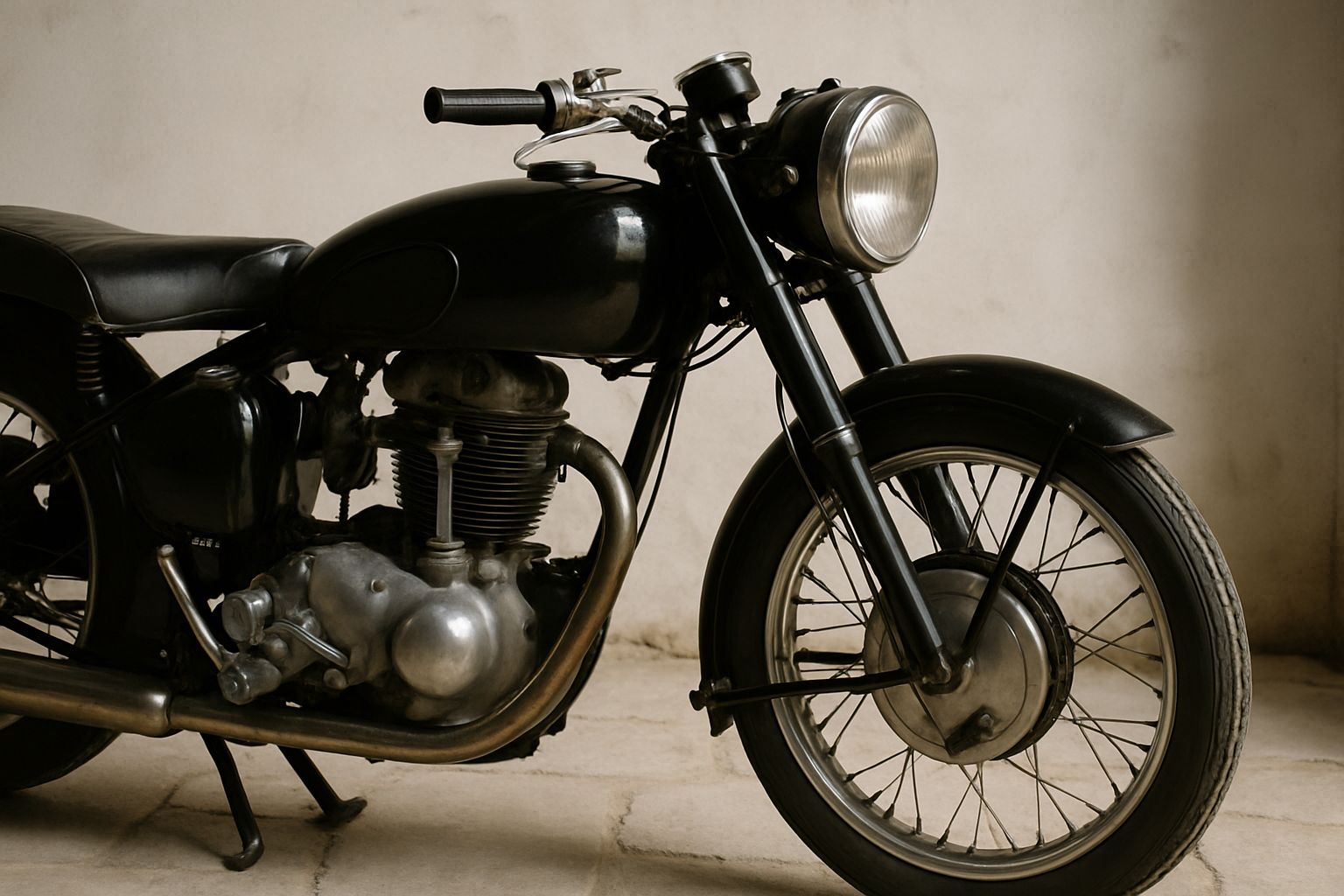
Andreas Nicolaou, a refugee from Kyra, a village near Morphou in the occupied north, started collecting motorcycles in 1980, and the museum he set up in old Nicosia opened in January 2000; it spent 2025 marking its 25th year. The collection now numbers more than 450 motorcycles made between 1914 and 1983, and about 150 are on show at any one time, according to the newspaper Phileleftheros, which visited in December 2025. The museum's own list of makes runs from AJS, MV Agusta, Matchless, Norton, BSA and Triumph to Ariel, BMW, James, Moto Guzzi and Royal Enfield. The oldest machine, a 1914 New Hudson, has no clutch: it was push-started, belt-driven and lit by an acetylene lamp.
Some of the machines carry the island's history. The police motorcycles that escorted Archbishop Makarios III are here: the museum's own page counts three, while the December 2025 report counted four: two Triumphs and two Harley-Davidsons, the Harleys a gift from President John F. Kennedy after Makarios's visit to the United States in June 1962. There is the motorcycle of the EOKA fighter Stylianos Lenas, used to carry weapons and ammunition; Lenas, from Chandria, made bombs for EOKA, was badly wounded in a clash with British forces and lived another 40 days in the hospital of the Akrotiri base, according to the University of Cyprus's Lekythos archive. Another belonged to the Turkish Cypriot Zeki Isa, the first motorcycle champion of Cyprus, from 1970 to 1973, and there are military motorcycles from the Second World War. The museum also has a film room, a permanent exhibition of photographs, a gift shop, an accessories shop and a small coffee shop, and it welcomes school groups.
Visiting the motorcycle museum
The museum is at 44 Granikou Street, inside the walls in the Agios Andreas quarter, 76 m from the Fairytale Museum (see our post on two unusual Cyprus museums), about six minutes on foot from Eleftheria Square or the bottom of Ledra Street and three from the Paphos Gate. It opens Monday to Friday from 10:00 to 17:30 and on Saturday from 10:00 to 13:00, and it is closed on Sundays and public holidays. Tickets are 5 EUR for adults, 4 EUR for students and 2.50 EUR for children; children up to 3 go free, and groups should ask for a price. Ring 22 680 222 or 99 543 215, and ask about wheelchair access before you go. The old-town circular bus, NPT L1, stops on Voulgaroktonou Street at Arsinois, two minutes' walk away, and Solomos Square, the main bus terminus with Intercity buses from Larnaca and Paralimni, is a four-minute walk.
Deryneia: a village house and a yard of old trades
Deryneia, on the edge of the free part of Famagusta district, has belonged to Paralimni-Deryneia Municipality since the 2024 local government reform. The Deryneia Folkloric Museum, as the municipality calls it in English, is an old house at 2 Dimitri Liperti Street, given by Varnavas and Margarita Hadjiliasi in memory of their three children, who died young; the building is listed and was restored by the municipality. Its household equipment and farm tools were laid out with the Cyprus Handicraft Service, the objects were given by local families, and there is a bread oven in the yard. The stone church of the Virgin Mary stands next door. The Folk Museum is one of the municipality's venues for civil weddings, and on International Museum Day, 18 May 2026, it hosted a talk on Deryneia's historic monuments.
Opposite, at no. 3, the Open Air Museum of traditional professions gives a room to each old trade, among them the furniture maker, cobbler, tailor, blacksmith, builder, barber, stonecutter, fisherman and market gardener, and its semi-open yard holds a cart, a reaper, a threshing machine, a boat and millstones. One caution: the merged municipality's own museums page now lists only the Folk Museum, so ring before you go if the open-air museum is the reason for the trip.
Visiting Deryneia, and the view over Varosha
The Folk Museum opens Monday to Saturday from 09:00 to 13:00 and 15:00 to 17:00 in winter and until 18:00 in summer, and it is closed on Sundays and public holidays; Visit Cyprus gives the same hours for the open-air museum. The municipality does not publish the dates when one timetable gives way to the other, so ring first. Entry is 2 EUR, or 1 EUR each in a group. The municipality's switchboard is 23 819 300 and its culture office 23 819 169; Visit Cyprus still lists the old Deryneia number, 23 811 000. A 2023 access survey for Visit Cyprus found a ramp up to the Folk Museum's ground floor, but its toilets are not adapted for wheelchair users and its inner doors are only 52 to 65 cm wide.
About 800 m away, 11 minutes on foot, the Famagusta Municipality Cultural Centre at 35 Evagorou Street, founded as the Cultural Centre of Occupied Famagusta, has an observatory with binoculars for looking across to the fenced-off town of Varosha in the occupied north (see our Varosha guide), photo exhibitions and film screenings, and it gives guided visits; ring 23 740 860 to arrange one for a group. Entry is free. It opens Monday to Friday from 07:30 to 17:00 and on Saturday from 07:30 to 15:00 in summer, and Monday to Saturday from 07:30 to 15:00 in winter, which starts in early November according to Famagusta Municipality and Visit Cyprus. The Deryneia crossing point, open since 12 November 2018, is about 1.1 km from the museums on foot; take a passport or ID card if you cross. By bus, OSEA route 501 runs from Paralimni Square in 13 minutes, and routes 710 and 501 from Ayia Napa take about 35 minutes.
Kallinikeio Municipal Museum, Athienou: icons, finds and village life
Athienou's museum opened on 3 July 2009 in the Kallinikeio Municipal Hall, which it shares with the town hall. The building's design, by Giorgos Hadjichristou and Skevi Farazi, won first prize in a 1996 competition, and part of its land was given by the monk Kallinikos Stavrovouniotis, after whom both are named. Born Kostas Mammous in Athienou in 1920, Kallinikos entered Stavrovouni Monastery at 20 and learned icon painting there, trained in 1946 under the Mount Athos icon painter Ioannikios Mavropoulos and in 1960, urged by Archbishop Makarios III, alongside Fotis Kontoglou, and in 1996 published a book on the technique of icon painting that also came out in English, French, German and Russian. He had promised his icons to Athienou once it had a worthy museum, and he presented the Collection of Ecclesiastical Art himself at the opening; he died on 23 January 2011.
The Archaeological Collection runs from the Late Bronze Age (1600 to 1050 BC) to the Hellenistic period (310 to 30 BC), with finds from university and Department of Antiquities excavations around the town, including Malloura, where the Athienou Archaeological Project has dug since 1990; most of the Malloura finds, though, are in the Larnaka District Museum. A faithful copy of a 5th century BC funerary stele with two sphinxes from ancient Golgoi, whose original is in the Metropolitan Museum of Art in New York, is on permanent display. The Icon Painting and Mosaic Workshop shows icons and mosaics by the Athienou-born brothers George and Alkis Kepolas; it was set up in the museum's first months at Alkis's wish, to teach children icon painting free of charge, and he died in December 2009. The Ethnographic Collection covers Athienou's bread and dairy making, its lace, the lost trade of the muleteer, its schools, scouts and sports clubs, and the town's men who served in both world wars.
Visiting Athienou
The museum is at 2 Archbishop Makarios III Avenue and opens Monday to Friday from 08:00 to 15:00; at weekends it opens with advance notice, and it is closed on public holidays. Entry is 2 EUR, 1 EUR reduced, and children go free. Ring 24 524 002 or email [email protected]. Every part of the museum is accessible, with a lift and an accessible toilet, and the Larnaka Virtual Museums platform has a virtual tour. LPT bus 415 leaves Larnaca Station on weekdays at 07:45, 11:15, 13:30 and 15:35 and takes about 50 minutes to the stop by the town hall; buses back leave at 08:41, 12:11, 14:41, 16:31 and 19:01, with three a day each way at weekends and on 28 October. From Nicosia, take NPT route 5 to Alampra and change there to NPT 56, about an hour and 20 minutes in all. By car it is about 26 minutes from Larnaca and 41 from old Nicosia. If a day among old engines, icons and village trades turns into thoughts of a longer stay, our relocation help can take the paperwork off your hands.
