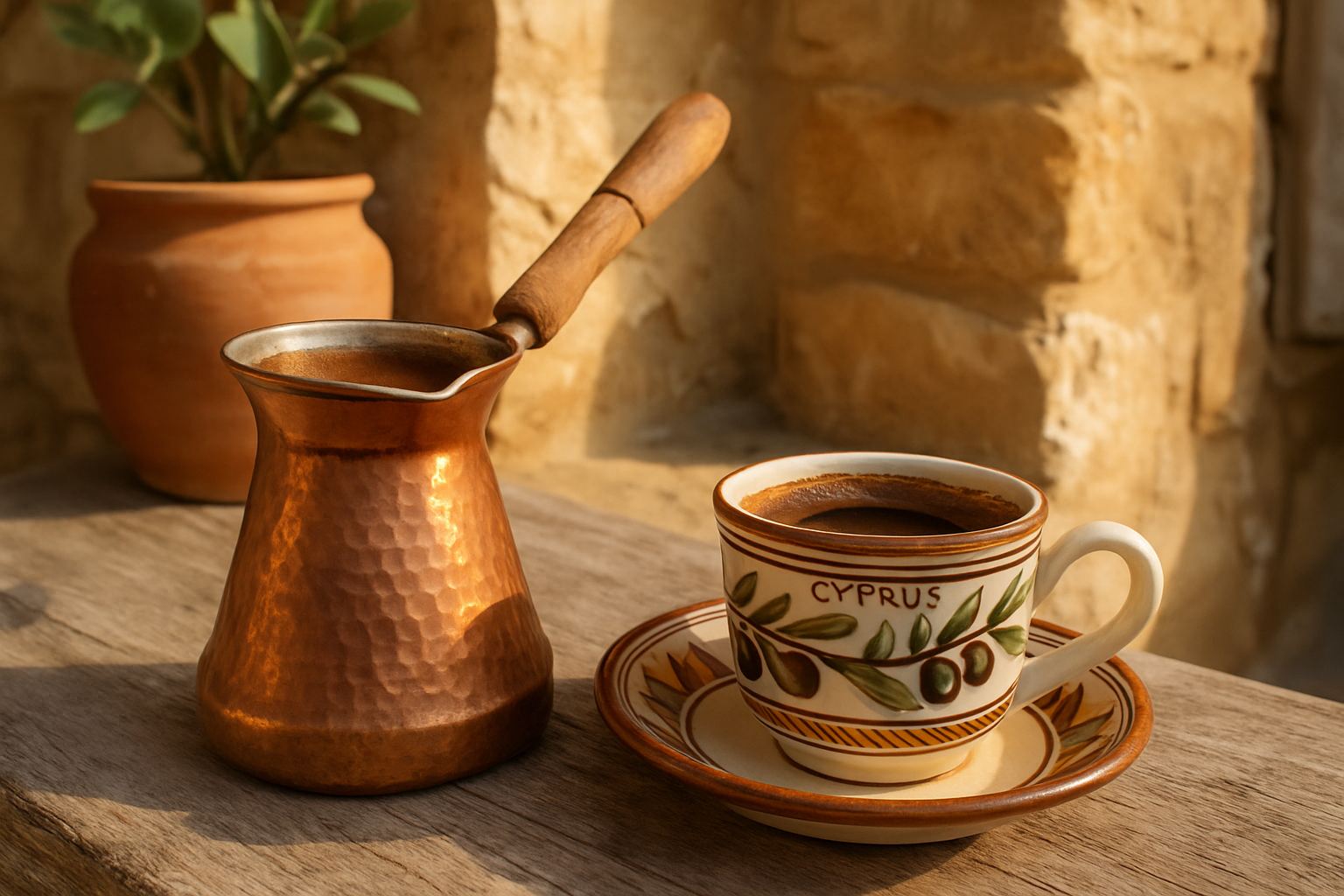
Cyprus coffee, kypriakos kafes in Greek, is a strong, unfiltered coffee boiled in a small long-handled pot and served in a small cup with a glass of water; milk is never added, as Visit Cyprus puts it. It is the same style of coffee that is called Greek coffee in Greece and Turkish coffee in Turkey; as the factory manager of the Laiko roastery told City magazine in 2016, in Cyprus they call it Cypriot and in Greece they call it Greek.
The beans are Arabica. Laiko describes its Cypriot coffee as 100% Arabica, and G. Charalambous gives Brazil as the origin of its 100% Arabica Classic, adding Ethiopian beans in its stronger Mokka and Ethiopian and Colombian ones in El Primero. The same Laiko manager described a medium roast, and the Limassol roaster I Anatoli says Cypriot coffee is roasted close to a chestnut colour, which it calls blond, while Turkish or Lebanese coffee is roasted dark; Visit Cyprus says the beans are finely ground. G. Charalambous was founded in Nicosia in 1943, Laiko in Nicosia in 1948 by a group of professional coffee-shop keepers, and Amalia in 1948 in the Agios Lazaros arcade in Larnaca, and all three still sell Cypriot coffee today.
The sugar goes in at the start, so you choose it when you order. According to Visit Cyprus, sketo (σκέτος) is plain, with no sugar; metrio (μέτριος) has one teaspoon; and glyki (γλυκύς) has two. Cyprus Mail lists the in-between orders too: me oligin, with only a little sugar; mallon glykis, a little sweeter than metrio; and varis glykis, extra sweet. In a village coffee shop, the Heartland of Legends rural tourism site suggests asking for it 'meraklitiko parakalo', which means please make it with extra attention and care.
To make it at home you need a briki (μπρίκι), the small long-handled pot that Visit Cyprus says was traditionally copper, with every household owning at least one; a Cypriot online supermarket sells an 11 cm one for 7.95 EUR. Following the Nicosia Tourism Board's method, measure the water with the cup itself, add one heaped teaspoon of coffee for each cup and put the sugar in while the water is still cold. Heat it slowly. The foam, kaimaki (καϊμάκι), starts at the sides and makes the coffee rise, and the trick is to take the pot off the heat at the right moment, before it spills over, so the kaimaki stays. Pour it into small cups, serve it with a glass of cold water, and leave the thick layer at the bottom of the cup.
In a traditional kafeneio the pot goes on hot sand instead of a flame. Heartland of Legends describes the kafetzis, the coffee-shop owner, setting the pot on the outzaki, a small tray filled with heated sand, then bringing the coffee to your table on a tin tray, in a small cup on its saucer with the glass of water; the Nicosia Tourism Board calls the bed of hot sand the hovoli. Visit Cyprus adds that the coffee is best sipped slowly, and that by tradition fortune-tellers can read your future from the patterns the dried grounds leave in the cup.
The kafeneio is where Cyprus coffee belongs. Heartland of Legends describes it as a meeting place for people of all ages, for a game of tavli (backgammon) or pilota (a card game) and heated talk about the news of the day, usually under a vine-covered pergola, and by custom the player who loses the game pays for the coffees. The Cyprus Food Museum records that the traditional kafeneio also served loukoumia, soumada (an almond cordial), tea and lemonade.
A few long-running places still serve it. The kafeneio I Plateia on the square in Vouni, a Limassol wine village, has been open for more than a century. In old Nicosia, Tria Fanaria on 28 October Square in Faneromeni has been a traditional pastry shop since 1952, when Savvas Lemonaris and his wife bought an old coffee shop there, and Ta Kala Kathoumena on Nikokleous Street has been an alternative kafeneio and bar since the mid-1990s; the Nicosia Tourism Board lists both under its Cyprus coffee tip. In Kato Lefkara, the Stafilaris coffee shop has been run by one family since 1957, and in Paphos town Sykaminia Cafe has been open since at least 1953 by its own account. To see coffee brewed slowly in hot sand, Kafes sti Hovoli, a stone-built coffee shop by the square in Kyperounta in the Troodos, makes it that way.
To take some home, Cypriot supermarkets sell the main brands in 100 g to 500 g packs. On 13 October 2026 one online supermarket listed Laiko's gold pack at 1.99 EUR for 100 g, 3.80 EUR for 200 g and 9.19 EUR for 500 g, G. Charalambous at 3.80 EUR for 200 g and 9.50 EUR for 500 g, and Amalia at 2.37 EUR for 200 g. Visit Cyprus suggests taking a briki back too: coppersmiths still make them, and they are sold in workshops and souvenir shops.
Settling in Cyprus and want help with more than the coffee order? Our relocation help takes care of residency, GeSY healthcare registration and the rest of the paperwork.
