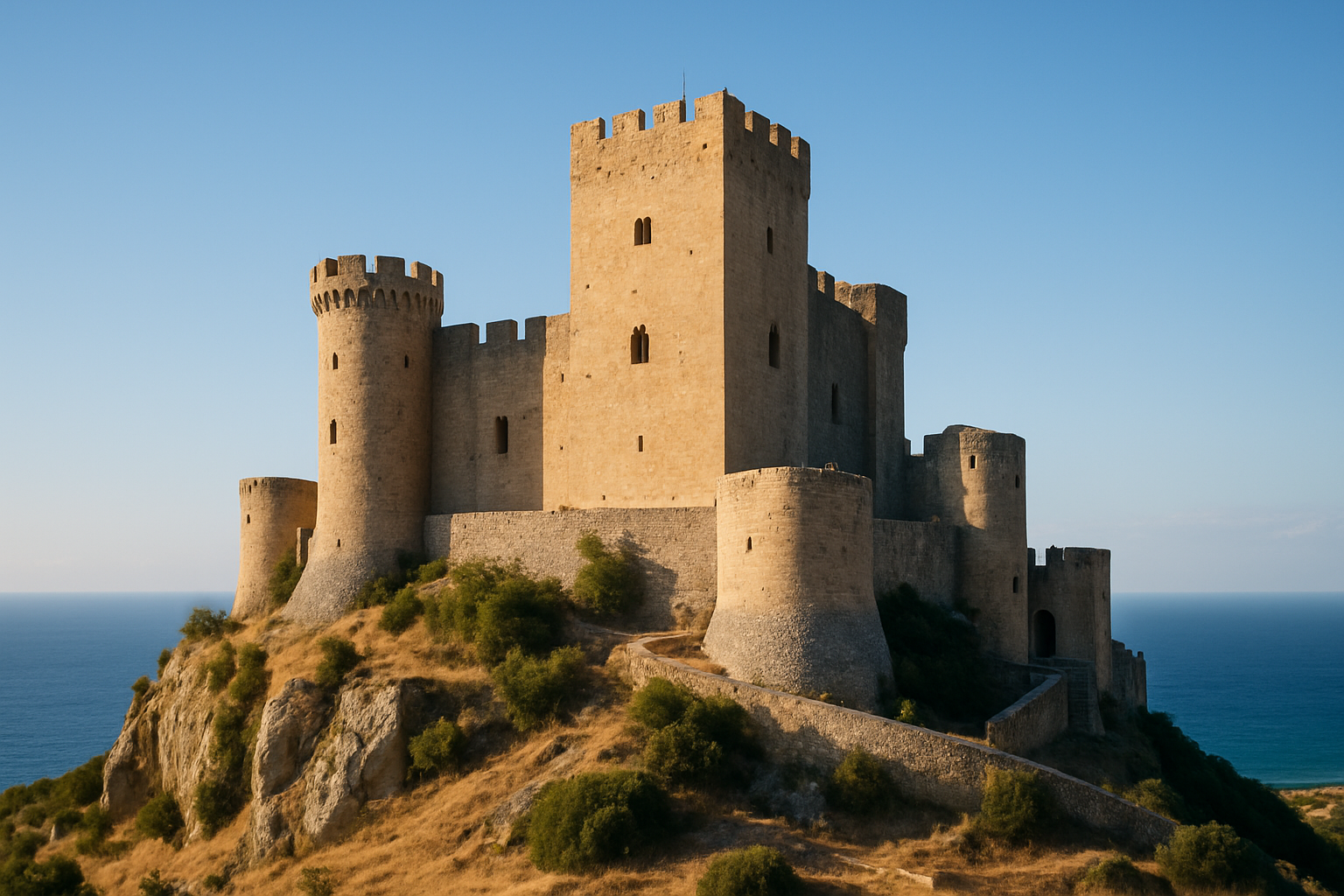
Amid the azure waves of the northern coast of Cyprus, the town of Kyrenia is a treasure trove of history. Its old harbour is guarded by a great castle, and on the mountain ridge behind the town stand two more, St Hilarion and Buffavento. If stones could speak, these would tell of Byzantine watchmen, Crusader kings, Venetian gunners and an Ottoman admiral. Kyrenia and both mountain castles lie in the Turkish occupied north, so a visit means crossing at one of the official checkpoints with a passport or ID.
Kyrenia Castle, at the eastern end of the old harbour, is the place to start. Research at the site suggests the Byzantines built the first castle here in the 7th century to guard the town against Arab raids from the sea, and it enters the records in 1191, when Richard the Lionheart took it from Isaac Komnenos. John of Ibelin enlarged it between 1208 and 1211, and from 1540 the Venetians rebuilt it for the age of gunpowder, with thick walls, cannon embrasures and long ramps for hauling guns up to the ramparts, which gave the castle the shape you see today. Inside the walls are the small Byzantine church of St George, whose dome rests on marble columns with reused late Roman capitals, the tomb of the Ottoman admiral Sadik Pasha, who took Kyrenia in 1570, and the dungeons. Under British rule the castle served as a police barracks and as a prison for members of EOKA.
The castle also houses the Shipwreck Museum and its star exhibit, a Greek merchant ship of the 4th century BC. The Kyrenia diver Andreas Cariolou found it in November 1965 at a depth of 33 metres, about a nautical mile north-east of the harbour, and a University of Pennsylvania team led by Michael Katzev excavated it in the late 1960s. The ship went down around 294 BC or a little later, already old and much repaired, carrying 381 amphorae of wine and oil, more than 9,000 almonds and 29 millstones. More than half of its hull timbers survived, and the hull now rests in a specially controlled environment in the museum, together with its cargo.
About 5 km south-west of the harbour as the crow flies, on a crag above the old pass road to Nicosia, stands St Hilarion, the best preserved of the three castles of the Kyrenia range (the other two are Buffavento and Kantara). It is named after an obscure hermit saint who, by tradition, fled to Cyprus after the Arab conquest of the Holy Land. The Byzantines began fortifying the peak in the 11th century, the Lusignans strengthened it, and their kings may have used it as a summer residence; it was also the focus of a four-year struggle between Emperor Frederick II and John of Ibelin. The castle climbs the rock in three wards: the lower ward held the stables and the quarters of the men-at-arms, and the upper ward the royal apartments, with the carved Queen's Window looking out over the north coast. Local lore says St Hilarion inspired the castle in Disney's Snow White.
Buffavento stands about 10 km south-east of Kyrenia as the crow flies, at around 960 metres on a crag above the pass from Kythrea to the north coast. Its Italian name is usually translated as 'defier of the winds'. Nobody knows exactly when it was built; the Byzantine period, perhaps the late 11th century, is the most likely answer. It served mainly as a watchtower, passing signals between St Hilarion and Kantara, and as a prison: its defenders surrendered to Richard the Lionheart in 1191, and the Lusignans kept prisoners there. The Venetians judged it redundant and let it fall into ruin. Roughly 600 steps lead up to it, and the reward is a view over the north coast on one side and the central plain on the other.
Seeing all three castles makes a full day out. Wear sturdy shoes for St Hilarion and Buffavento, which both mean steep climbs over uneven steps and rock, and check the current opening hours before you set off.
For those considering a deeper relationship with Cyprus, beyond just a fleeting visit, the allure of these historic sites can be a compelling factor. Living in proximity to such rich history allows one to continually discover new stories and appreciate the cultural tapestry of this unique island. If you are contemplating making Cyprus your home, there are resources and services available to aid in your journey.
Exploring the fortified past of Kyrenia is a journey through time, offering insights into the island's strategic significance and rich cultural evolution. Whether you are a history buff or simply seeking a unique travel experience, the castles of Kyrenia provide an unforgettable adventure. For those inspired to make Cyprus a more permanent part of their lives, consider seeking relocation help to navigate the transition with ease. Cyprus Decoded is here to support your journey, ensuring that the charm and history of this Mediterranean gem are just a step away.
