Kampi (Καμπί), usually called Kampi tou Farmaka after its larger neighbour Farmakas, is a small hill village at the southern edge of Nicosia district, in the Pitsilia region, at about 860 m above sea level. It had 80 residents at the 2021 census, down from 97 in 2011. By road it is about 43 km from central Nicosia, roughly 45 minutes, about 49 km from Limassol (allow an hour) and about 70 km from Larnaca (about 1 hour 15 minutes). Its land borders Sykopetra in Limassol district, and the Nicosia, Limassol and Larnaca districts meet just south of the village. What brings visitors is small and walkable: a streamside trail with a tree house, two old bridges, the stone church of St George with its carved woodwork, and a family taverna built over the stream.
The Aidonia trail and the tree house
The Aidonia nature trail (aidonia means nightingales) follows the village stream for about 1 km, a walk of around 30 minutes on the easiest grade, with benches, gazebos and a picnic spot along the way. The community council made it with EU funding, helped by the village youth centre and the association of Kampi's expatriates. Plane trees and walnuts shade this streamside path, and the community says hundreds of nightingales nest along it. The trail sign is on the right about 100 m past the Potamos taverna, and the other end comes up near the church, so you can return along the village lane instead of retracing your steps.
Its best-known stop is a tree house in a riverside plane tree. Village children built the first one; it fell apart and was rebuilt when the trail was made, and the community says it now stands on six trunks of the same plane tree. According to the road-trip writer of the Wiz Guide, the small waterfall below the taverna has water all year and is strongest in winter. Locals call the stream the Kleisithkias, and it feeds the Palaichori-Kampi dam, about 4 km away, which the Water Development Department lists on the Akaki river system and dates to 1973.
Two bridges from British rule
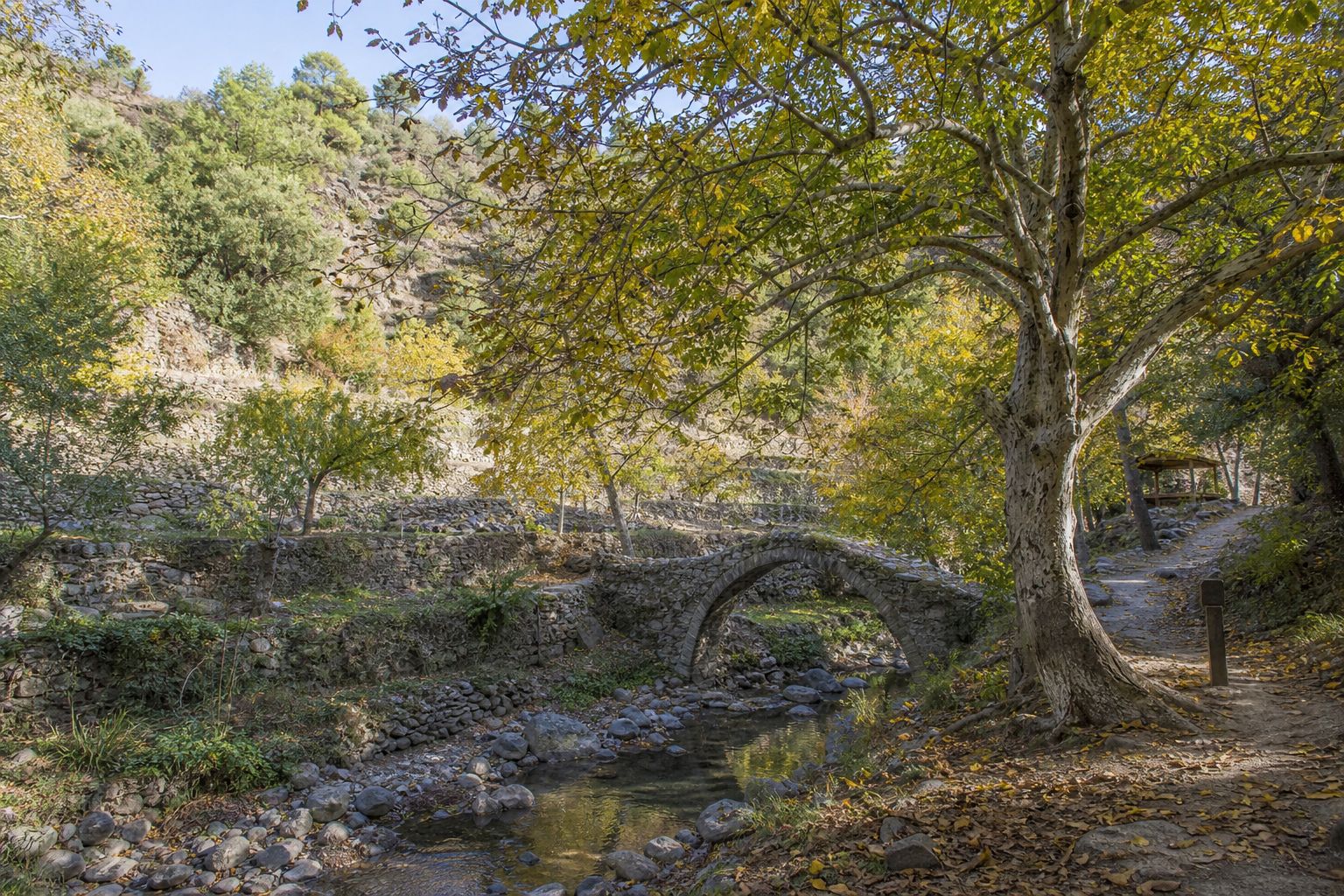
West of the village, about 100 m apart, stand two old crossings. Kamaroto is a single stone arch built in 1942, under British rule, over a small side stream, and it once carried the dirt road; Kato Ampelia is a wooden footbridge on stone piers, with benches. Kampi's community leader told the newspaper Dialogos in 2019 that both were built under British rule with the help of people from Kampi and the villages around, for military reasons and to link Kampi with Apliki. Villagers say a barn owl nests in the great plane tree by the Kato Ampelia bridge.
St George's church, the museum and the village story
The parish church of Agios Georgios (St George), part of the Holy Metropolis of Tamassos and Oreini, is built of stone and known for its carved woodwork. Its age is uncertain: the parish priest dates it to the early 17th century, while the Great Cyprus Encyclopedia calls it a building of 1800. Local tradition says the first village, also called Agios Georgios, stood a little to the south and was abandoned after a plague, and that its survivors founded today's Kampi. According to the parish priest, the church keeps a rare 15th-century icon of St George surrounded by scenes of his martyrdom.
The feast of St George is on 23 April, but when 23 April falls before Orthodox Easter the feast moves to Easter Monday. In 2027 Orthodox Easter is on 2 May, so Kampi's feast day falls on Monday 3 May 2027.
Near the church is a small community museum. According to the community, it has a room of farm tools and household objects and a room of church treasures, among them an icon of St Tryphon, protector of farmers, sent by Archbishop Kyprianos. The story fits the archbishop's record: Kyprianos, archbishop from 1810 to 1821, had more than 150 icons of St Tryphon painted in 1820 and 1821 and gave them to churches across Cyprus during a plague of locusts. To see inside, ring the community council on 22 642722 or email [email protected] before you go. A handwritten Gospel lectionary of the 16th century from St George's church is now on display at the Byzantine Museum of the Holy Metropolis of Tamassos and Oreini in Episkopeio, about half an hour's drive away on the road back to Nicosia.
Earlier history is harder to pin down. A medieval list of the Templars' estates in Cyprus, handed over to the Hospitallers, names a village called Campin; the Great Cyprus Encyclopedia identifies it with Kampi, but Louis de Mas Latrie, the French historian who published the list, thought it was perhaps Kampia, a different village. The 20th century is clearer: according to the encyclopedia, electricity and telephone lines reached Kampi only in 1970 and piped water in 1974. A small park north of the church holds a memorial to three villagers missing since 1974.
Where to eat
O Potamos tis Militsas is a family taverna built over the stream and run by Militsa Giasemi, who says the story began in 2005; it serves traditional Cypriot food and a Cypriot breakfast, and Sigmalive described it in 2025 as a restaurant with a fireplace and glass walls. It was trading in late 2025, so ring 22 643315 to check its opening days before you set out.
Getting there
By car from Nicosia, take the Nicosia to Palaichori road (E903) and, near Apliki, turn left at the signs for Farmakas and Machairas; at the next junction the signs point right to Kampi, about 1 km on. From Limassol, leave the A1 motorway at Parekklisia and climb north through Prastio, Kellaki, Eptagoneia, Melini, Odou and Farmakas. On its visit the Wiz Guide parked in the small village square and walked up to the church; the taverna is about 400 m further on by car.
Without a car, route 65 runs between Kampi and Tamasos Bus Station in 30 to 35 minutes, by way of Farmakas, Gourri and Kalo Chorio, and at Tamasos Bus Station you change to route 2, which takes 45 to 55 minutes to Solomos Square in central Nicosia. On weekdays buses leave Tamasos Bus Station for Kampi at 06:55, 08:45, 12:40, 14:40, 16:55, 17:15 and 18:45, plus two runs before dawn, and leave Kampi at 04:20, 05:15, 07:55, 10:10, 13:20, 15:15, 17:30, 18:00 and 19:20. On Saturdays they leave Tamasos at 05:30, 08:35, 14:00 and 17:00 and Kampi at 06:05, 09:25, 15:20 and 17:30; on Sundays Tamasos at 08:30 and 15:50 and Kampi at 09:20 and 16:25.
A weekday day trip works like this: route 2 from Solomos Square at 07:40 reaches Tamasos Bus Station at 08:35, in time for the 08:45 to Kampi, which arrives at 09:18; coming back, the 13:20 from Kampi meets the 14:00 route 2, which reaches Solomos Square at 14:55. Allow about 1 hour 40 minutes each way. This timetable runs until 27 January 2027, so check the times on publictransport.com.cy before you travel.
Kampi pairs well with its neighbours. Farmakas is a couple of minutes' drive away and the Palaichori-Kampi dam about 7 minutes. Palaichori, 12 minutes away, has the Church of the Transfiguration of the Saviour, one of the ten painted churches of the Troodos on the UNESCO World Heritage List, whose wall paintings UNESCO assigns to the Cretan school of the 16th century, and the Museum of Byzantine Heritage. Fikardou, a whole village declared an ancient monument in 1978, with its folk museum houses, is about 13 minutes away, and Machairas Monastery about 19 minutes. If village life within reach of Nicosia appeals, our relocation help is here when you need it.
