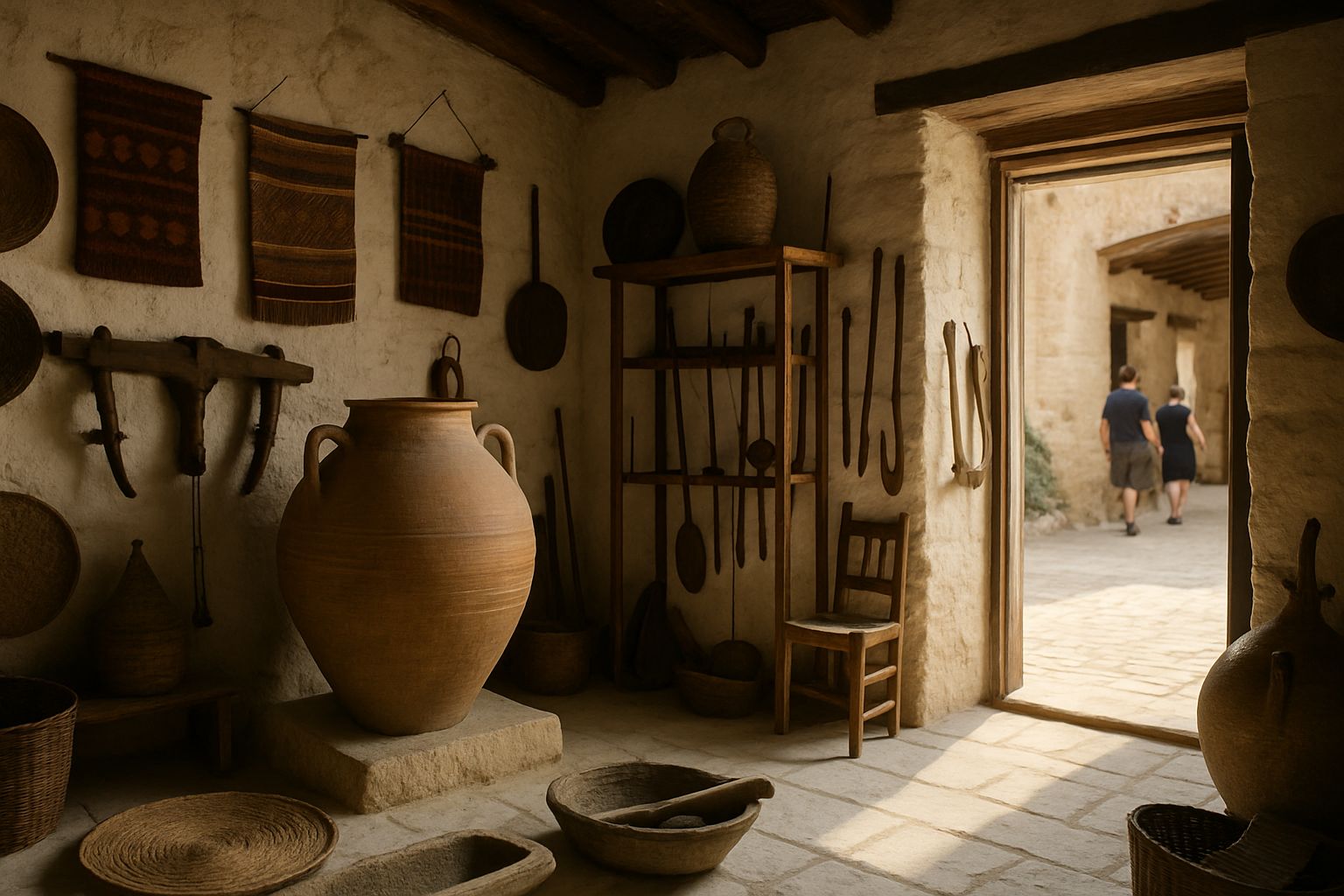
Both of these folk museums are run by the Department of Antiquities, and both are free. The first is a single house in Fikardou, a mountain village about 35 km (40 minutes by car) south-west of Nicosia that is protected as a whole; the second fills an 18th-century house in Geroskipou, about 3.5 km east of Paphos town centre. Between them they show how a village house was laid out and worked, and the crafts of rural Cyprus in the 19th and early 20th centuries.
Fikardou: a protected village and the House of Katsinioros
Fikardou sits at about 900 m on the eastern slopes of the Troodos, in the Pitsilia area. The whole village was declared an Ancient Monument in 1978, the Department of Antiquities has been restoring its houses since 1984, and the restoration won a Europa Nostra award in 1987. Since 2002 it has been on UNESCO's tentative list for World Heritage, described as an excellent example of a traditional mountain settlement that has kept its 18th and 19th century character and architecture. The village emptied over the 20th century as families moved to the towns: the census counted 133 people in 1921, 13 in 1982 and 25 in 2021.
The museum is the House of Katsinioros, named after its last owner: a two-storey stone manor house with a steep wooden roof that keeps many architectural features of the 16th century, from the Venetian period. The family lived upstairs, while the ground floor was used for pressing grapes, storing wine, produce and tools, and stabling the animals. The house is furnished on older examples to show everyday life in a rural home, tools and utensils of rural life are displayed on the ground floor, and upstairs an exhibition of photographs, drawings and texts shows the village houses and how the Department restored them. The neighbouring House of Achilleas Dimitri is now a weaving workshop and a guest house for scholars.
The museum opens Tuesday to Sunday and is closed on Mondays (a Department of Antiquities rule since June 2023) and on public holidays, including Wednesday 28 October. Entry is free and the house is partly wheelchair accessible. The Department lists 08:30 to 16:00 from 16 September to 15 April and 09:30 to 17:00 from 16 April to 15 September, while Visit Cyprus keeps the summer hours until 30 October, so this month plan on 09:30 to 16:00, which every source covers, or ring 22 634731 first. Visit Cyprus gives the route from Nicosia as the E903 and then the E904, which runs through Malounta and Klirou. By bus, the closest you can get is the Gourri stop on route 65 from the Tamasos bus station in Arediou, a 2 km walk from the village. Machairas Monastery is about 10 km away by road, and from 21 November 2026 to 6 January 2027 Fikardou is one of the official Christmas villages.
Geroskipou: the Folk Art Museum in the House of Hadjismith
The Folk Art Museum of Geroskipou (the Local Ethnographic Museum in the Department of Antiquities' English listings) has been housed since 1978 in the 18th-century House of Hadjismith, a listed Ancient Monument restored by the Department. The house belonged to Andreas Zimboulakis, the British consular agent for western Cyprus, who provisioned the British troops. Its name comes from his family's close ties with the British admiral Sir Sidney Smith and from a family member's pilgrimage to the Holy Land, since "hadji" means pilgrim.
The collection comes from all over Cyprus, mainly from the Paphos district, and covers daily life, crafts and folk art in the 19th and early 20th centuries. Some rooms are set out as the parts of a traditional village house; others show crafts and trades, which Visit Cyprus lists as pottery, kerchief making, rug weaving, rope making and silk production, a craft the island was once famous for.
The museum opens every day, 08:30 to 16:00 from 16 September to 15 April and 09:30 to 17:00 from 16 April to 15 September, except on public holidays, so it is also shut on 28 October. Entry is free; the building is not wheelchair accessible, and the municipality lists toilets, a car park and a free leaflet in Greek and English. It is at Athinon 9 (telephone 26 306216), and the Geroskipou Art Museum bus stop is beside it: route 613 from Karavella station in Paphos runs every day and takes about six minutes, route 601 also runs from Karavella Monday to Saturday, and route 606 from the Kato Paphos harbour station, Monday to Saturday, takes about half an hour to a stop 85 m away. A single fare is €2.
About 200 m away, three minutes on foot, the church of Agia Paraskevi is a five-domed, three-aisled basilica of the 9th century with wall paintings from the 8th or 9th century up to the 15th; entry is free, and it closes for lunch from 13:00 to 14:00. Geroskipou's loukoumi has been protected in the EU as a PGI since December 2007, and our Cyprus sweets guide covers where to buy it. Every Tuesday from 09:30 to 12:30 a free guided walk of Ierokipia, the municipality Geroskipou now belongs to, takes in the church, the museum and the loukoumi, starting from the bus stop on the municipal square (26811500 or 26960857).
Other folk museums, and two to skip for now
The Department of Antiquities' Local Museum of Traditional Embroidery and Silversmith-work in Lefkara, in the House of Patsalos, is also free and opens daily, and Paphos town has the Ethnographic Museum of Pafos, home of the Eliades collection. Two others are closed for now: the Ethnological Museum in the House of Hadjigeorgakis Kornesios in Nicosia has been shut since 1 September 2026 because of technical problems, and the Kostas Kaimakliotis Folklore Museum in Aradippou is closed for rebuilding. If a day among old village houses turns into thoughts of a longer stay, our relocation help can take the paperwork off your hands.
