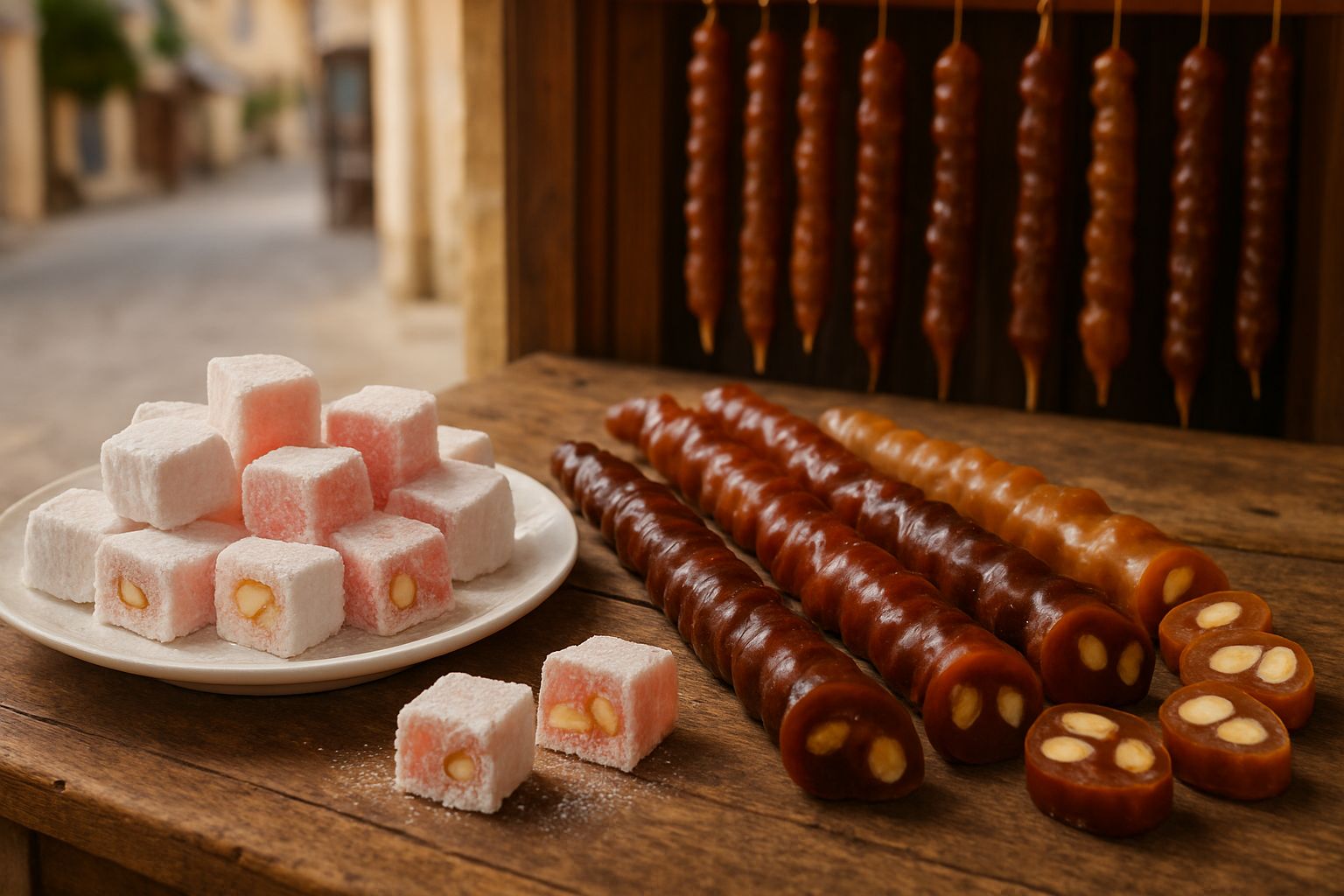
Loukoumi, the soft, sugar-dusted cube known abroad as Turkish delight, is the sweet most tied to Geroskipou, a municipality 3 km east of Paphos and, since 2024, the seat of the wider Municipality of Ierokipia. 'Loukoumi Geroskipou' was registered in December 2007 as an EU Protected Geographical Indication, the first Cypriot food to get one, and the village's sugared almonds, Koufeta Amygdalou Geroskipou, followed in 2012. The EU specification says what sets it apart: it is firmer, more elastic and less sweet than other loukoumi, made without glucose or gelatine, cut into pieces of about 20 x 20 x 25 mm and coated in caster sugar or desiccated coconut, in 14 permitted flavours from rose and bergamot to mastic and pistachio.
The EU file traces it to 1895, when Sophocles Athanasiou started making loukoumi in Geroskipou; family stories differ on where he learned the recipe. His descendants have made it the same way ever since: his daughter Chariklia and her husband Gabriel Hadjizinoviou took over in 1920 and registered the trade name Aphrodite in 1959, and the family won a certificate of honour at the British Empire Exhibition at Wembley in 1925. Today four small family firms on the main road make, pack and sell it, according to Cyprus's national inventory of intangible heritage, which added Geroskipou loukoumi in 2023; two of them, Aphrodite Delights and Arsinoe Yeroskipos Delights, face the village square.
You can watch it being made. Aphrodite Delights' factory at 2 Kantarenas Street has a first-floor viewing area where visitors sample the sweets (book through its website), and its renovated shop on the square, with the old factory behind it, shows a film about the process; Arsinoe still cooks its loukoumi in copper cauldrons in a small workshop open to visitors. Since 6 October 2026 the Pafos Regional Board of Tourism has run a free three-hour guided walk of Ierokipia every Tuesday from 09:30 to 12:30, taking in the Agia Paraskevi church, the Folk Art Museum and the loukoumi makers, from the municipal square bus stop. The museum itself, in the 18th-century House of Hadjismith, is free and open daily from 08:30 to 16:00 in winter (16 September to 15 April). Bus 613 from Karavella station in Paphos reaches its stop in 5 to 6 minutes, for 2 euros.
Geroskipou held its first Loukoumi Festival in the village square on 26 and 28 September 2025, organised by the Aphrodite Folklore Group with the municipality, with loukoumi workshops for children and adults, traditional dances and craft stalls; by mid-October 2026 no second edition had been announced. The loukoumi festival that now comes round every year is in Foini, in the Limassol hills, which has held one each June since 2024, the third on 7 June 2026. Foini and Lefkara are, with Geroskipou, the three main loukoumi villages named by Heartland of Legends, a project of the Deputy Ministry of Tourism.
Soutzoukos and palouzes come from the vineyards. Palouzes is grape must boiled with flour into a thick, creamy pudding, traditionally about one part flour to eight parts must, with a little local white clay, asproi, stirred in to clear and sweeten the must first. For soutzoukos, almonds, or sometimes walnuts, are threaded on strings two to three metres long and dipped three to five times in the hot palouzes, then hung up for five to six days to dry; sliced, it shows a nutty centre in a chewy grape coat, and Visit Cyprus notes it is often served with zivania. Both are made at harvest time, from August to October, mostly in the wine villages of the Troodos and Paphos regions, and Archimandrite Kyprianos already recorded walnut and almond soutzoukos in 1788.
The palouzes festivals are the place to taste them fresh. The Deputy Ministry of Tourism's 2026 list of village festivals ran from a Grape and Palouzes Festival in Agios Amvrosios on 6 September through Vouni, Vasa Koilaniou and Salamiou (20 September), Arsos (27 September), Pachna (1 October), Agios Mamas and Praitori (4 October) and Polistypos (11 October). The 2026 dates were Sunday 18 October for the Palouzes Festival at the Viticulture and Agricultural Museum in Pera Pedi, and Sunday 25 October for the Pastelli Festival in Anogyra, for the island's carob-syrup sweet. Pachna's festival is for its own kneaded palouzes, made only from white Xynisteri grapes and on the national inventory since 2017.
Athienou, in Larnaca district, has a 'loukoumi' of its own, but it is a different sweet: an almond-filled wedding pastry that looks like a kourabies, on the national inventory since 2018. On 25 September 2026 the Department of Agriculture sent the European Commission applications to protect Athienou bread and Athienou loukoumi as PGIs, and the municipality's 8th Pancyprian Festival of Athienou Products, held on 11 October 2026, gathered 36 local producers; the next is due in October 2027.
One more Cypriot sweet carries EU protection: Glyko Triantafyllo Agrou, the rose-petal spoon sweet of Agros, a village at about 1,000 m, made from damask roses and a PGI since 2016. Agros holds its Rose Festival in May, the 18th on 9 to 10 and 16 to 17 May 2026. Spoon sweets in general, from candied figs, cherries and walnuts to almond-stuffed baby aubergines, are offered to guests as a sign of hospitality, says Visit Cyprus, always with a glass of cold water.
If you are weighing a move to Cyprus, Cyprus Decoded offers relocation help to make settling in straightforward.
