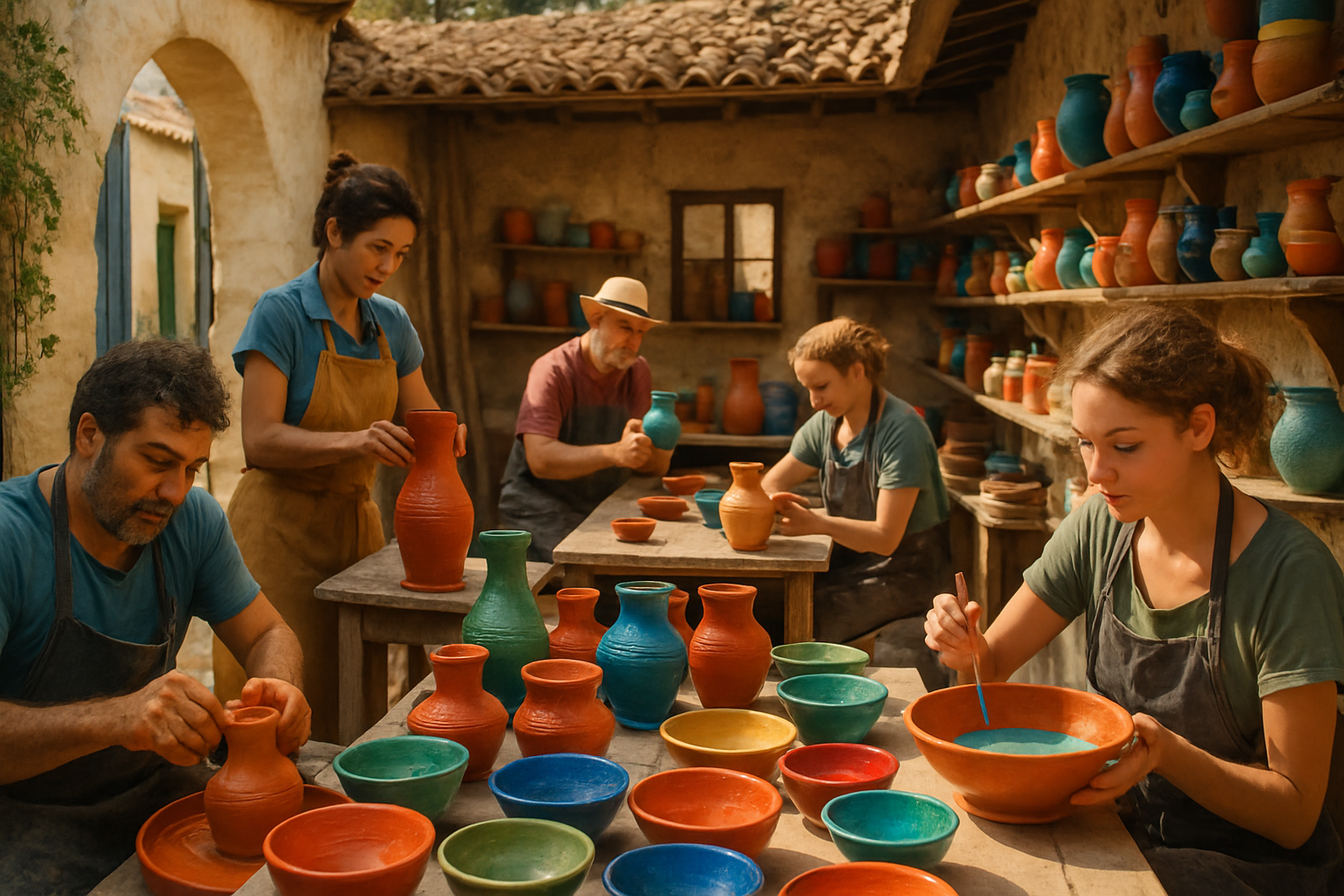
Cyprus has worked red clay since prehistoric times, and two villages kept the craft alive into living memory: Kornos in the Larnaca district and Foini in the Troodos. Both are on the national inventory of intangible cultural heritage kept by the Cyprus National Commission for UNESCO, Kornos since 2016 and Foini since 2017. Here is what each village is known for, what you can still see and where to get your own hands in the clay.
In Kornos, pottery is women's work today. The potters, the mastorisses, sit low with the gyristari, a slow, foot-turned wheel, between their legs and build every pot by hand from pure red clay brought from the Stavrovouni area. The decoration is simple: a few bands combed or pricked into the clay just below the neck, and small birds modelled by hand on the belly. The pots were once fired for ten to twelve hours in domed kilns whose doors were sealed with broken pottery; today they go into gas or electric ovens.
The village made water jugs (kouzes), meat pots, big open cooking pots and pitharia, the large storage jars, and the archaeologist Gloria London records Kornos as an important centre of pithari making as early as 1769. Today's potters also make fruit bowls, vases and small jugs. The best time to watch them at work is the Kornos Red Clay Festival: its 13th edition, on 3 and 4 October 2026 at the village pottery building, had pottery demonstrations, hands-on workshops for children and adults, exhibitions and music. At other times, ring before you go; the Heartland of Legends route lists the Kornos potters' cooperative on +357 99 040121.
Foini lies south of the Troodos peaks, 3 km from Trooditissa monastery and 6 km west of Platres, at the western edge of the wine villages, and it was one of the most important pottery centres on the island. Its pots look much like those of Kornos, but its fame rested on the pitharia. The men who made them, the pitharades, built these huge jars entirely by hand without a wheel, and in summer they often travelled to the wine villages to build them where they would be used. The work was slow and hard, and pithari making stopped in the early 1970s. Foini's craft also spread to the neighbouring villages of Agios Dimitrios and Kaminaria.
Today the women of Foini keep the tradition going with red clay pots made mainly for decoration, and the village has a pottery workshop, set up with the help of its community centre and its emigrants' association. The Pilavakion Museum, the folk museum of local pottery and farm tools that Theophanis Pilavakis set up in a 16th-century house in the village centre, has been closed since his death, according to the village's own website.
The easiest way to try village pottery yourself is the Heartland of Legends programme of the Deputy Ministry of Tourism, which runs free craft workshops in villages from May to November 2026, on Wednesdays, weekends and public holidays. Its October pottery sessions include Yiota Aristeidou in Foini (Antoniou and Evgenias 1, +357 99 136262), Andreas Fasoulides at the primary school in Agioi Vavatsinias (+357 99 539705), Froso Kappa in Foinikaria in the Limassol district (+357 99 872002) and sessions in Askas and Fikardou in the Nicosia district (+357 94 402727). Every session has to be booked with the organiser in advance.
For a wheel class in town, Tochka Ceramics at 44 Konstantinou Palaiologou in Nicosia sells two-hour themed workshops, most of them 40 EUR in October 2026, as well as courses for beginners. Meltemi Creative Areas in Limassol runs weekly ceramics classes from 100 EUR a month, and Lemba Pottery near Paphos offers private wheel lessons from 70 EUR for one person, plus 25 EUR for each extra participant.
If a slower village life appeals, Cyprus Decoded offers relocation help to make the move to Cyprus as smooth as wet clay on the wheel.
