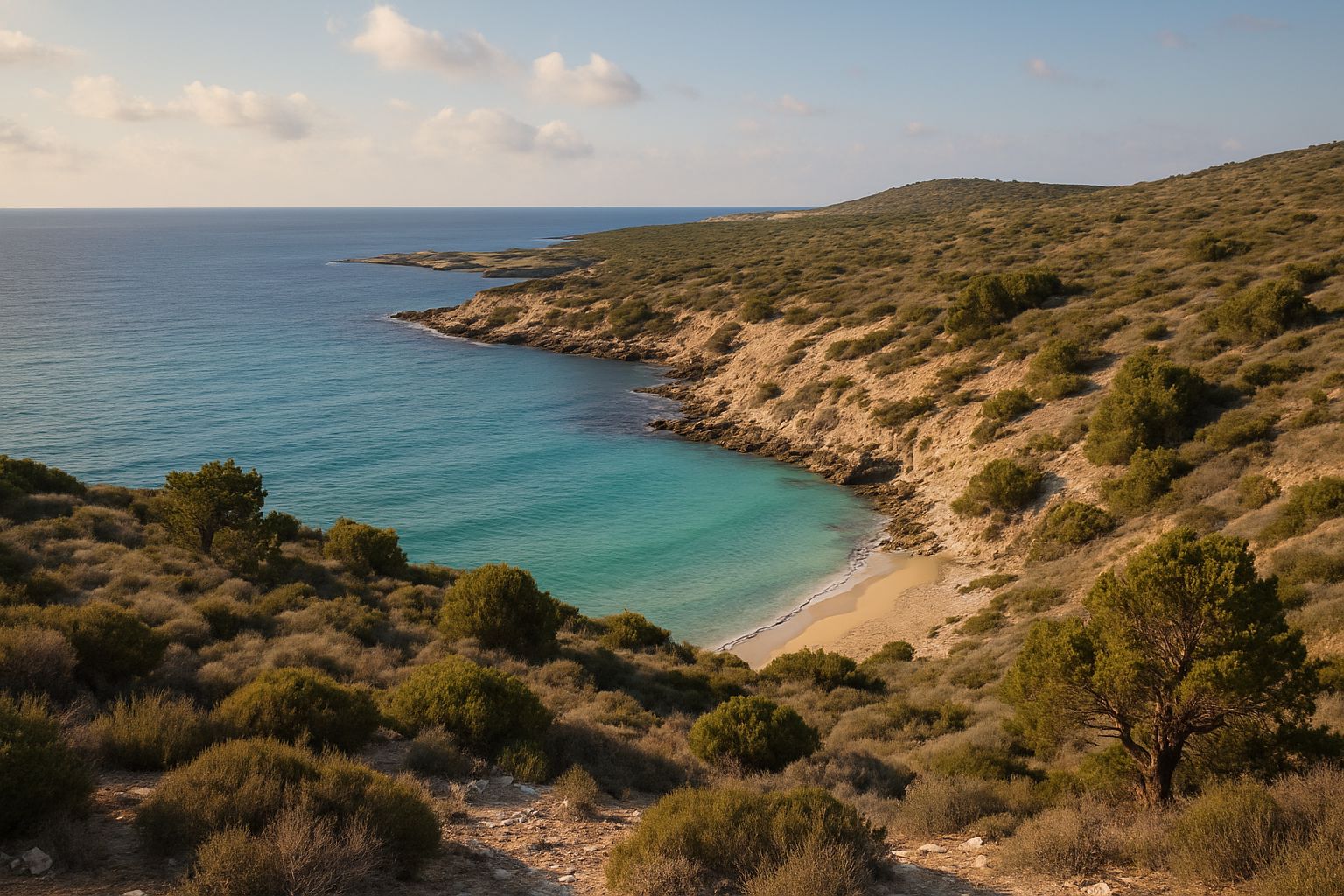
Natura 2000, the EU's network of protected sites, covers 29.5% of the area under the Republic's control: 69 sites on land and at sea. On top of that, the Department of Forests runs 11 national forest parks, from the Paidagogiki Akadimia park in Nicosia (1983) to Akamas (2016), and Larnaca Salt Lake has been the Republic's one wetland on the Ramsar list of wetlands of international importance since 2001. The Department of Environment is also running LIFE-IP PHYSIS, an EU LIFE project of about 17 million EUR from 2019 to 2029, to manage the network.
The largest forest park after Troodos is Akamas, declared on 17 June 2016 over 7,662 hectares of the north-western peninsula. The Department of Forests has recorded about 650 native plants there, 43 of them Cyprus endemics, and two, the knapweed Centaurea akamantis and the tulip Tulipa akamasica, grow nowhere else on the island. In 2026 the park got 16 rangers, on duty since 11 May, and a revised plan that proposes a 741-hectare natural reserve, 12.7% of the forest, where all human activity including hunting would be banned; it is due before the Cabinet in the last quarter of 2026.
Centaurea akamantis survives in three neighbouring gorges, about 800 plants in the 2013 census, and its largest stand, in the Avakas Gorge, has been a plant micro-reserve since 2013. The Avakas Gorge trail itself has been closed by the Department of Forests since 6 December 2025 because of flooding, slippery ground and the risk of rockfall, and no reopening date has been set. In March 2026 the fire service rescued 31 hikers trapped there by rising water, and on 14 October 2026 police freed six more tourists, so do not pass the chain at the entrance. The forest roads from Avakas to Agia Matrona and to Lipati were also closed on 27 January 2026 until further notice.
On the west coast, the beaches of Lara and Toxeftra are where green and loggerhead turtles mainly nest. About 10 km of this coast and the sea out to the 20 m depth line were declared a protected area under the Fisheries Law in 1989, managed by the Department of Fisheries and Marine Research, whose turtle programme, begun at Lara in 1978, was the first in the Mediterranean; since 2022 it has been carried out with the NGO MedTRACS. In June 2026 two females nesting in Lara Bay were fitted with satellite trackers for the first time. From 1 June to 30 September umbrellas, sunbeds and tents are banned and nobody may stay on the beach from an hour before sunset. Driving on the beaches and lighting fires are banned all year, and boats must keep out of the protected sea from 1 May to 31 October.
East of Akamas, the Paphos Forest is home to the Cyprus mouflon, the island's wild sheep: more than 3,000 today, according to the Game and Fauna Service, up from a few dozen in the 1930s. The whole forest was declared a game reserve in 1939, after the hunting law was tightened in 1938. On 9 March 2026 the Department of Forests closed the mouflon enclosures at Stavros tis Psokas and Platania as a precaution against foot-and-mouth disease, and we found no notice that they have reopened, so check with the department before going to see them.
At the other end of the island, Cape Greco National Forest Park, declared on 18 February 1993, covers 384.9 hectares east of Ayia Napa, with about 400 plant species, 14 of them endemic. The 2026 Visit Cyprus hiking map lists four easy trails there, among them the 2 km Aphrodite trail from the park's visitor centre car park, past the Kamara tou Koraka rock arch, and the 4 km walk from the sea caves to the chapel of Agioi Anargyroi. The Environmental Information and Education Centre charges 2 EUR, or 1 EUR for children aged 6 to 12, and opens daily from 10:00 to 18:30 between May and October and on weekdays from 10:00 to 14:30 in winter. In May 2026 the Department of Forests put up a temporary fence at the sea caves to stop cliff diving, and boats are banned from the core of the Ayia Napa Sea Caves marine protected area, where monk seals live, from 1 November to 30 April.
The salt lakes are where the flamingos winter. Larnaca Salt Lake has been protected since 1997, and the Game and Fauna Service says 5,000 to 10,000 flamingos winter on the island's main wetlands in an average year, although numbers have fallen by 14 to 31% since 2013; a 4 km nature trail runs from the lake to the Kamares aqueduct. The larger Akrotiri Salt Lake lies in the British Sovereign Base Area and has been a Ramsar site since 20 March 2003, yet only 30 flamingos were counted there in January 2025, the lowest since surveys began in 1992. BirdLife Cyprus, which has taken part in the international January waterbird count since 1983, lists three birds that breed in Cyprus and nowhere else: the Cyprus wheatear, the Cyprus warbler and the Cyprus scops owl.
A few rules apply in every state forest. Lighting a fire is banned anywhere inside a state forest and within 2 km of its boundary, except at the designated spots in picnic and camping sites, and smoke or flames should be reported on the free number 1407. Bicycles and motorbikes are banned on all nature trails, cutting plants, removing rocks and disturbing wildlife are against forest law, and camping needs a permit from the Department of Forests. Drones need authorisation in restricted zones, and Larnaca Salt Lake lies inside one of the airport's restricted zones. If you are thinking about a move to Cyprus, our relocation help covers the practical side.
