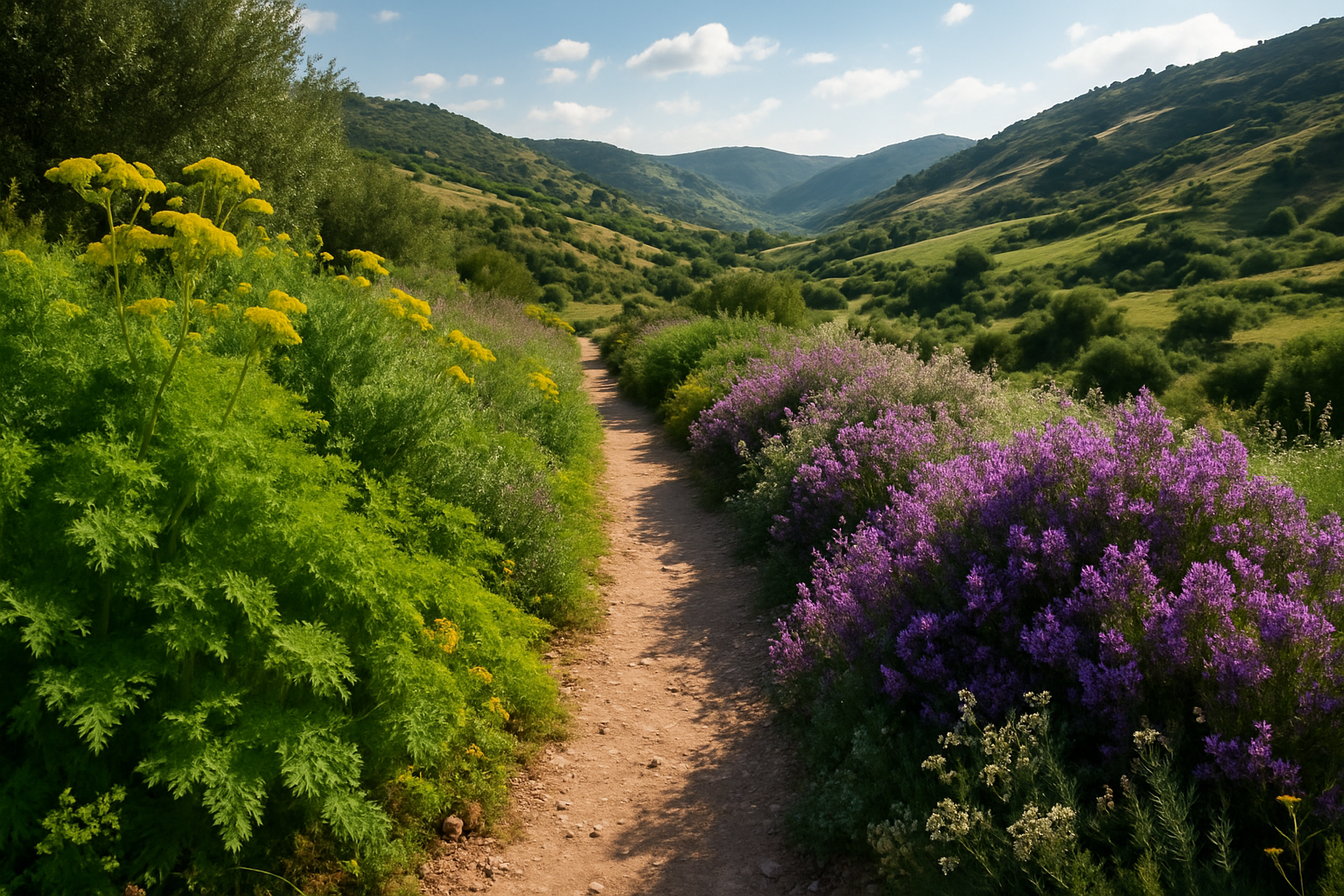
Walk a Cypriot hillside in spring and you often smell the herbs before you see them. An FAO country report counts more than 280 wild aromatic and medicinal plant species in Cyprus, and several have long been gathered from the wild: sage (Salvia fruticosa) for a tea against sore throats and colds, thyme (Thymus capitatus) for cooking, and oregano, which the island also grows as a crop. Here is where to walk among them, and where to see Cypriot herbs labelled, grown and distilled.
In the mountains, start in Troodos National Forest Park. The Department of Forests counts more than 750 plant species there, 72 of them endemic to Cyprus and 12 that grow nowhere but the park, several named after the mountain, such as the catmint Nepeta troodi. Its signed nature trails carry information boards at the main points of interest, and along the main streams wild mint grows among oriental plane, alder, laurel and myrtle. The Department gives April to November as the usual walking season.
For names and labels, go to the Troodos Botanical Garden 'A.G. Leventis', at 1,400 m on the site of the old Amiantos asbestos mine, by the Karvounas to Troodos road and a 20 minute walk from the Troodos Geopark visitor centre. The Department of Forests began it in 2004 with support from the A.G. Leventis Foundation, and it opened in 2010. Its roughly 200 species are set out in sections for endemic plants, riverside vegetation, an arboretum and aromatic and traditional garden plants, and indoors there is a herbarium, with stereoscopes for looking at fresh and dried plants up close. Entry is free; Visit Cyprus lists weekday hours of 09:00 to 14:00 and weekend hours that change with the season, so ring +357 25 550 092 before a weekend visit.
On the Akamas peninsula, the Akamas Botanical Garden lies in the state forest near the Baths of Aphrodite, west of Polis. The Department of Forests began it in 2003 as a miniature of the Akamas, with wide paths through the peninsula's natural habitats; about 120 species have been planted so far, towards a target of more than 250. From the Baths, the circular Aphrodite nature trail (7.5 km, 3 to 4 hours, graded 3, the hardest on the Department's scale) climbs through natural forest of juniper and Calabrian pine past the ruins of Pyrgos tis Rigainas, with views to Cape Arnaoutis, Polis Chrysochous and Paphos Forest.
To see herbs grown, distilled and sold, head to CyHerbia Botanical Park in Avgorou, about 30 minutes by car from Larnaca or Ayia Napa. A family project that opened to the public in June 2012, it has nine themed organic herb gardens, what it bills as the only maze in Cyprus, a woodland planted in the outline of the island and a distillation room where essential oils and hydrolates are extracted; the lavender flowers in June and July. It opens Tuesday to Sunday, 09:00 to 18:00 (last tickets 17:00, closed on Mondays); adults pay 6 euros, children aged 5 to 12 pay 4 euros and under-5s go free, and a cup of herbal tea in the Botanicus Bistro is included. It also runs workshops, from tincture making and tea blending to the wild greens of Cyprus.
Before you go: carry water and keep to the marked paths. Lighting a fire anywhere in or near a forest is against the law in Cyprus, and barbecues are allowed only in the pits at picnic sites. Enjoy the scent, but leave wild plants where they grow.
Walking these fragrant paths offers more than just a pleasant stroll: it's an opportunity to connect with the island in a meaningful way. As the scents of Cyprus remain with you long after you've left, you might find yourself yearning for the simplicity and peace found on these trails. For those considering a more permanent relationship with this aromatic paradise, Cyprus Decoded offers relocation help to guide you through the process of making Cyprus your home.
