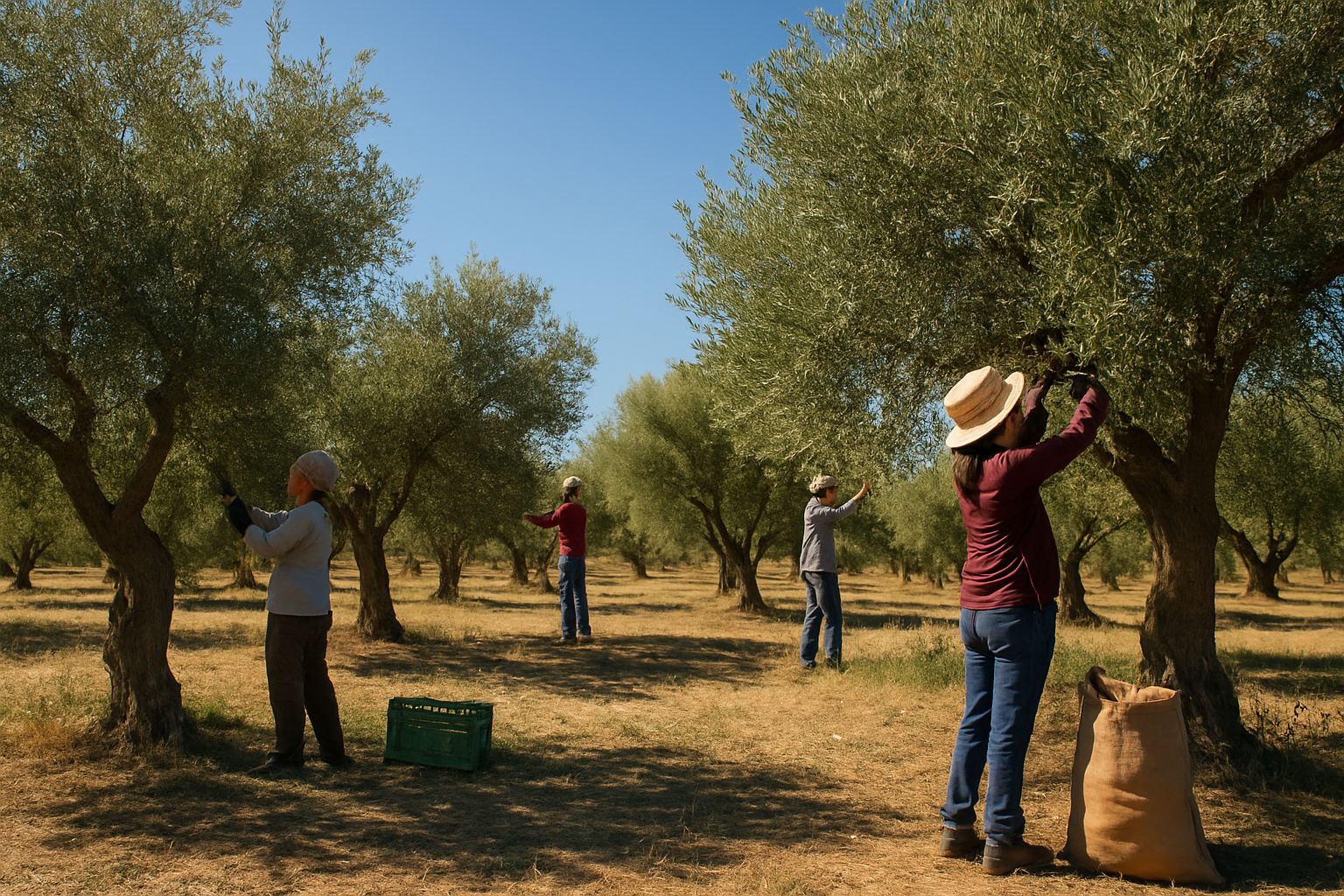
The olive is Cyprus' largest tree crop by area: about 110,000 decares, roughly 11,000 hectares, with a harvest worth about 26 million EUR a year, the agriculture minister said in October 2026. The Department of Agriculture's 2022 olive manual, using 2020 figures, counts olive groves in 412 communities, on 17,670 holdings, with Nicosia and Larnaca districts each holding about 30% of the area. This guide follows the crop from the tree to the bottle; for mills, museums and producers that take visitors, see our olive oil routes guide.
Most Cypriot oil comes from the native Ladoelia, the most widespread variety on the island, grown mainly for oil; the Department of Agriculture ranks it among the most aromatic olive varieties in the world. A study of the 31 olives in the Agricultural Research Institute's collection identified two more Cypriot varieties: Kato Drys, for table olives or both uses, and Korakou, for the table only. Imports came later: the Greek Koroneiki arrived around 1977, Picual has been grown systematically since the mid-1980s, and newer clones for high-density planting include Arbequina i-18, Arbosana i-43 and Koroneiki i-38.
Some trees are far older than any working mill. The Department of Forests protects 115 single trees and 27 groves as Monuments of Nature, and old olives are prominent among them. The Deputy Ministry of Tourism lists a tree of about 800 years at Kyperounta, 8.10 m round the trunk, one of about 700 years at Anglisides with a girth of 10.35 m, another of 700 at Avdimou, and groves of 43 old olives near Anogyra, 28 near Germasogeia and 18 near Pano Lefkara. The department's own register adds trees of about 700 years at Kato Polemidia and Potamiou and of about 600 at Eptagoneia, Filousa Chrysochous and Silikou. The ages are estimates made when each tree was declared: the Anglisides olive was put at 708 years in 2004.
The harvest, the ladia, runs from October to March according to the Deputy Ministry of Tourism. Ladoelia ripens first in the lowlands, from late October to early November, and a month later in the semi-mountainous villages; Koroneiki ripens in November and December and can run into January. When to pick is a choice about the oil. Green olives give a greener, bitter and pungent oil with the most antioxidants and the longest shelf life, but a low yield; olives turning colour give a fruity oil with slight bitterness and a high yield; black olives give sweeter, more golden oils that keep least well, and overripe fruit gives high acidity.
How the olives come down depends on the grove. Picking by hand, combing the branches with the fingers or small combs into nets or containers, is the costliest method and is used mainly for table olives and small trees, but the fruit stays unbruised. Beating the branches with canes or wooden sticks, the old way with small oil olives, also strips leaves and wounds the trees, which raises the risk of olive knot disease. The Department of Agriculture calls portable motorised beaters, used on trees pruned to no more than 4 m, a practical answer for Cyprus, with its small plots and hilly ground. Bigger machines exist: trunk shakers with umbrella catchers, and over-the-row harvesters for super-high-density groves, which need flat land, large areas and special pruning. Picking is the biggest single cost of the crop, 60 to 80% of the total, depending on the method.
Speed matters once the olives are off the tree. The department advises ventilated plastic crates or wooden boxes rather than plastic sacks, and milling without delay: fruit left in big heaps goes mouldy and gives an oil with the defect tasters call fusty, olives attacked by the olive fruit fly give a grubby oil that can soon turn rancid, and fruit gathered off the ground lowers the quality dramatically. It adds that oils from mountain and semi-mountainous groves are more aromatic than lowland ones, and that dry limestone soils give a thinner, more aromatic oil than heavy soils.
Before electric mills, villages crushed their olives in stone. In the old presses, usually built by a church square or in a monastery, a heavy millstone turned in a stone basin, and the paste went into woven baskets, zembilia, stacked under heavy stones or in a press. The Deputy Ministry of Tourism lists restored presses in Lythrodontas, Palaichori, Choirokoitia, Tochni and Kalavasos. In 2026 the Olive Fair in the square at Agios Ioannis, a village in Paphos district, was on Sunday 25 October, with oil extraction shown on a traditional stone mill and a press with zembilia; the Deputy Ministry of Tourism publishes the village festival dates each year, and the 2027 list is not out yet.
The words on the label are regulated. Under EU rules (Regulation 2022/2104), 'first cold pressing' may appear only on virgin or extra virgin oil from a first mechanical pressing of the paste in a traditional system with hydraulic presses, below 27°C, and 'cold extraction' only on oil separated below 27°C by percolation or centrifugation. Extra virgin is a tested grade, not a pressing: free acidity of no more than 0.8%, further chemical limits, and a tasting panel that finds no defect and some fruitiness. At home, the Department of Agriculture advises clean, opaque, airtight containers in a dark, cool place, ideally at 10 to 15°C.
Cyprus makes only a few thousand tonnes of oil a year, and drought has cut that further. International Olive Council figures fall from 4,800 tonnes in 2022/23 to 2,800 tonnes in 2023/24, with 3,800 tonnes for 2024/25. In November 2025 Politis reported that the new crop was barely 20% of a typical year, with extra virgin oil selling for around 7.50 EUR a litre in the shops. There is no EU protected designation for Cypriot olive oil or table olives.
Not every olive becomes oil. Early green olives are cracked with a stone and soaked in brine to make tsakkistes, served with coriander seeds, garlic, olive oil and lemon, while black olives are preserved in salt and kept in large jars to last the year, according to Visit Cyprus. Olives and chopped onion kneaded into bread dough make eliopittes, eaten mainly in the fasting periods, as the Cyprus Food Museum records. The tree runs through religious life too: in Cyprus Palm Sunday is Olive Sunday, when olive branches are taken to church and the blessed leaves later burned as incense against evil spirits, and church lamps burn olive oil because it leaves no soot on icons and wall paintings. Two olive branches frame the island on the flag of the Republic.
If you are weighing a move to Cyprus, Cyprus Decoded offers relocation help to make settling in straightforward.
