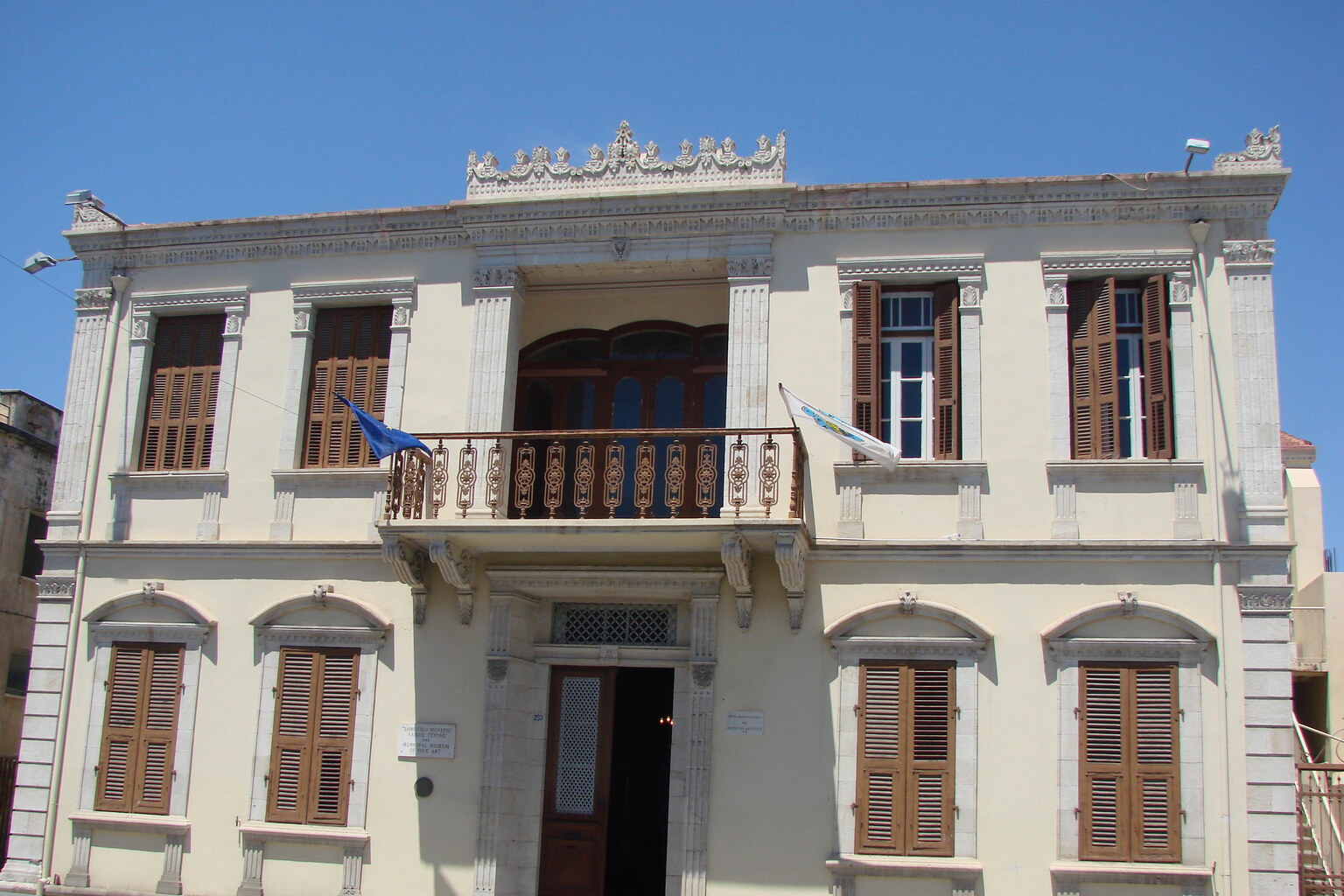
Two old town houses, one in Paphos and one in Limassol, hold museums of Cypriot folk art a short walk from the centre. In Paphos it is the Ethnographic Museum, the private collection of the archaeologist and teacher George Eliades, which he opened to the public in the summer of 1958 in the family house. In Limassol it is the Municipal Museum of Folk Art, which the Municipality of Limassol opened on 20 June 1985 in a listed house of the early 1920s on Agiou Andreou Street. Two folk museums run by the Department of Antiquities, at Fikardou and Geroskipou, are in our earlier folk museums post.
Paphos: the Ethnographic Museum and the Eliades family
George S. Eliades was born in Paphos on 14 December 1912 and died on 3 February 2007, according to his family. He studied at the University of Athens, taught at the high school in Paphos, took part in excavations in and around Paphos and served as honorary curator of the Paphos District Archaeological Museum; his books include a 1979 guide to the House of Dionysos, the Roman villa in Kato Paphos known for its mosaics. He began collecting in 1939, and the family's own site says the collection had been gathered over a period of twenty years when he opened it to the public in the summer of 1958. His daughter, Fryni, wrote in 2014 that it was renamed the Ethnographic Museum in 1972.
The house, at 1 Exo Vrisis Street, which the museum places at the heart of the old town of Paphos, is a two-storey stone building completed in 1894, with three large arches on its front that the tourism boards describe as Gothic in style. According to the family, two merchant brothers, Efthyvoulos and Evryviadis Ioannou Antoniades, the father and uncle of Eliades' wife, Chryso, designed and built it, and the iron gate and railings, which carry the initials E.I.A. and the year 1902, were added eight years later. In 2014 Chryso and their daughter, Fryni, were running the museum between them; Chryso died in July 2021, and the museum's website still calls the house the family's home.
Inside, whole rooms are set out as they were: a country kitchen with the housewife's tools, a bedroom with an old brass bed and lace covers, a barber's shop, a large wardrobe of traditional and ceremonial costume, and a room of old tools and of the looms that wove village rugs and cloth. Around them are carved wooden dowry chests, rural costume and trimmings, farming tools, kitchen utensils, clay pots, woven pieces and hand-made silver, with archaeological pieces from his collection: prehistoric tools, pots and oil lamps of the Geometric and Roman periods, coins and glass. The museum also shows a head of Apollo that it dates to the 5th century BC and a mirror it describes as an Empire piece from Napoleon's time. Upstairs, his daughter wrote in 2014, one room held Eliades' own large library.
The courtyard garden holds a tomb that the museum dates to the end of the 3rd century BC, in the Hellenistic period, with a small chapel beside it; Visit Pafos, the Paphos tourism board, describes a Hellenistic rock-cut tomb, natural caves and a terebinth tree in the grounds. Look out too for the wood-fired stone oven in the yard; in 2014 Fryni also described an olive mill and big storage jars in the courtyard. Visit Pafos says the museum can also host civil and religious weddings, in collaboration with the Anglican Church; our weddings page lists other venues across the island.
Visiting the Paphos museum
Visit Pafos's museum page, updated in February 2026, gives the hours as Monday to Saturday 10:00 to 17:00 and Sunday 11:00 to 13:00, closed on public holidays, and the ticket as 5 euros for adults, free for children and 3 euros each for groups of six or more. Other listings disagree: Visit Pafos's own list of museums, updated in July 2026, gives 2.56 euros; the CultureSpot museum directory, in its last archived copy of March 2026, gave 3 euros and kept the museum open until 18:00 from Monday to Saturday in summer; and Visit Cyprus, on a page first published in 2015, still gives Sunday as 10:00 to 14:00 and the ticket as 3 euros. So ring the museum on +357 26 944 833 to check the price and before a Sunday or late visit. Visit Pafos calls the museum wheelchair accessible on its museum page and partly accessible on its list of museums, and the two floors are linked by stairs, so ask before you go if you use a wheelchair.
Exo Vrisis Street is about 5 minutes' walk (350 m) from Kennedy Square and about 10 minutes (730 m) from the Karavella bus station, and Agios Theodoros Cathedral is about 3 minutes away. The nearest bus stop, C.T.O. Offices, about 300 m from the door, is on route 618 from Karavella towards the Tombs of the Kings, with buses mostly every 15 minutes on weekdays but a gap of about an hour in the late morning; buses back towards Karavella stop on Apostolou Pavlou Avenue. A single ticket on the Paphos buses costs 2 euros. The free Thursday walking tour of Paphos that Visit Cyprus lists passes the museum: it meets at the Market bus stop at 09:15, takes about two and a half hours and must be booked at least 24 hours ahead (+357 26 811 500 or +357 26 932 841). Visit Cyprus gives March to April and October to December, except public holidays; the Pafos Regional Board of Tourism announced the 2026 walks for October and November. The church of Agios Kendeas, the Ottoman baths and the Municipal Market are all within about 10 minutes on foot, and the Paphos District Archaeological Museum on Griva Digeni Avenue is about 13 minutes away. The Holy Metropolis of Paphos has moved its Byzantine Museum to Geroskipou and renamed it the Ecclesiastical Museum, which opened in 2017; the Metropolis's own page says it is now closed for conservation works.
Limassol: the Municipal Museum of Folk Art
Limassol's museum fills the ground floor of a listed two-storey house on the corner of Agiou Andreou and Othonos kai Amalias streets in the old town. A Cyprus Institute record of the building dates it to the early 1920s, when each floor was a separate home, and describes elaborate facades with many decorative stone elements imitating neoclassical public buildings, and a loggia at the centre of the front on Agiou Andreou. Ioannis Schizas bought it and in 1958 gave it to the municipality, which used it as an old people's home, and the municipality names the gift as that of the Ioannis and Katerina Schiza family. It was restored and converted in 1984 and 1985, and the museum opened on 20 June 1985. The municipality won a Europa Nostra award for 1988 for restoring the building and turning it into a museum, and the municipality also singles out the care taken over the display.
The municipality calls it one of the most important collections of Cypriot folk art and craft from the late 19th to the early 20th century: dress, embroidery, woodcarving, farm tools and utensils, jewellery, ornaments and furniture. The rooms follow themes: a draw loom and weaving; the waistcoat collection, which the municipality calls one of the most beautiful in the Greek world; town dress and town decoration, village dress and village decoration; the dowry, with white embroidery, lace and jewellery; the bedroom; and farming life and its tools. Among the objects it lists are carved chests, pictures made with silk cocoons, baskets, swords, bronze pots, a spinning wheel, a flute, reaping hooks and wooden mirrors. One hall shows 30 porcelain plates in Greek, European and Chinese styles given by Anna F. Kourea, some of them dated 1725. Visit Cyprus counts over 500 exhibits in six rooms, and the municipality's Greek page offers a 3D virtual tour of the museum.
Visiting the Limassol museum
The museum opens on weekdays only. The Municipality of Limassol, which runs it, gives Monday to Friday 07:45 to 14:45, while Visit Cyprus and the CultureSpot museum directory give slightly different times (08:30 to 15:00, and 08:15 to 14:30 in March 2026), so plan on 08:30 to 14:30, which all three cover, or ring +357 25 362 303. It is closed at weekends and, according to Visit Cyprus and CultureSpot, on public holidays. Both give the ticket as 2 euros.
Agiou Andreou 253 is about 11 minutes' walk from the nearest corner of the Municipal Garden and about 15 minutes from Limassol Castle; our Limassol Castle post describes the walk between the castle and the garden. By bus, route 30, between My Mall and the Parklane hotel, stops 300 to 400 m away on Christodoulou Chatzipavlou, at the Zinas Kanther stop heading east and the Mistral Hotel stop heading west, about every 10 minutes on weekdays. Since 5 November 2026 a single ticket on the Limassol buses costs 2.50 euros, or 2.00 euros paid from a Motion card's e-wallet.
Two museums, two old towns
The two museums are 69 km apart by road, about an hour by car, so they suit separate days: the Paphos museum opens every day except public holidays, though Visit Pafos gives only two hours on Sundays, and the Limassol one on weekdays only, until the early afternoon. For the Cyprus Folk Art Museum in Nicosia, see our old Nicosia museums post. If a morning among dowry chests and old looms turns into thoughts of a longer stay, our relocation help can take the paperwork off your hands.
