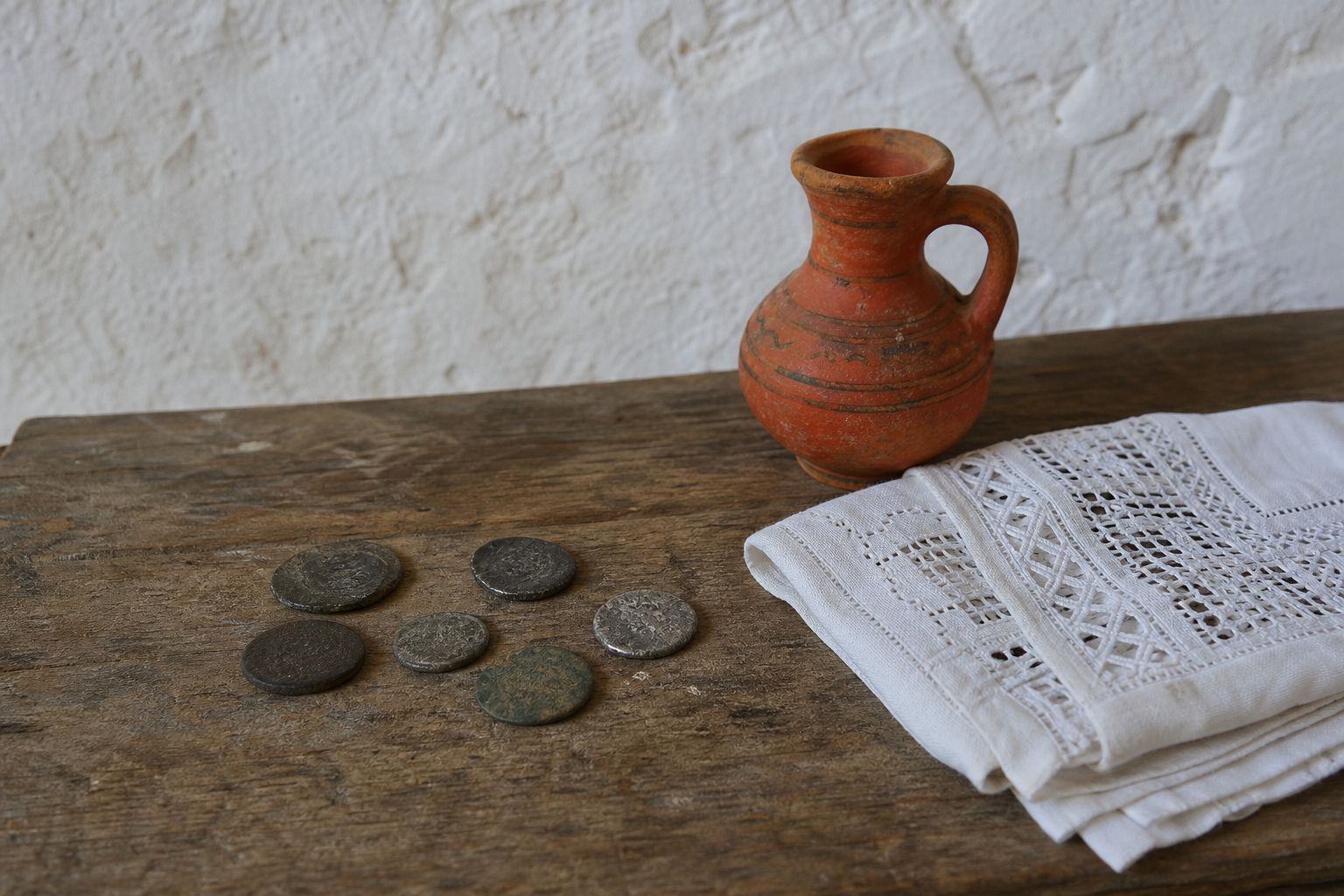
Three of old Nicosia's museums sit a short walk apart inside the Venetian walls. The Cyprus Folk Art Museum and the Byzantine Museum of the Archbishop Makarios III Foundation stand about 50 m apart on Archbishop Kyprianos Square, beside St John's Cathedral, and the Bank of Cyprus Cultural Foundation, home of the Museum of the History of Cypriot Coinage, is about 650 m away near Phaneromeni Church, a walk of 8 or 9 minutes. Between them they run from village weaving and woodcarving to Byzantine icons and some 2,500 years of Cypriot coins. One correction to older guides first: the Makarios III Foundation's picture gallery, which Visit Cyprus still lists as its Art Galleries with weekday hours and a 4 EUR ticket, is closed for renovation, with no reopening date.
The Cyprus Folk Art Museum, in the Old Archbishopric
Members of the Society of Cypriot Studies founded the Cyprus Folk Art Museum in 1937; Visit Cyprus lists it as the Ethnographic Museum of Cyprus. Archbishop Makarios III opened its first small display in the old Archbishopric in 1950, and when the archbishops moved to their new palace in 1961, the Society was given the whole building. The Society describes it as a 15th-century Gothic building with later additions, on ground that Benedictine monks used as a monastery in the early 13th century. Inside, a Gothic arch carries a 16th-century fresco of the Annunciation, uncovered in 1950 and conserved in 1995.
The collection runs to more than 5,000 catalogued items: weaving, embroidery, lace, costumes, pottery, metalwork, woodcarving, basketry, leatherwork, naive painting and the tools of farming and weaving. Look for the 19th-century door from a church of St Mamas with its little owl: George Seferis opened his poem "Details on Cyprus" (Λεπτομέρειες στην Κύπρο, in his Logbook III) with the little owl perched on the latch of St Mamas, and dedicated it to the painter Adamantios Diamantis, the museum's first director. Upstairs are rooms on the island's silk industry, opened in June 1999, and the room Archbishop Kyprianos used, which is known by his name.
Its hours are hard to pin down. The museum's own pages give Monday 10:00 to 14:00, Tuesday to Friday 09:00 (09:30 on its English page) to 16:00 and Saturday 09:00 to 13:00, closed on Sundays and public holidays; tourism pages give other times, and the museum's website was returning an error when we checked on 30 October 2026. We found no closure notice, but ring 22 432578 before you go. Entry is 2 EUR for adults, according to Visit Cyprus and the Nicosia Tourism Board, and Visit Cyprus gives 1 EUR for students.
The Byzantine Museum of the Archbishop Makarios III Foundation
Across the square, in the Foundation's Cultural Centre in the courtyard of St John's Cathedral, the Byzantine Museum reopened on Tuesday 18 March 2025 after five years of renovation. The displays now run in date order from the 4th to the 18th century, with themed sections on subjects of icon painting and on named painters; the labels are detailed, and QR codes and screens carry more. The best known pieces are fragments of the 6th-century apse mosaic of the Panagia Kanakaria church at Lythrangomi, in the occupied north, which were stripped from the church in the late 1970s; four of them came back after a 1989 court ruling in Indianapolis. The frescoes of Agios Efimianos at Lysi are on show too, and the collection holds wall-painting fragments from Christ Antiphonitis at Kalograia, some of them returned from Munich in November 2013.
Screens let you explore the churches inside Nicosia's walls, the island's UNESCO monuments and the churches the returned treasures came from; VR headsets take you round the old Cathedral of St John and the world of the Holy Eucharist, and 3D holograms show the most important treasures. There is a gift shop at the entrance and a place to leave your bags.
The museum opens Tuesday to Saturday, 09:30 to 17:00, and is closed on Sundays and Mondays; Visit Cyprus adds that it closes on public holidays. Tickets cost 7 EUR, or 4 EUR each for groups of more than 10. Visit Cyprus also lists reduced tickets for under-18s and over-65s, and free entry for groups of children and students, soldiers in uniform, ICOM and ICOMOS card holders and journalists; the Foundation's own pages do not mention these, so ask at the desk. Phone 22 430008 (the Foundation's office is open Monday to Friday, 07:30 to 14:30) or email [email protected].
The Foundation's picture gallery, in the same building, stays shut. It holds four collections: Western European painting from the 15th to the 19th century, bought by Makarios III in 1963 from Nikos Dikaios, Cyprus's consul in Lyon, including works the Foundation attributes to Poussin, Claude Lorrain and Delacroix; Greece in the 18th and 19th centuries, with the revolution of 1821 at its heart; Greek painting of the 19th and 20th centuries; and Cypriot painting from the 20th century to today. It closed with the Byzantine Museum in 2020, did not reopen with it in March 2025, and the Foundation lists it as closed for renovation, with no date.
The Museum of the History of Cypriot Coinage
From Archbishop Kyprianos Square it is 600 to 650 m on foot, 8 or 9 minutes, to the Bank of Cyprus Cultural Foundation at 86 to 90 Phaneromenis Street; the Department of Antiquities gives the main entrance as Lykourgou Street, and the Nicosia municipality says the building is the bank's old administrative building of 1936. The coin museum on the ground floor opened in 1995, and the Foundation calls it the only one of its kind in Cyprus. More than 500 coins in 23 showcases follow nine periods, from the city-kingdoms of the 6th to 4th centuries BC through the Hellenistic, Roman, Byzantine, Lusignan, Venetian, Ottoman and British periods to the Republic of Cyprus today, with labels in Greek and English.
On show are silver sigloi struck around 530 to 500 BC at Salamis, the ancient city-kingdom on the east coast that now lies in the occupied north, in the time of King Evelthon or his successors. The collection began with a small group of coins from the bank, among them a Roman bronze inscribed KOINON KYPRION, "League of the Cypriots", which has been the Bank of Cyprus logo since 1963. It also holds electrum bezants of the first Lusignan rulers, among them one of Guy de Lusignan (1192 to 1194); copper coins of Marcantonio Bragadin, the last Venetian commander, which the museum's curator calls the last coins struck by a Cypriot mint; and the silver 45-piastre piece of 1928 that marked 50 years of British rule. Since November 2025 the Foundation has had Tefkros, the island's first museum guide powered by artificial intelligence, for this museum, but it works only at sessions on announced dates, so do not count on meeting it.
On the mezzanine of the same building is the Museum of the George and Nefeli Giabra Pierides Collection: more than 600 objects from the Early Bronze Age, about 2500 BC, to the 16th century, including Mycenaean pottery, limestone sculpture, clay figurines, seals, jewellery, coins and copper objects. Solon Triantafyllides, then chairman of the Bank of Cyprus Group, and his wife Clio gave the Foundation her parents' collection in 1999, and the museum opened in 2002. Its SPYRA screen lets you set a replica potsherd or limestone fragment on a reader and see the whole object rebuilt on a big screen.
The coin museum and the Pierides collection both open every day from 10:00 to 19:00, according to the Foundation's own pages and floor plans (an older municipality page still says 17:00). Entry is free according to Visit Cyprus and the Nicosia Tourism Board; the Foundation's own pages do not mention a fee. Visit Cyprus says both close on public holidays, while the Foundation says Monday to Sunday, so ring 22 128157 before a holiday visit. The municipality and Visit Cyprus say the building has facilities for disabled visitors.
Walking between them, buses and parking
Start on Archbishop Kyprianos Square: the Folk Art Museum and the Byzantine Museum are 50 m apart, under a minute's walk. Solomos Square bus station is about 14 minutes' walk from Archbishop Kyprianos Square and about 7 minutes from the Cultural Foundation. These walking times are our own calculations on OpenStreetMap walking routes. Among the Nicosia municipality's car parks, the Pentadaktylou car park (54 spaces) is about 2 minutes from Archbishop Kyprianos Square, and the Faneromeni underground car park (123 spaces) about 4 minutes from the Cultural Foundation; the municipality's pages give their capacities but not their prices.
Tuesday to Saturday is when all three are open. The Folk Art Museum keeps the shortest hours, closing at 13:00 on Saturdays, so go there first, cross the square to the Byzantine Museum, and finish at the Cultural Foundation, which stays open until 19:00. Expect the Folk Art Museum and the Byzantine Museum to close over the coming holidays, on 24, 25 and 26 December 2026 and on 1 and 6 January 2027, all days on which they would otherwise open.
The square has more: the Pancyprian Gymnasium's free museums, covered in our guide to the Pancyprian Gymnasium museums, St John's Cathedral and the National Struggle Museum opposite the school. For more museums and their hours, see our historic sites page, and if a day in old Nicosia has you thinking about living here, our relocation help is ready when you are.
