The Pancyprian Gymnasium Museums fill twelve rooms of their own building on the corner of Agiou Ioannou and Theseos streets, inside the walls of old Nicosia and right next to the Pancyprian Gymnasium, the oldest secondary school in Cyprus. Entry is free. The collections moved into this building in 2007: the Nicosia board of Greek schools and the school's head teachers and teachers found them a home, and the Anastasios G. Leventis Foundation supported the move and still supports their conservation. The school itself is still at work next door, where it houses a lyceum, an all-day gymnasium and the Music Gymnasium and Lyceum.
What is in the twelve rooms
Besides the School History Collection, the museums list an archaeological collection, a numismatic (coin) collection and collections of old maps and old weapons, the maps and weapons mostly Cypriot in character. There is also a picture gallery of works by Cypriot painters who taught or studied at the school, and a natural history collection. The piece the museums single out is the Blessing Christ, a full-length relief of Gothic art that they call unique in Cyprus.
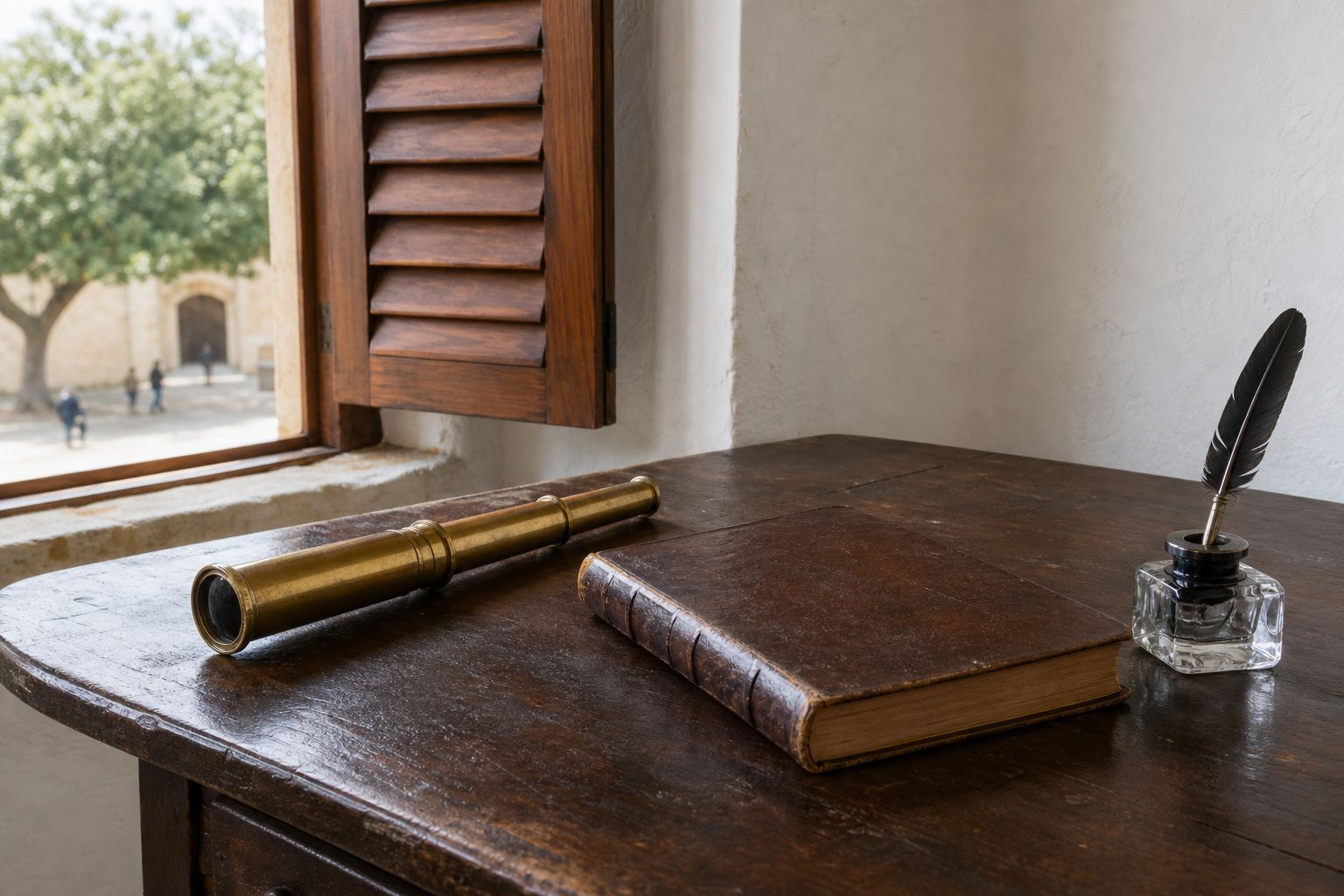
The school's own photographs of the rooms show school uniforms on mannequins, enlarged class photographs, a teacher's desk, glass cases of scientific instruments from a brass telescope and an armillary sphere to a cine projector, an anatomical skeleton, and a case of theatre costumes about drama at the school. The rooms are small, with white walls and timber ceilings, and the panels are in Greek and English.
From the Ellinomouseion to Kyprianos's Hellenic School
The school counts as its forerunner the Ellinomouseion, a Greek school that Archbishop Philotheos founded in Nicosia in 1741. Kyprianos, born in Strovolos in 1756, studied there from 1768 to 1771. In 1808, according to a record in the Archbishopric's codex, the monk Ioannikios gave his house to create a school. As archbishop, Kyprianos founded the Hellenic School with a founding act dated 1 January 1812, which survives complete with his signature; he dedicated the school to the Holy Trinity, and its first teacher was Leontios Myrianthefs. After the persecutions of 1821, in which Kyprianos was hanged on 9 July, the school was dissolved. Archbishop Panaretos founded it again in 1830, with Onoufrios Mikellidis at its head; English joined the lessons in 1887 and Latin in 1892.
1893: a full gymnasium, named Pancyprian in 1896
Archbishop Sophronios III played the decisive part in turning the Hellenic School into a gymnasium. Its founding act of 16 May 1893, signed by the abbot of Kykkos, 17 citizens and, last of all, the archbishop in red cinnabar ink, set up "a gymnasium like those in Greece". The school became a six-class gymnasium, recognised by the Greek government as equal to Greek secondary schools, and was inaugurated on 12 December 1893 under its first head teacher, Ioannis Dellios from Serres, who led it until 1896. In 1896 it was renamed the Pancyprian Gymnasium. From the 1890s until 1935 a teacher-training course, the Pancyprian Didaskaleion, ran alongside it, and in the Greco-Turkish war of 1897, 15 of its pupils volunteered for the Greek army.
Fire, a tobacco manufacturer's gift and the Severeios Library
On 25 October 1920 a fire destroyed the whole school, its first library included. Ioannis Vergopoulos, a tobacco manufacturer from Volos in Greece, then paid for a new building: on 27 October 1921 he took on the whole cost of five classrooms, a staff room and a columned entrance, and on 24 January 1922 he added four more classrooms, 5,000 pounds in all, the Great Cyprus Encyclopaedia records. That central wing still stands, with four Ionic columns under a pediment: the band above the columns spells out the school's name in Greek capitals, and the wall behind them carries the Greek words for Vergopoulos Wing.
The Severeios Library, in the south wing of the school complex, is named after Demosthenis Severis, a former pupil who gave large sums for the building and its equipment and chaired the Bank of Cyprus from 1926 to 1955. Designed by the architectural office of the Brothers M. Michaelides, it was inaugurated on 13 March 1949 with 13,000 volumes, and its collections include old printed books, manuscripts, codices and maps. In 2021 the head teacher put its holdings at more than 80,000 titles, among them a handbook printed in 1570. On 27 January 1956 pupils clashed with British security forces at the library, a day the school remembers as the battle of the Severeios Library; the British authorities closed the school, which opened again in September 1956. Readers can use the library from Monday to Friday, 08:30 to 14:30 (phone 22 466718).
The Crypt of the Filikoi
Under the school is a barrel-vaulted stone chamber that, the school says, the Benedictine monks of a Frankish monastery on the site built about six centuries ago, probably as a cistern or a wine cellar. Tradition links it with the Philiki Etaireia, the secret society that prepared the Greek revolution of 1821: Kyprianos is said to have lodged its envoys at the school rather than at the Archbishopric, so that they would not be suspected. The memoir the school quotes, Georgios Kipiadis's account printed in Alexandria in 1888, speaks only of "a room of the adjacent Hellenic School". A marble plaque set up on 9 July 1954 by the Hellenic Intellectual Club of Cyprus, and unveiled by Archbishop Makarios III, records that hospitality, and the school calls the chamber, known as the Crypt of the Filikoi, its most sacred place. It lies inside a working school, so ask at the museums whether it can be seen.
Famous pupils
Makarios III, later archbishop and the first president of the Republic of Cyprus, enrolled in the school's fourth class in 1933, at the age of 20, and graduated in 1936. Christopher Pissarides, born in Nicosia on 20 February 1948, shared the 2010 Sveriges Riksbank Prize in Economic Sciences, the economics Nobel, with Peter Diamond and Dale Mortensen, and his Nobel autobiography reproduces his leaving certificate from the Pancyprian Gymnasium. Demosthenis Severis, the library's benefactor, was a pupil here too.
Visiting, getting there and what is next door
The museums open on Monday, Tuesday, Thursday and Friday from 09:00 to 15:30, on Wednesday from 09:00 to 17:00 and on Saturday from 09:00 to 13:00. They close on Sundays and public holidays, and entry is free. Hours can change, so check before you go: phone +357 22 466014 or email [email protected]. The entrance is on Theseos Street: walk to the end of Agiou Ioannou Street and turn right.
On foot it is about 14 minutes from the south end of Ledra Street and 16 to 17 minutes from Solomos Square or Eleftheria Square. The NPT bus L1, a loop from Solomos Square, stops at Ermou, a 3-minute walk away, every 30 to 60 minutes from 05:45 to 21:15 every day; check the current timetable before you travel. Drivers can use the Pentadaktylou municipal car park (54 spaces), a 2-minute walk away, and coaches drop groups at the Liberty Monument on the Podocataro bastion, an easy walk of about 6 minutes.
Several sights share the square. The old Cathedral of St John the Theologian, 2 minutes away, is free and opens Monday to Friday from 09:00 to 15:00 and Saturday from 09:00 to 12:00; the four large icons on its iconostasis were painted by the Cretan master Ioannis Kornaros in 1795 and 1797. The National Struggle Museum opposite the school is free and opens on weekdays from 08:00 to 14:30. The Cyprus Folk Art Museum in the old Archbishop's Palace charges about 2 EUR; ring 22 432578 to check its hours before you go. The Byzantine Museum of the Archbishop Makarios III Foundation, 3 minutes away, reopened on 18 March 2025 after five years of renovation and opens Tuesday to Saturday from 09:30 to 17:00, at 7 EUR. Most of them close on public holidays. For another small museum inside the walls, see our guide to the Cyprus Postal Museum, and if Nicosia has you thinking about a longer stay, our relocation help is here when you need it.
