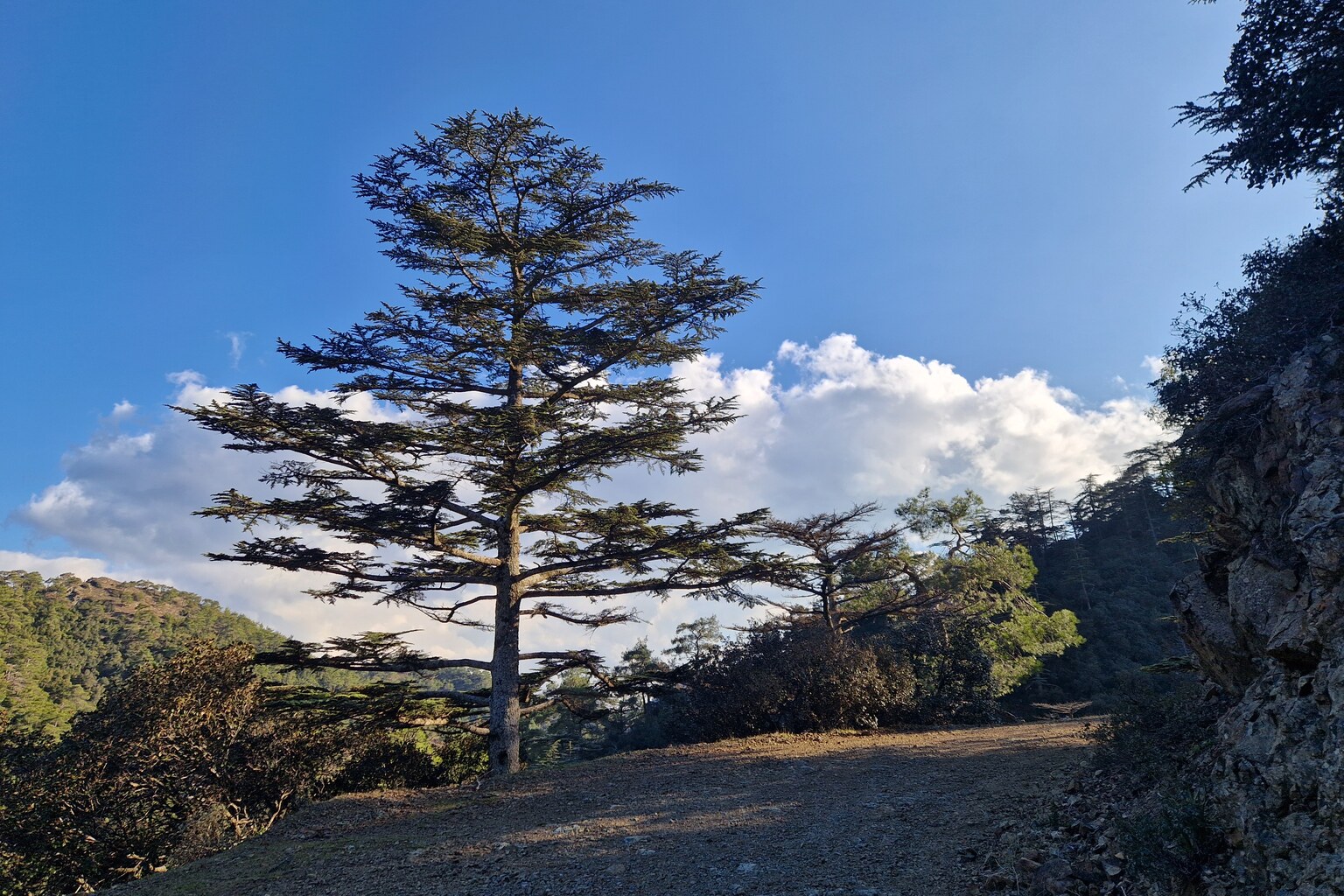
Cedar Valley (Κοιλάδα των Κέδρων) is a high, wooded valley in the Paphos Forest, on the western slopes of the Troodos range, and the place to see the island's own tree, the Cyprus cedar, growing wild. The Department of Forests puts the whole population at about 50,000 trees, from young plants to centuries-old ones, found mainly here and on the top of Tripylos, the peak above the valley. Although the valley lies in the Paphos Forest, the car park, at about 1,140 m, is in Nicosia district. It is a long, winding drive from anywhere: about an hour and twenty minutes from Paphos without stops.
The Cyprus cedar
The Cyprus cedar, Cedrus brevifolia, is what Visit Cyprus calls a close relative of the famous cedars of Lebanon, and the IUCN Red List treats it as a variety of the Lebanon cedar, Cedrus libani. Its name refers to its unusually short needles, which the Gymnosperm Database describes as shorter than those of any other cedar. It grows wild nowhere else: the Department of Forests' management plan for the Paphos Forest calls the stands around Tripylos and Cedar Valley the only natural stands of the Cyprus cedar, pure or mixed with golden oak and Calabrian pine, and the Royal Botanic Garden Edinburgh's threatened conifers project describes the species as restricted to the Tripylos area, in five natural stands. It has also been planted, for example on terraces around Tripylos after the fires of 1974 and in the Troodos Botanical Garden at Amiantos.
The Department of Forests' Thomas Kyriacou said in December 2025, as reported by the Cyprus Mail, that the cedar covers no more than 300 hectares in all, of which only 100 are pure cedar forest; elsewhere it grows among pines and other trees. The Royal Botanic Garden Edinburgh's summary counts about 16,000 mature trees at Tripylos alone. The cedar is listed as Vulnerable on the IUCN Red List, last assessed in 2010, and in the Red Data Book of the Flora of Cyprus.
Fire is the biggest threat. "The limited spread of cedar means that an extensive fire could cause irreparable damage," Kyriacou said, which is why a permanent fire lookout station operates on the top of Tripylos. He also named competition from the faster-growing Calabrian pine, droughts and extreme temperatures that make it hard for the trees to regenerate naturally, and low genetic diversity. The cedar's dense, fragrant wood was once used in Cyprus for woodcarving and church art, including icons and iconostases; today the species is strictly protected.
The area has been protected for more than four decades. In 1984, 823 hectares around Tripylos and Cedar Valley were declared a protected area for flora and fauna, the management plan records, and the valley lies within Natura 2000 site CY2000008, which takes in Cedar Valley and the Kampos area. Forests of Cyprus cedar are one of the EU's priority habitat types.
The walk up Tripylos
Tripylos, the highest point of the Paphos Forest, rises to about 1,360 m (the management plan gives 1,352 m, maps 1,362 m), roughly 220 m above the car park. An official nature trail climbs to the summit through the cedars and pines; Visit Cyprus's 2024 map of the Troodos area lists it simply as Tripylos. We found no current official length or grade for it: hiking guides give about 2.5 km each way, and the path drawn on OpenStreetMap is closer to 3 km. At a steady pace, allow about an hour up and a little less to come down.
On the summit stands the Department of Forests' fire lookout station, and Visit Cyprus suggests the peak as a stop for its panoramic view of the Paphos Forest. The same Visit Cyprus map names two other trails that start from Tripylos, one to Selladhi tou Livadiou and Selladhi tou Staktou and one to Selladhi tou Stavrou, but gives no lengths, so carry a detailed map if you plan to go further.
Mouflon
The Paphos Forest is also the main home of the Cyprus mouflon, the island's wild sheep, and the management plan says it may be seen in the Tripylos and Cedar Valley area, along with hares, foxes and partridges; a sighting is a matter of luck. In December 2025 the Department of Forests released 18 mouflon into the wild from Stavros tis Psokas, its forest station 16.5 km away by road, ten of them fitted with satellite transmitters. The enclosures where visitors could see mouflon up close, at Stavros tis Psokas and Platania, have been closed since 9 March 2026 as a precaution against foot-and-mouth disease, and we found no notice of a reopening as of 12 November 2026. Our nature reserves post has more on the mouflon and how its numbers recovered.
Getting there
There is no bus to the valley. The nearest stops are at Tsakistra and Kykkos Monastery, on route 82 of the Nicosia district buses, which runs twice a day in each direction from Monday to Saturday, but Tsakistra is 14.7 km from the car park by road and Kykkos 16 km; on the Paphos side, the nearest stops are at Panagia and Asprogia, about 9 km away as the crow flies. In practice you need a car.
From Paphos the quickest road climbs to Panagia, about 35 km and 45 minutes from the town centre, then follows the forest road towards Kykkos Monastery, which Visit Cyprus's route guide describes as asphalted, with many turns. About 15 km after Panagia, a right turn, signposted for Cedar Valley according to the same guide, leads the last 4 km to the valley. In all it is about 54 km, an hour and twenty minutes without stops by OSRM's routing estimate; expect it to take longer.
From Limassol the quickest route, about 104 km and two hours, also goes up through Panagia; from Nicosia it is about 103 km and two hours, through the mountains via Pedoulas and Kykkos. Kykkos Monastery is 16 km from the valley, about half an hour, and Polis about 52 km, an hour and a quarter. On OpenStreetMap no stretch of these routes is marked as unpaved, and no official source we read says you need a four-wheel drive; of the approaches we checked, only the one from Pomos in the north includes gravel, about 6 km of it. OpenStreetMap shows no petrol station within about 12 km of the valley in a straight line; the nearest it shows, at Pedoulas, is about 32 km away by road, so fill up before you head into the hills.
Before you go
Take food and water: the official pages we read list no café or shop in the valley. If you want to camp, the Department of Forests reminded the public in July 2026 that putting up any structure in a state forest, tents and caravans included, needs its director's permission, and the Cyprus Mail reported that the campsite at Stavros tis Psokas was the only one still operating on state forest land; check that it is open before you go, and see our places to stay page.
In winter the higher parts of the Paphos Forest, above 800 m, get snow on four to six days a year on average, about 20 cm deep, and the mean daily temperature in winter does not exceed 5 to 10 °C, depending on altitude, according to the management plan's climate data from the Meteorological Service. We found no official policy on closing these roads in snow, so check the forecast before a winter visit and turn back if the road is icy. Fire is the cedar's greatest danger: do not light a fire or barbecue in the forest, and take your rubbish home.
Kykkos Monastery, 16 km away, makes a natural second stop on the same drive; our historic sites guide has its hours and those of its museum. If mountain air like this has you thinking about a longer stay in Cyprus, our relocation help can take the paperwork off your hands.
