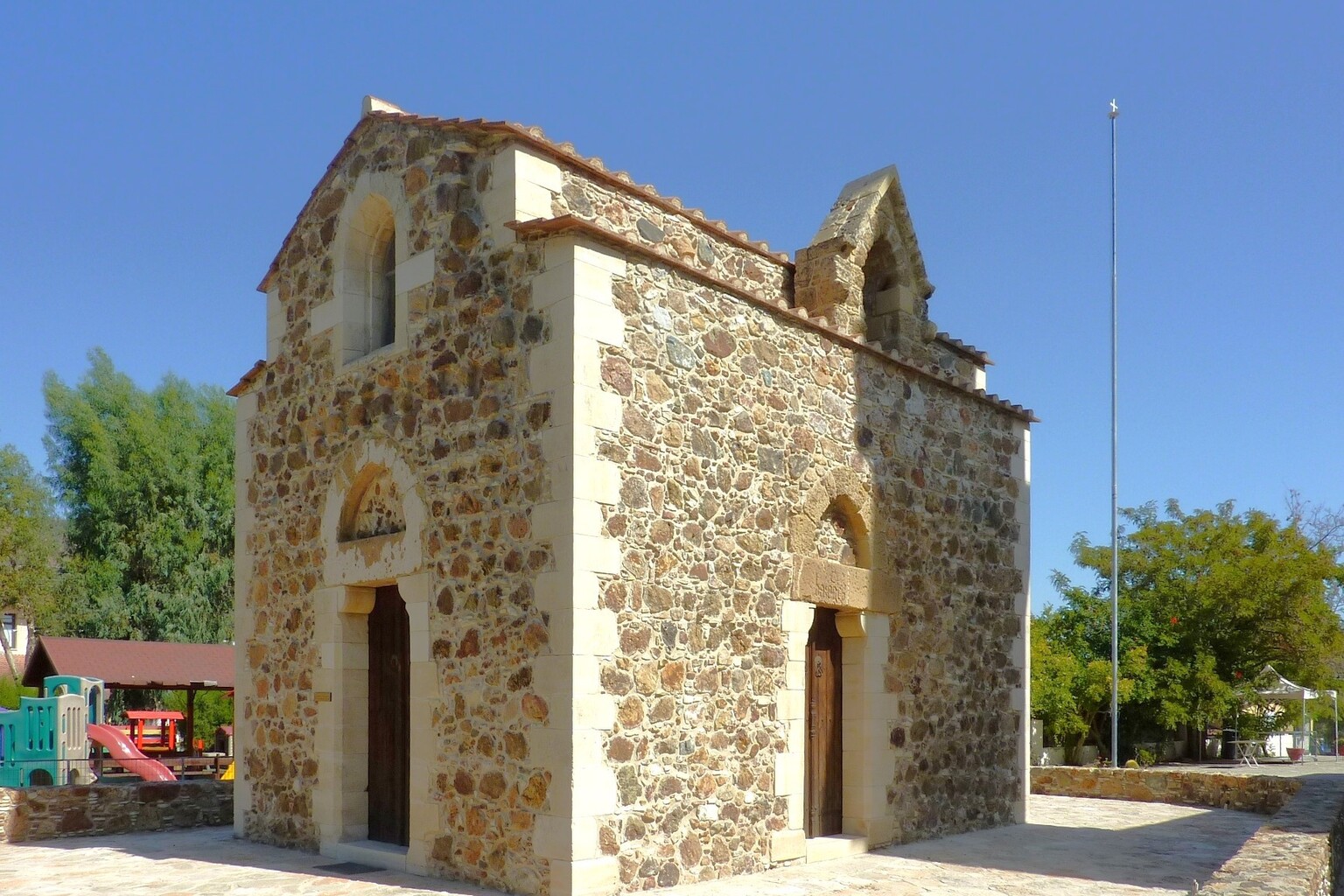
At the west end of Pyrga, a village in Larnaca district just off the Nicosia to Limassol motorway, a small stone chapel stands on a low rise above a branch of the Trimithos river. The Department of Antiquities calls it the "Royal Chapel" of Agia Aikaterini (St Catherine), and an inscription that has since been lost dated the building and its wall paintings to 1421/22, in the reign of the Lusignan king Janus. At the foot of a painted Crucifixion inside kneel two crowned figures that the Department says could be Janus and his queen, Charlotte de Bourbon. The chapel opens on weekdays only, entry is 2.50 EUR, and it was closed from late November to the end of December in each of the last two years, so read the visiting section before you set off.
A chapel dated by a lost inscription
When the French art historian Camille Enlart described the chapel in his 1899 book on Gothic art in Cyprus, a painted inscription in French, white on a green ground under the west window, still gave the date of its paintings, the year of our Lord 1421, and named the chapel as being in honour of God and of the Passion of our Lord. George Jeffery, quoting Enlart in his 1918 description of the island's historic monuments, reported that the inscription had since been destroyed. The Department of Antiquities, which runs the site today, says the inscription dated the building and its paintings to 1421/22, and that some researchers argue, justly in its view, that the chapel was dedicated to the Passion of Christ. The list of monuments protected under the Antiquities Law of 1905, revised to December 1915 and printed in Jeffery's book, calls it the Chapel of the Passion.
Visit Cyprus says the Lusignan King Janus built it in 1421. The Department names no builder, and Jeffery noted that no chronicle of the mid-15th century mentions its founding. Enlart took it for the private chapel of a royal manor, and Jeffery thought it probably stood within one. It is a small, single-aisled vaulted building without an apse. A portico once enclosed it on every side except the east, and until the end of the 19th century the ruins of a manor house or a monastery attached to it could still be seen; today only traces survive, the Department says. Enlart, as Jeffery summarises him, recorded three doorways with lintels, a small Catherine wheel badge on the south one and a fragment of an inscription bearing the French family name Bazoges, and Jeffery adds a small bell-cote on the south wall.
The crowned figures at the foot of the cross
The chapel was once painted all over, like the Byzantine churches of the Troodos, but many of the paintings have been lost. The Department sees in them the mix of Byzantine and western elements found in Orthodox churches of the time, suggests the painter may have been a Greek, and notes that the French inscriptions are spelt phonetically, as if the painter had learnt the language by ear. At the lower part of the Crucifixion two crowned figures kneel in front of the cross. The Department says they could be King Janus, who reigned from 1398 to 1432, and his second wife, Charlotte de Bourbon; Visit Cyprus states it as fact. The Department suggests that a figure kneeling at Christ's feet in the Entombment could be the king's brother, Hugh of Lusignan, who was the Latin archbishop of Nicosia.
Enlart was confident about the royal pair: the date of 1421 pointed to Janus and to Charlotte, whom the king had married ten years earlier, in 1411 by Jeffery's account. He described the king with chestnut hair, a heavy crown with fleurs-de-lis and a grey houppelande whose open, hanging sleeves were lined with a green and white pattern, and the queen fair-haired, with her hair worn loose, in a pink gown under a grey or white surcoat: French dress of the period. Jeffery describes dim traces of panels and busts of saints with French captions that could be read only with difficulty, such as "La Pentecouste" and "La Cene dou Jeudi Saint" (Pentecost and the Last Supper), and a Last Supper with Christ and St Peter seated in high-backed chairs under canopies. These descriptions are more than a century old; we could not confirm how much of each scene can still be made out.
The paintings also include a series of coats of arms of the medieval Kingdom of Cyprus (Jeffery noted the royal badge of Jerusalem and Cyprus on the vault), and pilgrims and travellers carved graffiti into the painted walls, with dates between the 15th and the 16th centuries, the Department says; Jeffery listed dated ones of 1470, 1522, 1524 and 1546.
Thread, a Latin complaint and an iron gate
One graffito records a custom that lasted for centuries. According to Jeffery, people used to wind thread round the building as a charm against epidemics, a practice that a passing traveller had already attacked in a Latin inscription inside the chapel. Jeffery suggested that the boots of people climbing the walls to tie the thread may be what destroyed Enlart's dated inscription. In the summer of 1911 the Curator of Ancient Monuments had the chapel repaired and enclosed with an iron gate, he wrote, despite some local protest that this got in the way of winding thread round it.
July 1426: the king's army at Casal Piria
Five years after the chapel's date, Janus's kingdom met disaster. In July 1426 an army sent by the Mamluk sultan of Egypt took Limassol, and the king marched out of Nicosia to meet it. In the chronicle that Jeffery quotes, the army reached Potamia on 3 July and the next day "marched to Casal Piria, and there passed the night", a place Jeffery identifies with Pyrga, before going on to Choirokoitia. In the battle there on 7 July the king's brother, the Prince of Galilee, was killed and "the King was taken prisoner and carried to Larnaca". Jeffery mentions the king's later imprisonment in Cairo; Janus died in June 1432.
Opening hours, tickets and closures
The Department of Antiquities opens the chapel on weekdays only: from 16 September to 15 April, Monday to Friday, 08:30 to 16:00, and from 16 April to 15 September, Monday to Friday, 09:30 to 17:00. Visit Cyprus adds that it is closed at weekends and on public holidays. Entry is 2.50 EUR, organised groups of more than ten get 20% off, and according to Visit Cyprus the Department's passes for all its museums and ancient monuments cost 8.50 EUR for one day, 17 EUR for three days and 25 EUR for seven.
Check before you go. The Department closed the chapel from 25 November to 31 December 2024, citing technical issues, and again from 24 November to 31 December 2025; it was also shut from 12 to 30 August 2024 and from 4 to 29 August 2025, and in 2026 from 23 March to 13 April and from 3 to 14 August. When we checked on 14 November 2026 we found no notice of another closure this year, but given that pattern, ring the number on the Visit Cyprus page, +357 96 603 664, before you go, especially in late November, December or August.
Getting there
By car, the chapel is about 32 km and 32 minutes from Eleftheria Square in Nicosia by OSRM's routing estimate, most of it on the A1 motorway towards Limassol; after the exit for Kornos and Pyrga the chapel is about 2 km further on. From Limassol Castle it is about 56 km and 50 minutes by the same motorway, and from the Finikoudes seafront in Larnaca about 22 km and 28 minutes, by the A5 and then country roads past Klavdia.
The nearest bus stop is Ag. Marina Church, about 60 m from the chapel; we checked the timetables of all seven public bus operators published on the Motion bus card site. In the timetable for the week from 16 November 2026, Larnaca district bus 410 (Larnaca to Kornos and Delikipos, via Kalo Chorio, Agia Anna and Psevdas) calls there five times a day each way on weekdays and three times on Saturdays and Sundays. On a weekday you could leave the stop the timetable calls Larnaca Station at 11:00, reach the chapel at 11:54 and take the 15:28 back, due in Larnaca at 16:20. Route 53 of NPT, the Nicosia district operator, links the same stop with the Alampra bus station, about 20 minutes away, 13 times a day each way on weekdays; Intercity buses between Nicosia and Limassol, Larnaca, Paphos and Paralimni call at Alampra, but we did not time the connections. Buses also run at weekends, when the chapel is shut.
Nearby
Kornos, about 4 km away by road, is known for handmade clay pottery and for beekeeping, according to Visit Cyprus, and our pottery villages post covers its potters. Stavrovouni Monastery, on a rocky peak, is about 10.5 km from the chapel by road. Its rules are strict: Visit Cyprus says women may not enter, cameras and video are not allowed and men must be suitably dressed, and gives its hours from September to March as 07:00 to 11:00 and 14:00 to 17:00, closed on public holidays, with free entry. The monastery of Agia Varvara, at the foot of the mountain, is open to all visitors, Visit Cyprus says.
The facts in this guide were checked on 14 November 2026. If days out like this are part of why you are thinking of moving to Cyprus, our relocation help can take the paperwork off your hands.

