Palms frame many of the classic views of Cyprus, from Larnaca's seafront to the hotel strip of Kato Paphos, yet almost all of them were planted by people. Most of the island's palms belong to just three kinds: the date palm (Phoenix dactylifera), the Canary Island date palm (Phoenix canariensis) and the Washingtonia fan palms. None of them is rare, but each has its own story, and each has a place where it shows off best.
The date palm has been cultivated for so long that nobody knows exactly where or when it was first grown. In Cyprus it is commonly planted in the lowlands, and in Greek it is the finikas or chourmadia. It is easy to tell from its Canary cousin: a date palm often grows in a clump, with several stems rising from a single root system, while a Canary palm always grows as a single trunk.
The finest setting for date palms is Hala Sultan Tekke, on the west bank of the Larnaca Salt Lake. The official Visit Cyprus audio guide describes its minaret and dome rising among eucalyptus trees, cypresses and, mostly, palm trees. Tradition holds that Umm Haram came to Cyprus with the Arab raids of 647 or 649 and died where she fell from her mule; the mosque stands over her grave, and the complex was built in phases from 1760 to 1817. Entry is free and the site opens daily at 08:30, closing at 17:00 from 16 September to 15 April and at 19:30 in summer; it is closed on Christmas Day, New Year's Day and Orthodox Easter Sunday. Visitors take off their shoes before entering the mosque, and in winter, when rain fills the lake, flamingos spend the season on the water beside it.
Larnaca's seafront is named after its palms: Finikoudes is Cypriot Greek for 'little palm trees'. Local historians date the first ones to a seafront makeover that was finished by early 1922, under mayor Filios Zannetos, which also widened the coast road and laid out a promenade. Winter storms and salt spray killed many of the young trees, so they were replaced a few years later, and a photograph from 1930 shows them still young. Today the 600 metre promenade along Athinon Avenue, lined with palms on both sides, is Larnaca's most famous.
The Canary Island date palm, a native of the Canary Islands, is the heavyweight of the three: 10 to 20 metres tall, with feather-shaped leaves 4 to 6 metres long, and when gardeners trim the old leaves away the base of the crown looks like a giant pineapple. Together with the date palm it is also the main victim of the red palm weevil, a reddish-brown beetle about 3 cm long whose larvae eat the palm from the inside. The weevil was first found in Cyprus on 20 August 2006, on a Canary palm in Limassol district, and by October it had turned up in the Larnaca, Paphos and Famagusta districts as well. According to the Agricultural Research Institute it is now found all over the island and has destroyed hundreds of palms, mostly Canary and date palms. An infested Canary palm is easy to spot: its crown wilts and droops into the shape of an umbrella.
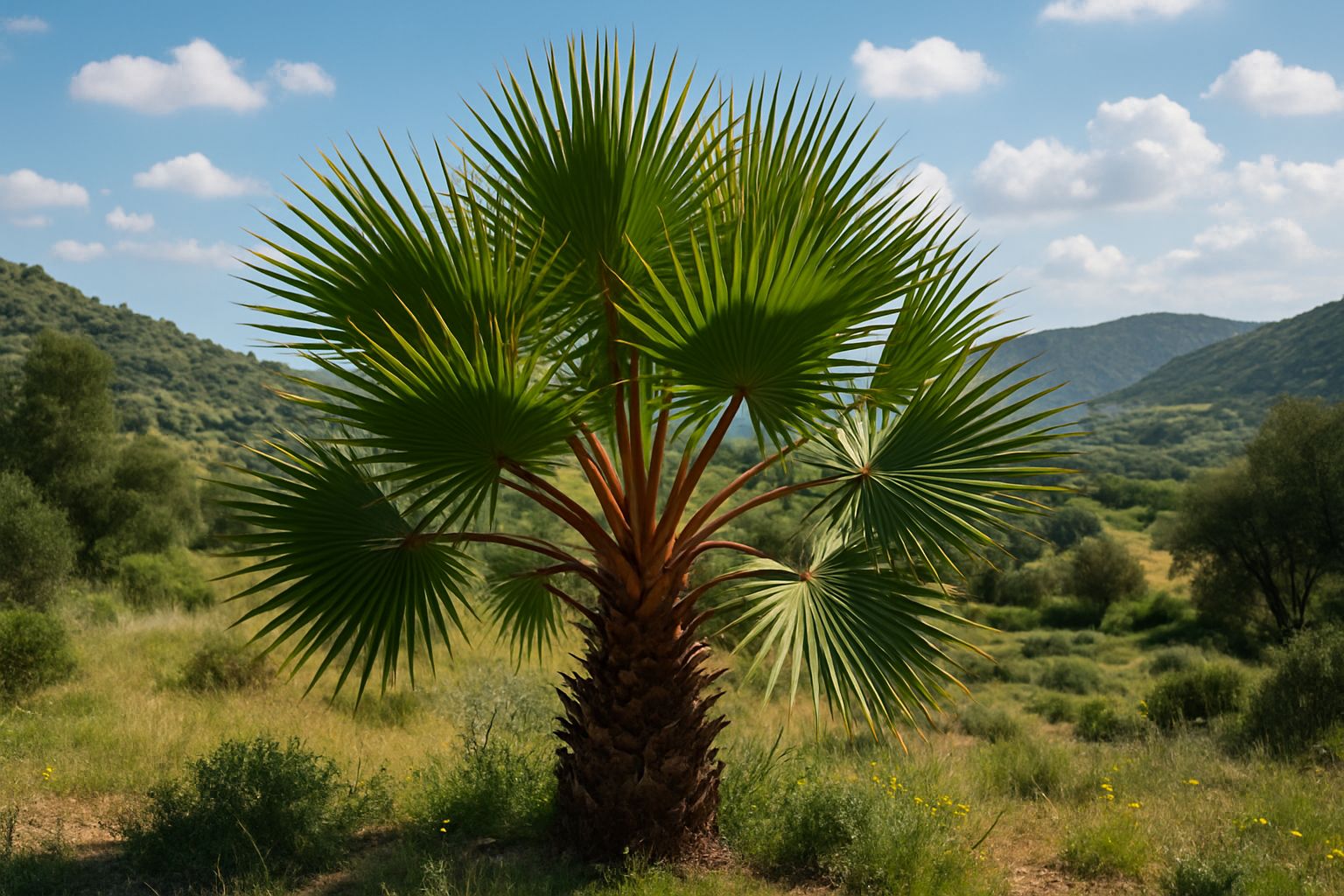
The tall, slim palms with fan-shaped leaves are Washingtonias, natives of the deserts of the south-western United States and north-west Mexico. The Mexican fan palm (Washingtonia robusta) grows to 25 metres, and if nobody trims it, its dead leaves hang down the trunk in a thick 'skirt'. In Cyprus they have started to sow themselves. In 2022 the Berlin botanist Ralf Hand reported that Washingtonia seedlings and young trees had recently been seen in abundance in the tourist areas of Kato Paphos and neighbouring communities, in flowerbeds, gutters, pavement cracks and stream beds, and in December 2021 he recorded two small trees, most probably not planted, in a stream bed by the sea at Polis.
Date palms seed themselves now and then too. Botanists have long known self-sown trees on cliffs, for example at Agios Sozomenos in Nicosia district, and on 17 December 2021 Hand collected one growing on the sea cliff at Chlorakas, just north of Paphos, the first record of the species in Cyprus backed by a herbarium specimen. Still, no self-sustaining wild populations are known, so botanists class the date palm here as 'casual', a planted tree that occasionally escapes. Gardens hold a few rarer kinds as well: when a second palm pest, the palm borer moth, turned up in 2008, it was found on European fan palms, pygmy date palms and Washingtonias.
So when you stroll under the palms at Finikoudes, you are walking under a hundred years of town planning rather than wild nature. If you are thinking of making Cyprus your home, our relocation help can take care of the logistics while you choose your favourite stretch of seafront.
