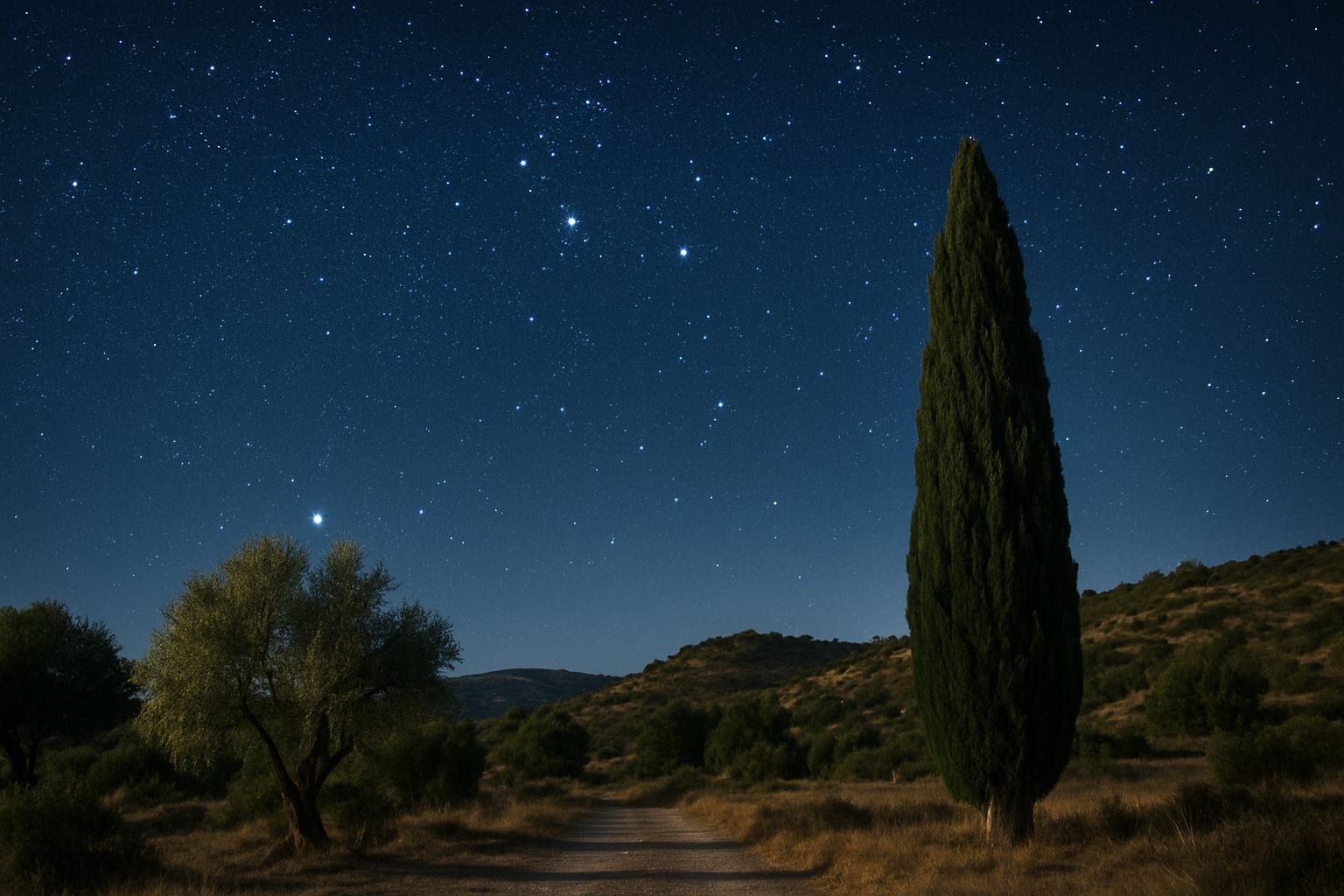
Cyprus gets over 300 days of sunshine a year, and the same dry air that makes the summers so reliable makes the night sky unusually good once you leave the coast. The catch is that the coast is where everyone lives. Limassol, Larnaca, Paphos and Nicosia throw a lot of light upwards, so the trick to stargazing here is height and distance: get into the Troodos or out onto a headland, and the Milky Way appears within the hour.
Troodos Observatory, Agridia. The easiest and best first stop. Cyprus opened a public observatory above the village of Agridia, between Agros and Kyperounda, at about 1,250 metres. It has a 20 inch telescope for the night sky and a separate solar telescope for daytime visits, plus a small cafe and shop. Night sessions run in two slots, 8pm to 10pm and 10pm to midnight, with a guided presentation before you go to the eyepiece. Tickets are 15 euros for adults and 10 for students and children, and it books out on clear weekends, so reserve ahead at troodosobservatory.com or on +357 25 314 556. Go on a night near the new moon if you want the faint stuff, and take a jacket even in August, it is cold up there after dark.
The eastern Troodos. If you would rather have the sky to yourself, the high ground east of Mount Olympus, around Kyperounda, Agros and Amiantos, is the darkest easily reachable part of the island. Local astronomers measure sky darkness on a scale where anything above 21 counts as properly dark, and readings here sit around 21.3 to 21.4. Pull off on any of the forest roads, switch the lights off, and give your eyes twenty minutes. The Milky Way's bright core rises in the south east on summer evenings and is at its best from May to September.
Paphos Forest. The single largest dark area in Cyprus is the Paphos Forest, the vast tract of pine between the Troodos and the west coast. It is darker than anywhere else on the island because there is simply nothing in it, but that is also the problem: winding unlit roads, no phone signal in places and a long drive back. Treat it as a trip for people with a proper vehicle, a full tank and a plan, not a spur of the moment stop after dinner.
Cape Greco. For a coastal night sky, the headland between Protaras and Ayia Napa is the pick. The national forest park has no lighting of its own and the sea gives you a clean dark horizon to the east and south, but keep well back from the cliff edges in the dark: the cliff top at the sea caves has been fenced since May 2026 because the rock there is unstable. You will still see the glow of Ayia Napa behind you, so face out to sea. It is the most romantic of the lot and the only one where you can swim first and stargaze after.
The Akamas. Out past Latchi and Neo Chorio, the peninsula has no towns, no street lights and a west facing coast, so the sunset runs straight into the stars. The track to Lara Bay and the viewpoints above Fontana Amorosa are the usual spots. The roads are rough and some tracks are closed to vehicles, so check access before you go and bring a torch with a red filter.
The Cyprus Planetarium and the astronomy clubs. The Cyprus Planetarium runs shows and public events including Dark Sky Week each spring, and the Cyprus Astronomy Organisation, a community of amateur astronomers based in Nicosia, holds regular star parties and observation nights that are open to anyone. They act as the island's ambassador for the International Dark-Sky Association, which campaigns for better outdoor lighting. If you have never used a telescope, joining one of their evenings is the quickest way to learn the sky before you go it alone.
When to go. Summer is Milky Way season, and the two big meteor showers are the Perseids, peaking around 12 to 13 August, and the Geminids around 13 to 14 December. The most important date is the moon: a full moon washes out everything but the planets, so plan for the week either side of a new moon. Winter nights are the clearest and the longest, but the mountains drop below freezing and Troodos roads can close for snow, so check the forecast. Whatever the season, arrive before dark so you can see the ground you are standing on, and let your eyes adjust for a full twenty minutes before you judge the sky.
What to bring. Warm layers, a red torch, a blanket or a folding chair, water, and a phone app that shows you the constellations. Binoculars show you more than you would expect: the moons of Jupiter, star clusters in the Milky Way, the Andromeda galaxy on a dark night. Leave the car headlights off, keep phone screens dim, and if someone else is already set up nearby, the etiquette is to switch everything off before you approach.
Where not to bother. The salt lakes at Larnaca and Akrotiri look promising on a map but sit under airport and city glow. Nicosia is the worst placed of all, a lit plain with the Kyrenia range lights to the north. From any of the towns, the rule of thumb is a 40 minute drive uphill: from Limassol that means Platres or the Kyperounda road, from Larnaca the Stavrovouni ridge and the Machairas forest above Lefkara, from Paphos the road up through Panagia towards Cedar Valley. Anywhere you can stand and see no street light for a kilometre in any direction will do.
Photographing it. A phone on a small tripod with night mode will catch the Milky Way from the Troodos on a moonless night, which surprises most people. A camera on a tripod does far better: wide lens, aperture wide open, ISO around 3200, and a 15 to 20 second exposure before the stars start to trail. Include a foreground, a pine, a chapel, the observatory dome, and shoot before the core drops behind the mountains after midnight in late summer.
Half the pleasure of living here is that a night like this is never more than an hour away. If you are thinking of making Cyprus your home, our relocation help can smooth the move, and the sky will be waiting whichever side of the island you settle on.
