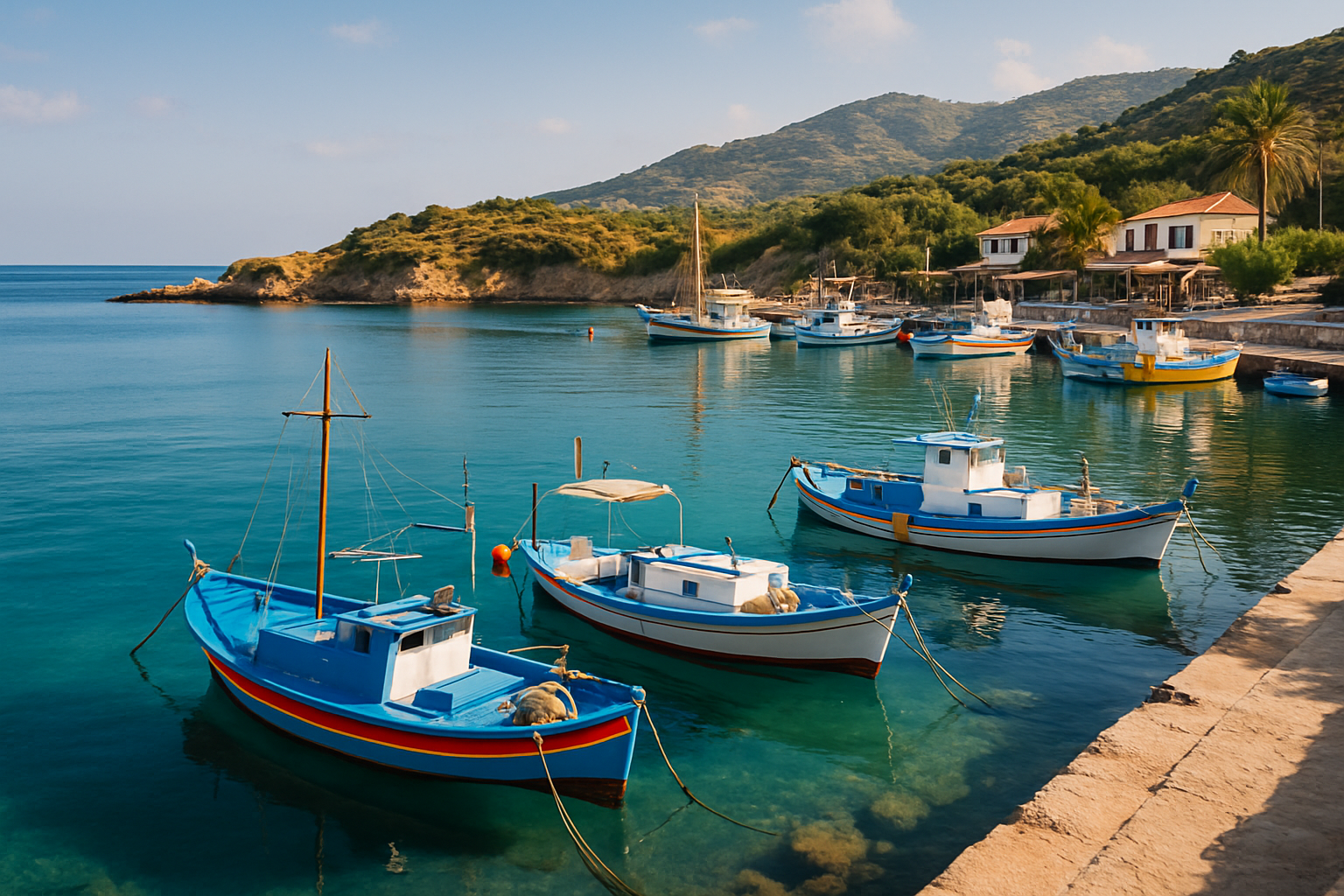
Away from the busy resorts, Cyprus keeps a string of small harbours where fishing boats still come and go. Visit Cyprus counts 16 fishing shelters and small harbours on the island, looked after by the Department of Fisheries and Marine Research, and at many of them you can stroll along the quay and watch the fishermen at work, while at some the catch goes straight to the tavernas that line the water. These are some of the most rewarding.
Start in the far north-west at Pomos, a village in the Tylliria region 17 km north-east of Polis, where the fishing shelter sits beneath Cape Pomos. It is one of the most remote villages in Cyprus, which is exactly its appeal. Pomos also gave its name to a symbol of Cypriot heritage, the Idol of Pomos, a cross-shaped picrolite figurine from the Chalcolithic period, around 3000 BC, now in the Cyprus Museum in Nicosia and pictured on the Cypriot €1 and €2 coins.
Follow the coast road south-west around Chrysochou Bay, through Polis, and about half an hour later you reach Latchi, a fishing village within the municipality of Polis Chrysochous. It was once a small port shipping out carobs, and its old stone carob warehouses now house restaurants and fish taverns. The harbour is also the gateway to the Akamas Peninsula: small cruises leave from here for the Blue Lagoon and the Akamas coast, and our Akamas guide covers what you will see.
On the south coast, about 40 km from Larnaca on the way to Limassol, Zygi is famous across the island for its fishing shelter and fresh fish. The shelter holds around 220 boats and is surrounded by fish taverns that draw diners from all over Cyprus, many of them with facilities for children, and the quay is a popular place for a stroll. Even the name comes from trade: it derives from the Greek for weighing, because carob exporters brought their beans here to be weighed before they went into the storehouses.
Pissouri, on the south coast halfway between Limassol and Paphos, has no harbour today, but its bay was once a working port. In medieval times carobs were shipped out from here, and the old stone carob warehouses have been turned into restaurants and homes. Now Pissouri Bay is a Blue Flag beach of fine golden sand and small multicoloured pebbles, with the white cliffs of Cape Aspro to the west and five public footpaths along the coast. Our guide to Pissouri covers the village on the hill above.
For a harbour that really is hidden, head to Potamos tou Liopetriou, west of Ayia Napa, where fishing boats moor along the Liopetri river. Visit Cyprus lists it among the island's 16 fishing shelters and small harbours, and it is the only one on that list described as natural. The French poet Arthur Rimbaud worked in an old quarry here in the late 19th century.
For history, Kyrenia's old harbour is hard to beat. Kyrenia Castle stands over it, and inside, the Shipwreck Museum displays the Kyrenia ship, a Greek merchant vessel that sank around 300 BC. Kyrenia lies in the Turkish occupied north, so a visit means crossing at one of the official checkpoints with your passport or ID.
Each of these harbours has its own story, from carob exports to a Chalcolithic idol, and most are best enjoyed slowly, with a walk along the quay and a long fish lunch nearby.
If the idea of making Cyprus your home appeals, moving and settling in a new country can feel daunting. Cyprus Decoded offers relocation help to make the move as smooth as a calm day in harbour.
