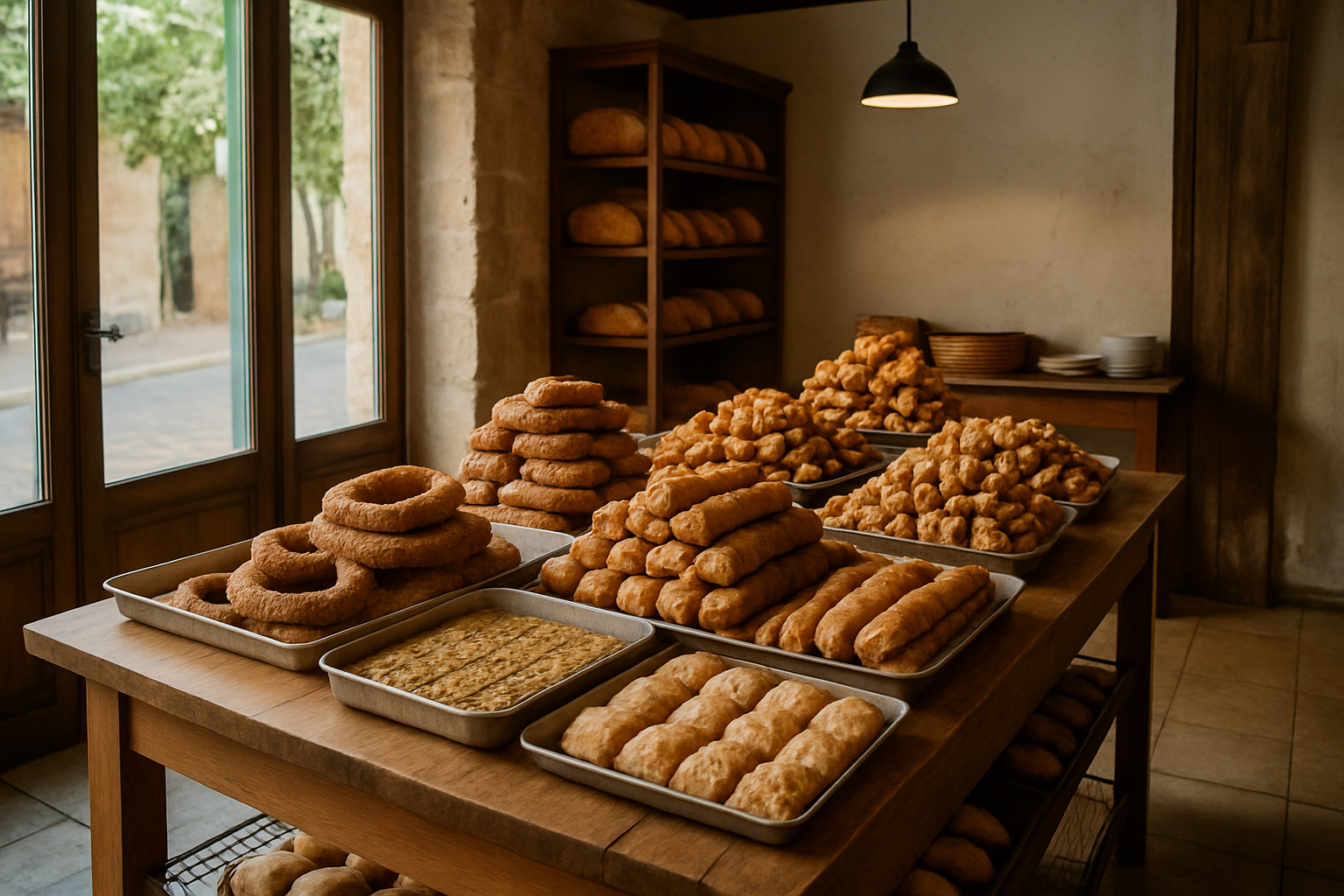
Bread has been the staple of the Cypriot diet since antiquity, says Cyprus's National Inventory of Intangible Cultural Heritage, which has listed the island's traditional baked goods since 2022 and notes that traditional mud-brick and stone ovens can still be found in the villages, even if traditional baking now survives in much smaller numbers. A bakery, the fournos (Greek for "oven"; the Zorbas chain trades in Greek as Fournoi Zorpas), sells far more than loaves. Koulouri is a ring or long loaf with an almost cake-like crumb, covered in sesame, caraway and aniseed. Halloumoti (halloumi pie) and elioti (olive pie) were traditionally baked alongside the bread. Kolokotes are crescent pies of pumpkin, bulgur wheat and raisins, and tahinopita is a sweet tahini pastry that Visit Cyprus describes as made with local carob syrup; both are Lenten favourites, and the Deputy Ministry of Tourism calls tahinopita one of the most popular pastries a visitor can buy in a bakery. Bourekia are small fried pastries filled with sweet anari cheese and cinnamon.
Omodos and Koilani: arkatena and glytzista
Begin in the Limassol wine villages. Omodos, at 800 metres and 42 km from Limassol, is famous for arkatena, rings of bread leavened with arkatis, a starter made from the foam of fermenting chickpeas, and eaten either soft or baked again into crunchy rusks. The craft, centred on Omodos and neighbouring Koilani, has been on the national inventory since 2015, which notes that arkatena are still offered at funerals and memorial services, with or without halloumi. Arkatena Fotini, at 4 Linos Road in Omodos, traces its family recipe back to 1935; it serves brunch (tables can be booked online) and runs arkatena workshops every Saturday at 11:00, booked through its website (+357 25 422355). In Koilani, women still make glytzista, braids of fried pastry dipped in syrup, sprinkled with sesame and decorated with scented geranium, on the inventory since 2017; the village holds a Glytzisto Festival in July (5 July in 2026).
Athienou: the big round loaf
Head east to Athienou, in Larnaca district, whose bread-making tradition has been on the national inventory since 2017. Its round loaf was bigger than other Cypriot breads, says the municipality, and under its PGI application it weighs 1.1 to 1.5 kg and is made with at least 90 per cent durum wheat, with a thick, crunchy crust and a dense, pale crumb that stays fresh for several days. The town's first commercial bakery opened around 1926. On 25 September 2026 the Department of Agriculture sent the European Commission applications to protect both Athienou bread and Athienou loukoumi as PGIs, with a decision expected within 2027; the loukoumi here is not the jelly sweet but a wedding pastry that looks like a kourabies. Zorbas, which the municipality calls the largest bread maker in Cyprus, began in an Athienou backyard in 1975 with a traditional oven, baking Athienitiko bread for the village. The Kallinikeio Municipal Museum, whose ethnographic collection includes the town's bread, opens Monday to Friday 08:00 to 15:00, and at weekends by advance notice (2 EUR, children free).
Geroskipou: loukoumi
For something sweeter, go to Geroskipou, 3 km east of Paphos town, famous for loukoumi, the soft cubes of Cyprus delight. Loukoumi Geroskipou became the first Cypriot food with EU protected status (PGI), registered in December 2007, and the town's sugared almonds, Koufeta Amygdalou Geroskipou, followed in 2012. In the old days, says the Cyprus Food Museum, sugar, cornflour, almonds and flavourings were cooked in a cauldron over a wood fire and stirred constantly; the PGI recipe is sugar, corn starch, water and a little citric acid, stirred for two hours, with nuts optional. Four small family firms on the main road make and sell it today. Aphrodite Delights, which traces its loukoumi to Sophocles Athanasiou in 1895, has its Old Factory Shop at 57 Makarios Avenue, open Monday to Saturday 08:00 to 21:00 and Sunday 10:00 to 21:00; it also sells glyko amygdalou, an almond, rose water and mastic spoon sweet. Opposite the square, Arsinoe Yeroskipos Delights, also dating from 1895, still cooks its loukoumi in copper cauldrons. Since 6 October 2026 a free guided walk of the town has left the bus stop on the municipal square every Tuesday from 09:30 to 12:30, taking in the Folk Art Museum and the loukoumi makers.
Spoon sweets: Agros, Trimiklini and Lania
Wherever you stop, you may be offered glyko tou koutaliou, the spoon sweets that Cypriot hosts serve as a sign of hospitality, always with a glass of cold water. Figs, cherries, watermelon rind, citrus peel, walnuts, bergamot and even almond-stuffed baby aubergines are first soaked in water with cooking lime to crisp them, then gently boiled in sugar over several days; the green walnut sweet is made from early to mid June. They are very sweet, so one spoonful is plenty, and most people now buy them by the jar. The Deputy Ministry of Tourism's Heartland of Legends route names Trimiklini, in the Limassol hills, and the Monastery of St Heraklidios, in Nicosia district, for walnut sweet, and workshops in Agros and Lania where you can watch the cooking, taste and buy. Agros, about 1,000 metres up in the Pitsilia hills, makes Glyko Triantafyllo Agrou, a spoon sweet of damask rose petals protected by the EU as a PGI since 2016; its EU specification names Niki Agathokleous, who began making it commercially around 1985, as the only authorised commercial producer, and Niki's Sweets is at Triantafillou 5 (25 521400). Agros holds its Rose Festival in May, and Kakopetria holds a Spoon Sweets Festival in September (27 September in 2026).
Where to watch sweets being made: Anogyra, Foini and Kato Drys
Anogyra, 45 km from Limassol, is the only village where pastelli is still made the traditional way, says Visit Cyprus: carob syrup is boiled down, then stretched and pulled by hand, and only between September and May, because the toffee will not shape well in the heat. Cyprus's carob traditions have been on the national inventory since 2018, with the village as co-applicant, and at inscription it had three carob syrup and pastelli workshops open to the public and three pastelli museums. The village website lists To Paradosiako, where you can watch the whole process, and a Carob Thematic Centre in the old primary school. Anogyra's Pastelli Festival, usually held in September, was moved to Sunday 25 October in 2026. Foini, at 920 metres in the Troodos, makes loukoumi in small workshops and held its third Loukoumi Festival on 7 June 2026; the next is due in June 2027. At the Bee and Embroidery Museum in Kato Drys, near Lefkara, Visit Cyprus says visitors can take a guided tour and watch homemade products such as bread, dried figs and fig pies being prepared (2 EUR, 1 EUR for students, closed on Thursdays, +357 99 89 26 77).
When to go: the baking calendar
Many bakery specialities are seasonal. Kolokotes are made from just before the Christmas fast until just before Easter, and lagana, which Visit Cyprus describes as a specially made version of koulouri, is the bread of Green Monday, which falls on 15 March in 2027. Flaounes, the Easter cheese pastries, are baked from Holy Thursday to Holy Saturday and eaten after the Resurrection, because they use foods the Lenten fast does not allow. A pastry dough is folded around a filling of the special flaouna cheese, often mixed with halloumi, with beaten eggs, mint, raisins, a little leaven and spices such as mahlepi and mastic, then brushed with egg and coated in sesame. Orthodox Easter Sunday falls on 2 May in 2027, so the first fresh flaounes come out from Thursday 29 April, although bakeries now sell them all year, most of all around Easter.
At Christmas, bakeries sell boxes of kourabiedes, tiny shortbread biscuits under a thick dusting of icing sugar, while homes bake melomakarona and foinikota. Foinikota are filled with dates, nuts and spices and made with vegetable shortening, so they can be eaten during the 40-day fast. On New Year's Eve families bake the vasilopita with a coin hidden inside, and whoever finds the coin is the lucky one of the year. If all this baking has you thinking of a longer stay, our relocation help is at hand.
