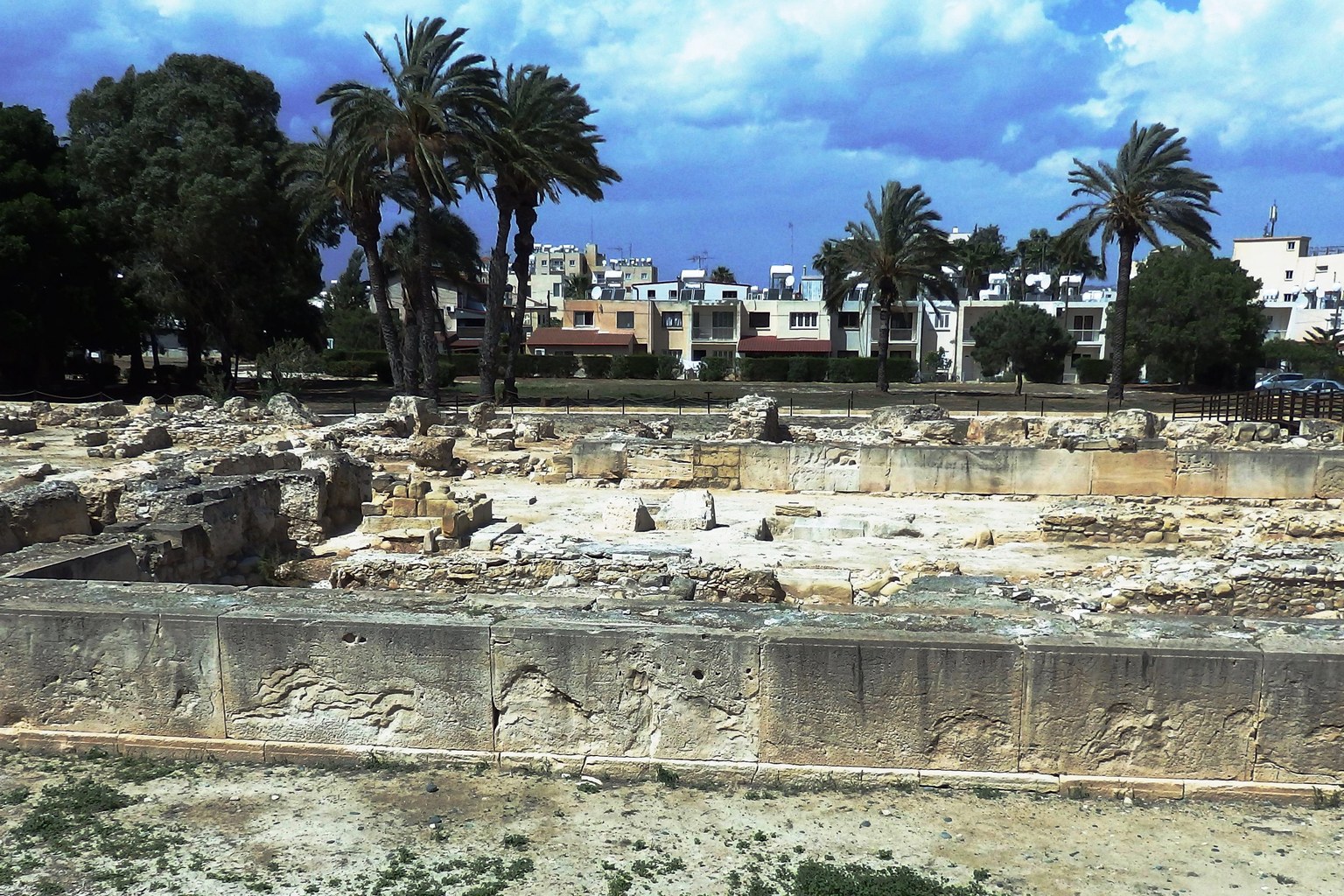
Two sites inside modern Larnaca
Kition was one of the city-kingdoms of ancient Cyprus, and its remains lie within the limits of modern Larnaca. The Department of Antiquities describes the archaeological area of Kition as two sites, Kathari and Pampoula. From the 18th century onwards, the Department says, foreign travellers and tomb robbers dug in the area and brought finds to light. One of those finds was the famous Assyrian stele of King Sargon II, which the Department's page says is now in Berlin.
The Swedish Cyprus Archaeological Expedition began the first systematic excavations in 1929. In 1959 the Department of Antiquities, under the direction of Vassos Karageorghis, began excavating at Kathari, and later, the Department's page says, the French expedition of the University of Lyon took over the excavations at Pampoula. The philosopher Zeno also came from Kition: the Stanford Encyclopedia of Philosophy says that Zeno of Citium, to use the Latin form of the city's name, founded the Stoic school around 300 BC.
Our guide to the archaeological sites beyond Paphos and Kourion covers Kition alongside Tamassos, Idalion and other sites, and our historic sites directory has a table of hours and tickets that includes Kition.
Kathari: five temples and copper workshops
According to the Department, the earliest phases of settlement and worship at Kition are found at Kathari. Five consecutive temples and workshops for smelting copper have been excavated there, and the Department dates them from the end of the 13th to the end of the 11th century BC. The Department places them in the Late Bronze Age and the Geometric period, when, in the Department's words, the city flourished and was inhabited by Mycenaean Achaeans.
Visit Cyprus adds that around the end of the 13th century BC the Mycenaean Achaeans fortified the city with cyclopean walls, built of giant blocks of limestone.
The Phoenician temple of Astarte
After the earlier temples were destroyed, the Department says, the Phoenicians built a magnificent temple in their place around 850 BC, and this temple has been identified as that of Astarte. According to the Department, the temple stayed in use until the beginning of the 3rd century BC, when it too was destroyed. The Department's page gives Astarte as the equivalent of Aphrodite, and Visit Cyprus describes her as a goddess of fertility linked with the worship of Aphrodite.
Pampoula and the war harbour
According to the Department, the excavations at Pampoula showed that people lived there without a break from the end of the Geometric period to the Hellenistic period, and the earliest buildings found there, a temple and other buildings, date from the 9th century BC. In the Archaic and Classical periods the temple grew to take in many rooms, open courts with stoas, shrines, hearths for offerings and installations for smelting copper.
The finds, the Department says, show that several gods were worshipped at Kition. The most important were the Phoenician deities Astarte, Melkart and Esmoun, whom the Department gives as the equivalents of Aphrodite, Heracles and Asclepius respectively, and the Department also names the Egyptian deities Hathor, Bes and Horus.
In the Classical period, the Department says, Kition carried out a programme of large public works. The marsh in the Pampoula quarter was drained, a sewerage system was built and two harbours were made, one for trade and one for the navy. The Department's page says that only the military harbour has been excavated so far and that the ramps used to tow ships in for repair or safe keeping still exist. Visit Cyprus says that Kition was well known for its harbour in antiquity and that many agricultural products were exported from it to the eastern Mediterranean, Egypt and the Aegean.
OpenStreetMap marks the ship sheds of the war harbour about 300 metres south-east of the site's entrance on Archiepiskopou Kyprianou Avenue, in a straight line. The Department's page gives one timetable, one ticket price and one entrance for Kition, the one on Archiepiskopou Kyprianou Avenue. It gives no visiting details for Pampoula or the war harbour, and none of the official sources we checked says that either can be visited, so plan your visit around the Archiepiskopou Kyprianou Avenue entrance and ring the site if you hope to see the harbour.
Hours, tickets and holidays
The archaeological site opens on weekdays only. The Department's page and the Department's table of opening hours give the same times: from 16 September to 15 April, 08:30 to 16:00 from Monday to Friday, and from 16 April to 15 September, 09:30 to 17:00 from Monday to Friday. The site is closed on Saturdays and Sundays all year.
A ticket costs 2.50 EUR, according to the Department, and Visit Cyprus also lists a 1.25 EUR ticket for pensioners. The Department sells special entry cards for one day (8.50 EUR), three days (17 EUR) or seven days (25 EUR) at the ticket office of every museum and monument it runs. While a card is valid, it allows one visit to each of the Department's museums and ancient monuments. Organised groups of more than ten people get 20 per cent off the entry fees.
Public holidays need care. The Department's holiday table lists all its museums, monuments and archaeological sites as closed on 1 January, Greek Orthodox Easter Sunday and 25 December. Kition is not among the sites that the same table lists as open on the other public holidays. Visit Cyprus's page says that the site is closed on public holidays, and the Larnaka Region tourism site says that it is closed on some public holidays. When we checked on 23 November 2026, the next weekday holidays in the Department's table were Thursday 24 December 2026, Friday 25 December 2026, Friday 1 January 2027 and Wednesday 6 January 2027. If you plan to visit near a holiday, ring the site first on +357 24 304 115.
The entrance is on the south side of the site, on Archiepiskopou Kyprianou Avenue: according to the Department's notice, the entrance was moved there from the north side. The Department's page says that the entrance is wheelchair accessible and that wheelchair users can also move around the site. Under accessibility, the same page also lists "Parking space (not marked)" and "No wheelchair accessible WC".
At weekends, when the archaeological site is shut, the Department's Archaeological Museum of the Larnaka District on Kalograion Square is open. The museum's page gives its hours as 09:00 to 16:30 from Tuesday to Sunday, closed on Mondays and on public holidays, and entry is free. The museum's page says that its second wing displays finds from the historic periods of Larnaca town and district, and the Department's Kition page says that a plaster cast of the Sargon II stele is exhibited in what the page calls the Larnaka Museum.
Getting there
We checked every bus timetable feed on motionbuscard.org.cy. In a straight line, the stops nearest the entrance are the two on Leontiou Machaira Street named after Kerkyras Street and Zakynthou Street, about 240 metres to the north-east, but the OpenStreetMap walking route from them is about 470 metres. On foot, the two stops named Panagia Chrisopolitissa Church are closer, about 360 and 370 metres away, and about 320 metres to the west in a straight line. In the timetable data for 23 November 2026 to 5 January 2027, the only route that calls at the Leontiou Machaira stops is Cyprus Public Transport's Larnaca route 418L (the data list the operator as LPT). Route 418L runs as a loop from and back to the stop that the data call Larnaca Station, and every trip calls at both stops: 16 trips a day from Monday to Friday and 8 a day on Saturdays and Sundays.
In the same data, route 428, which links Larnaca Station with Tsiakkilero and Aradippou, calls at the Panagia Chrisopolitissa Church stops 11 times a day in each direction from Monday to Friday and 6 times a day in each direction on Saturdays and Sundays, at one stop on the way out and at the other on the way back. More buses call at the stop named Dimitras-Apollonos, about 370 metres east of the entrance in a straight line and about 480 metres on foot: routes 424 and 427 call there 34 and 27 times a day from Monday to Friday and 16 and 17 times a day at weekends, besides other routes. Cyprus Public Transport announced that from Monday 16 November 2026, Zakynthou Street and Pavlou Valdaseridi Street are closed for roadworks until further notice and that its route 418 is diverted. The notice does not mention route 418L, and the timetable data show no change for it, but one of route 418L's two stops on Leontiou Machaira Street is named after Zakynthou Street, so check the operator's notices before you rely on that route.
Intercity Buses' route 42 from Nicosia and route 45 from Limassol run every day in the same data. On the way into Larnaca, both routes call at the stop named Pancyprian Lyceum, about 550 metres south of the entrance in a straight line and about 810 metres on foot. It is a busy stop: in the same data, 30 numbered routes call there, 24 of them Cyprus Public Transport's Larnaca routes. All the buses back to Limassol and most of the buses back to Nicosia call at the Old Hospital stop, about 620 metres south of the entrance in a straight line and about 770 metres on foot.
By road, the OSRM route planner measures about 8.5 km and 13 minutes from the departures area at Larnaca airport, about 46 km and 43 minutes from Eleftheria Square in Nicosia, and about 68 km and an hour from Limassol Castle.
We checked the Department of Antiquities' pages and its opening-hours and public-holiday tables, Visit Cyprus's page on Kition, the bus timetable data and the OpenStreetMap routes on 23 November 2026.

