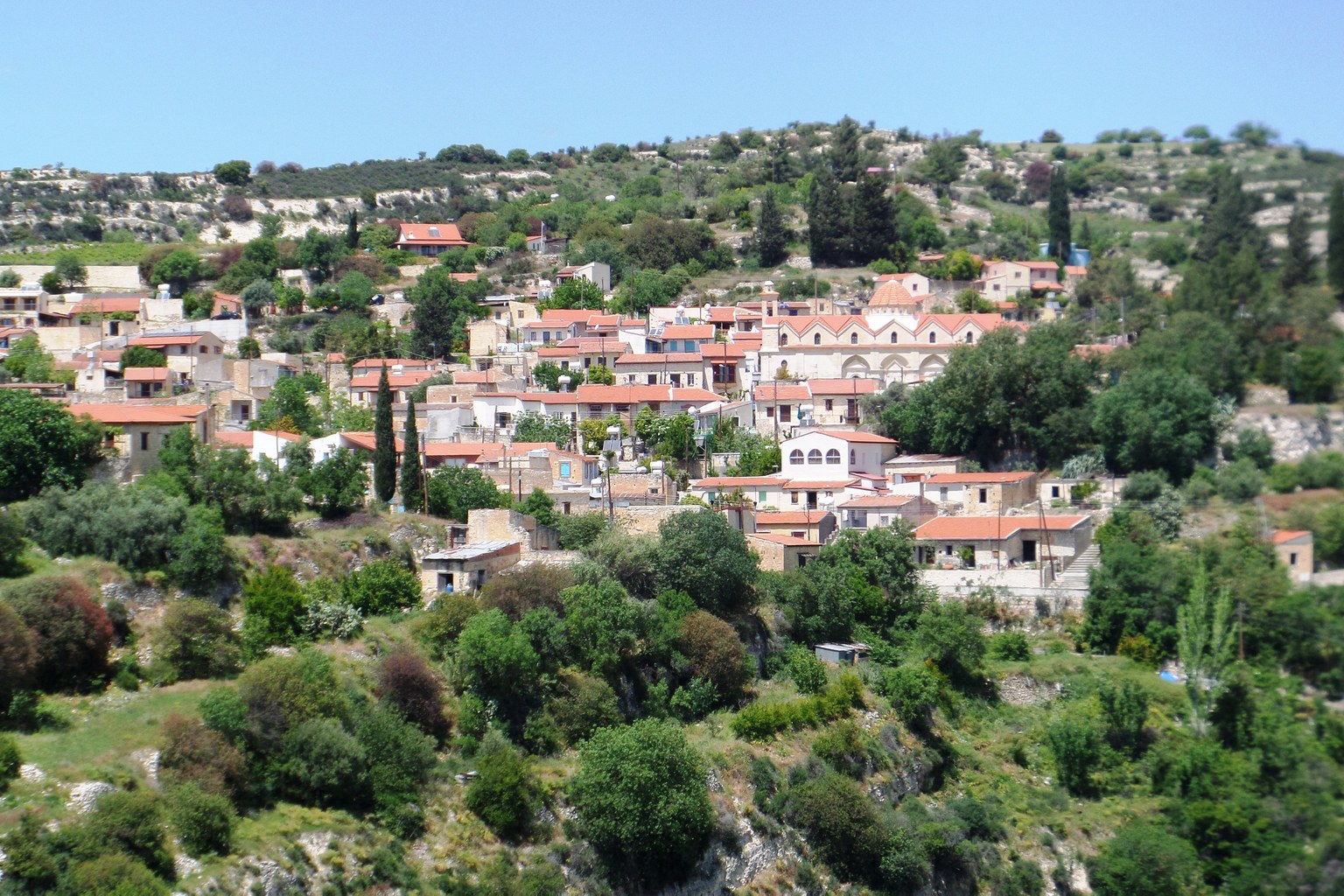
A small stone village in the Limassol hills
Visit Cyprus places Vasa Koilaniou, in the Limassol district, on the Troodos mountain range at an altitude of 750 metres, and the community council's history page describes it as built in a small valley and on the slopes around it, at an average altitude of 750 metres. At the main church, the two elevation models we checked give about 800 metres: Copernicus, which has a 90-metre grid, gives 797 metres, and EU-DEM, which has a 25-metre grid, gives 801 metres.
Visit Cyprus says that the village keeps its traditional limestone architecture and paved streets, together with old wine presses and distilleries for zivania, the strong local spirit. The council's page describes a compact village of stone-paved lanes, long single-room houses, two-room houses and houses with an upper floor, built of finely dressed limestone, and its list of completed works says that the council removed the asphalt from the streets inside the village and repaired the old stone paving underneath. The same history page traces the population from 397 in 1881 up to 871 in 1946, then down to 367 in 1982 and 170 at the 2001 census, and the Statistical Service's table for the 2021 census counts 168 people in Vasa Koilaniou.
A name and a medieval fief
Visit Cyprus says that the name comes from the ancient Greek word "vassa", meaning a wooded area, and the council's page gives its meaning as a wooded valley. The council's pages also link the name with Bassae in Arcadia, the site of the temple of Apollo Epikourios, and say that a sanctuary of Apollo once stood in the village. They disagree on where: the history page places the sanctuary where the main church now stands, and the museums page, with the words "it is said", places it where the old boys' school was built.
In the Middle Ages, according to the council's page, Vasa was an important fief that belonged to the Ibelins of Jaffa, a family of crusader lords. George Jeffery's description of the island's historic monuments, published in 1918, also records that "Vasa, or Vace, was a fief of the celebrated Jean d'Ibelin". The council's page adds that Rupert Gunnis, whose guide Historic Cyprus appeared in 1936, mentions the remains of a tower's foundations on a hill in the centre of the village, which the page takes to be the hill behind the church.
The school in Vasa remembers
Visit Cyprus lists a Museum of Education among the village's sights. According to the council's museums page, the old boys' school, a neoclassical building that had burned down and been rebuilt, holds the museum of the history of primary education in Cyprus that POED, the Pancyprian Organisation of Greek Teachers, set up there with the community. POED presented the museum on Saturday 25 September 2010 under the title "The school in Vasa remembers", and the education minister of the time, Andreas Demetriou, opened it.
A text on the same page from the time of the opening sets out four sections: the history of Vasa from ancient times, education under Ottoman rule, education under British rule, and a recreated classroom of a monitorial school as such classrooms were at the end of the 19th century and the start of the 20th. The text also says that the Department of Antiquities gave the museum 10 vessels from excavations in the village.
The display is built around five people linked with Vasa: Stylianos Chourmouzios, whom the text calls Archon Protopsaltis, or chief cantor, of the Church of Cyprus and a journalist; the teacher Charalambos Papadopoullos; Eleni Zachariadou and Andreas Nikolaidis, who each taught in Vasa for 40 years; and the poet Dimitris Lipertis.
The poet Dimitris Lipertis
The council's page calls Dimitris Lipertis one of the greatest representatives of poetry in the Cypriot dialect. The page says that he was born in Larnaca in 1866 and died in Nicosia in 1937, that he taught in Nicosia, at the Pancyprian Gymnasium from 1910 to 1912 and later for many years at the English School, and that he regularly spent his summers in Vasa Koilaniou and other villages. According to the same page, his collection "Tzypriotika Traoudkia" (Cypriot songs), published in 1923, was his first book of poems in the Cypriot dialect.
The village's other museums
Visit Cyprus also lists a Museum of Zivania. The council's page says that the Zivania Museum was set up on the council's initiative with help from the European Union between 2010 and 2012, on the site of the old community football ground, and that Nicos Anastasiades, President at the time, opened it on Wednesday 10 July 2013. The page calls it the only zivania museum in Cyprus, and says that the museum's display covers the tools of vine growing and zivania distilling and a traditional Vasa house. Our guide to Limassol's wine villages covers the winery in Vasa and the wineries of the neighbouring villages.
The council's page says that the Ecclesiastical Museum was created to keep the village's church treasures, and it credits Father Nikolaos Panagiotou, a priest from Vasa, with bringing the icons to light. The page says that the permanent display includes icons from the end of the 14th century to the 16th, the oldest an icon of the Virgin in prayer from the end of the 14th century. The page also describes a medieval silver spoon that bears a seal of the Lusignan dynasty, and a small bell that, according to tradition, belonged to Napoleon's fleet. The museums page also lists a museum of folk tradition with farming and household tools, and says that it is privately owned.
Around the village
The council's page dates the building of the main church, dedicated to the Annunciation (Panagia tou Evangelismou), to 1896 to 1900, at the villagers' expense, and its inauguration to 1903. The page describes the church as Gothic in style, with a dome and a tall bell tower, and built of dressed stone. The same page says that an older church of Osios Varnavas lay beneath it. Just outside the village, the page places two caves: one where Osios Varnavas lived as a hermit and where his relics were found, with his chapel beside it, and one dedicated to the Apostle Timon.
A page on the council's site, which credits another source, says that a stone bridge with two arches east of the village, over a tributary of the Chapotami river, was built in 1954, under British rule, entirely of soft gypsum stone, and that it was then the only way into Vasa.
Getting there
Vasa Koilaniou is about 29 km north-west of Limassol Castle in a straight line. For the drive, the OSRM route planner measures about 40 km and about 45 minutes by road from the castle, of which about 9 km is on the A6 motorway and about 23 km on the E601 road, which Visit Cyprus names as the way to the village. From Kennedy Square in Paphos, OSRM measures about 60 km and an hour by road. Visit Cyprus and the council give 35 km from Limassol without naming a starting point.
We checked every bus timetable feed on motionbuscard.org.cy. In all of them, the only stop within 1.5 km of the village is the one the data call Vasa Koilaniou, about 150 metres north-east of the main church in a straight line, or about 220 metres on foot, and the only route that calls there is route 40A of EMEL, the Limassol bus operator, whose website calls it EMEL Limassol Buses. In the timetable data for Saturday 28 November 2026 to Sunday 21 February 2027, where EMEL's data end, route 40A runs there only on Saturdays and Sundays. Its buses call at 07:30 and 11:05 on the way to the Malia junction stop, which the data call Distrato Malias, and at 10:24 and 13:39 on the way to Arsos and Agios Nikolaos.
Route 40A does not run to Limassol. EMEL's route 40 between Limassol and Omodos also calls at the Malia junction stop, but on this timetable a day trip from Limassol by bus does not work. At weekends in the same data, the route 40 buses from Limassol reach the junction at 10:21, 13:35 and 18:20, and the route 40A buses leave the junction for Vasa at 10:20, a minute before the first route 40 bus arrives, and at 13:35. Someone who takes the 13:35 bus to Vasa arrives at 13:39, but the last route 40A bus back towards the junction calls at Vasa at 11:05, and the 13:39 bus goes on to Arsos and Agios Nikolaos, so a return by bus the same day is not possible. EMEL's announcements page had no notice about routes 40 or 40A when we checked.
Opening hours, costs and the festival
We found no current published opening hours for any of the village's museums. The council's museums page, at the end of its section on the education museum, carries a block of visitor details that the page credits to an outside listing, Cyprus Highlights: 08:00 to 13:00 from Monday to Saturday and 10:00 to 15:00 on Sundays, or by arrangement by phone, and a ticket of 1 EUR a person, with free entry for organised groups of five or more after a visit to the Zivania Museum. The circular that the Ministry of Education, Sport and Youth sent to primary schools on 3 November 2025, for the 2025 to 2026 school year, said that the Museum of Education operated on Tuesdays, Thursdays and Fridays for its school programmes. Ring the community council on +357 25 942 634, the number on its contact page, before you go.
In 2026, the village's Grape, Palouzes and Wine Festival was set for Sunday 20 September at 16:00, in the courtyard of the Zivania Museum, according to the Deputy Ministry of Tourism's list of village festivals. Palouzes is a pudding made from grape must.
We checked the community council's pages, Visit Cyprus, the Limassol Tourism Board's page on the village, the Statistical Service's 2021 census table, the education ministry's circular on the museum, EMEL's announcements, the bus timetable data and the OpenStreetMap routes on 24 November 2026.

