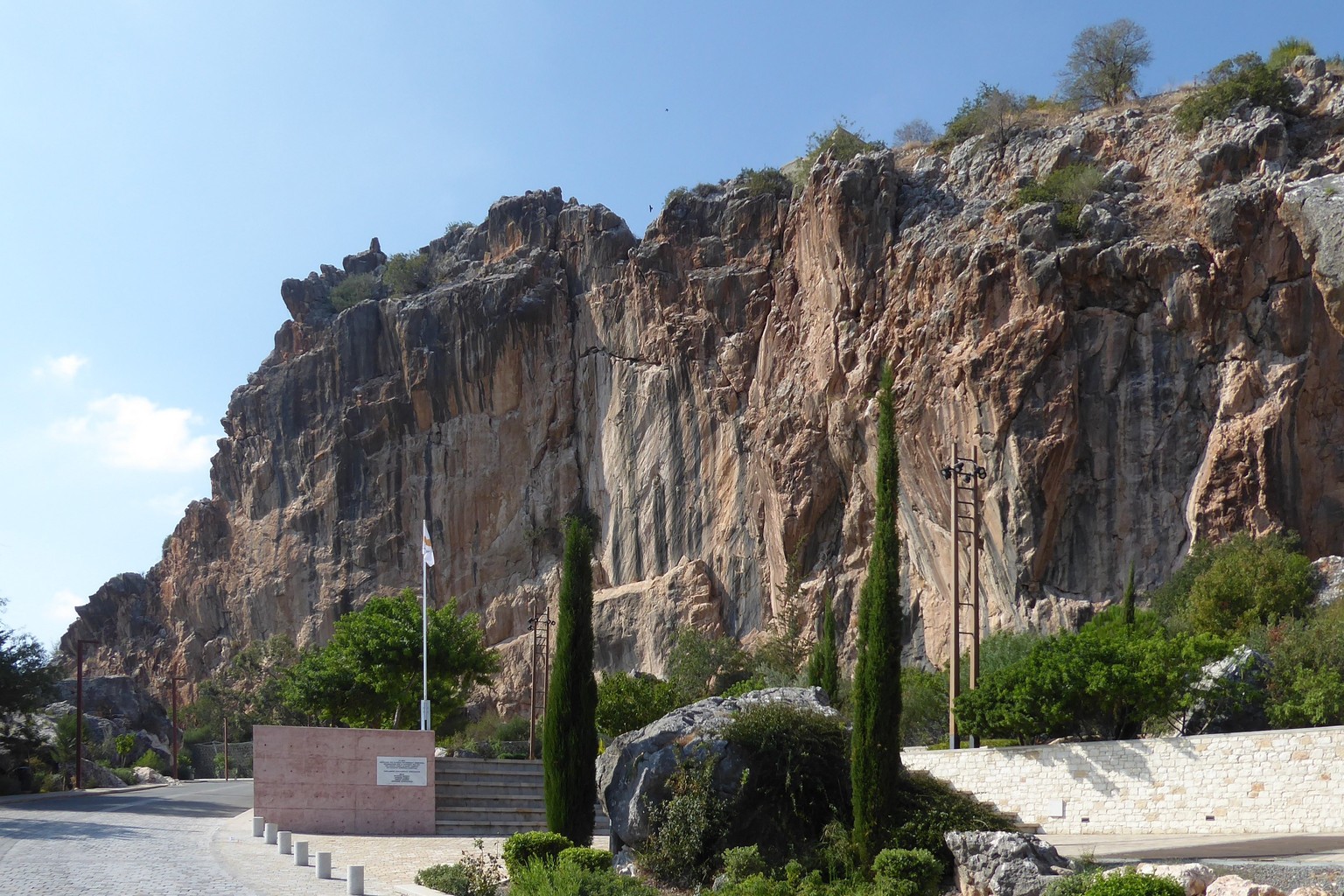
Episkopi is a village in the Paphos district, about 10 km east-north-east of Paphos town in a straight line, on the west bank of the Ezousa river, and not to be confused with Episkopi near Kourion in the Limassol district. Its landmark is an enormous rock which, in the words of the village's environmental centre, dominates the landscape as you come into the village. The centre, run by the community council, is devoted to the Ezousa valley, and a circular walking trail listed by Visit Cyprus starts at its door. We read the official pages and the bus timetables on 16 November 2026.
The Rock of Episkopi
The environmental centre describes the rock as 70 m high and 250 m long, probably the largest single monolith in Cyprus; Visit Pafos, the Paphos regional tourism board, gives the same figures on its page about the rock, though its climbing page lists the crag it calls Meteora as 200 m long and 60 m high. The centre says the rock belongs to the Mamonia geological complex and is designated a protected landscape under the name Rock of Episkopi. Visit Pafos's page on the rock, which it titles the Great Rock of Episkopi, says it is often called the Meteora of Cyprus.
The rock matters for wildlife too. Cliff plants grow in the cracks of its limestone, among them Verbascum levanticum, which the centre says has been found in only a few places in Cyprus, and a significant population of Bosea cypria grows at its foot. The centre notes that there are only three species of Bosea in the world, in Cyprus, the Canary Islands and the Himalayas. At least three pairs of peregrine falcons nest in the Ezousa valley, one of them on the rock, according to the centre, which also names the Cyprus wheatear, a bird that breeds only in Cyprus, and one of the island's largest populations of jackdaws.
Hilarion the Great and the church on the rock
Episkopi's other claim is a saint. Visit Cyprus says that Hilarion the Great, a hermit it dates to 291 to 371 AD, spent the last years of his life on a hill outside the village, and the centre says he settled there with a disciple, near a former temple. The tradition draws on the Life of Hilarion that St Jerome wrote in the late 4th century, which describes his last refuge in Cyprus as a place twelve miles from the sea among rugged mountains, near the ruins of an ancient temple, where he lived for five years and died in his eightieth year. Jerome also records that Hilarion's disciple Hesychius secretly took the body back to Majuma in Palestine about ten months later.
The village church, dedicated to the saint as Agios Ilarionas, stands on top of the rock, and Visit Cyprus's trail page names the rock as the walk's most impressive viewpoint, with views over the Ezousa valley to the Paphos forest and the Troodos range. Below the rock are the ruins of an older church of the saint, and the village keeps his feast on 21 October, according to Visit Pafos.
The village's name comes from the Greek for a bishop's seat. Visit Cyprus and the centre say the Orthodox bishop of Paphos moved his seat here from Polis Chrysochous in the Frankish (Lusignan) period, and the centre dates the move to the reign of King James II, 1460 to 1473; before that, both say, the village was called Komi.
The Ezousa valley
The riverside part of the walk, including the ford, runs through a Natura 2000 site of about 420 hectares in the Ezousa valley, Episkopi Morou Nerou (CY4000005), designated under the EU Habitats Directive, according to the European Environment Agency's site data. The loop also passes Moro Nero, which the centre describes as an abandoned Turkish Cypriot village, where the ruins of the church of Agios Gennadios are.
Walking the Ezousa trail
Visit Cyprus lists the Ezousa Walking Trail as a circular route of 7.6 km that starts and ends at the Environmental Information Centre, takes about three hours and is graded 2 for its downhill and uphill stretches around the valley. The centre's own downloadable trail map gives 7 km and shows the loop heading north out of the village past Moro Nero, crossing the river and coming back down the valley. Both elevation models we checked put the centre at about 250 m and the lowest point of the loop, beside the river, at about 135 m, so expect a descent and a climb of more than 100 m.
OpenStreetMap maps most of the loop on village lanes and dirt tracks rather than narrow paths, with a ford where it crosses the river, so ring the centre before you set out after heavy rain. Visit Cyprus says the crossing is shaded by oriental plane and oriental alder trees, and among the plants it lists along the way are the Cyprus cyclamen, Bosea, oleander, carob, terebinth and kermes oak. The centre also publishes a map of the nature trail between Episkopi and Kallepia, which it gives as 8 km long.
The Environmental Information Centre
The centre stands on the main road from Paphos, within the village boundaries. It was a project of the Episkopi community council, funded by the European Union and the Republic of Cyprus under the Rural Development Programme 2007 to 2013, and the council manages it. Inside are a 24-minute film on the valley's plants and animals, an exhibition hall with photographs, touch screens and dioramas on its geology, flora and fauna, and a laboratory for pupils, students and researchers; outside, a botanical garden groups the valley's plants by habitat, endemics, bulbs and rare plants.
The centre and Visit Cyprus give the same hours: Tuesday to Saturday 08:30 to 14:00 and Sunday 10:00 to 14:00, with the last tour starting at 13:15; it is closed on Mondays. When we checked again on 19 November 2026, the centre's own online calendar showed that its refurbishment closure ended on Wednesday 18 November as planned and that it was open for tours again from Thursday 19 November; the calendar also showed it closed on 25 and 26 December 2026. Visit Cyprus says that it opens all year except on Christmas Day, New Year's Day and Orthodox Easter Sunday, and lists entry at 5 EUR, or 2 EUR for children up to 8 and adults over 65; the centre's own site gives no prices, so check when you book a tour on +357 26 642 234. The centre also holds talks and workshops. The next one on its own calendar is an astronomy presentation and star party in English by the amateur astronomer David Raffe on Friday 11 December 2026 at 18:30, with guided star gazing in the back garden from about 19:45; it is for ages 9 and over and costs 6 EUR, or 5 EUR for under 18s. The calendar says booking is essential, on the same number in the mornings or through the centre's contact page, and that if the sky is cloudy another date will be given to those who booked.
Getting there, when to go and costs
By car, the centre is 16.3 km and about 24 minutes from Paphos Castle at the harbour by OSRM's routing estimate without traffic, the last 10.6 km of it on the E710, and 74.6 km and about 66 minutes from Limassol Castle, 58.3 km of it on the A6 motorway. OpenStreetMap shows a car park next to the centre.
By bus, we checked the timetables of all seven operators published on the Motion bus card site, and the only route that stops within 800 m of the centre is OSYPA's 609. From Monday to Friday it leaves Karavella Bus Station in Paphos at 07:50, 11:10, 14:20 and 15:40 and reaches the stop called 1st Stop Episkopi Pafou, about 240 m on foot from the centre, 23 to 28 minutes later. On Saturdays it leaves at 09:00 and 12:40 and takes 37 minutes, and there is no Sunday service. Buses back to Karavella leave from Episkopi Pafos Square, about 680 m from the centre on foot, at 07:00, 08:30, 11:50 and 15:00 on weekdays and at 09:40 and 13:20 on Saturdays. A single ticket on OSYPA's buses costs 2 EUR and can be bought on the bus.
On days the centre is open, from Tuesday to Friday, the 07:50 from Karavella leaves time for the walk and the centre before the 15:00 back. On Saturdays the 09:00 leaves time for the walk but not for the centre as well before the last bus back at 13:20, and the centre is shut on Mondays. The costs are the centre's entry fee, if you go in, and 2 EUR for each single bus ticket. The facts in this guide were checked on 16 November 2026. If days out like this are part of why you are thinking of moving to Cyprus, our relocation help can take the paperwork off your hands.

