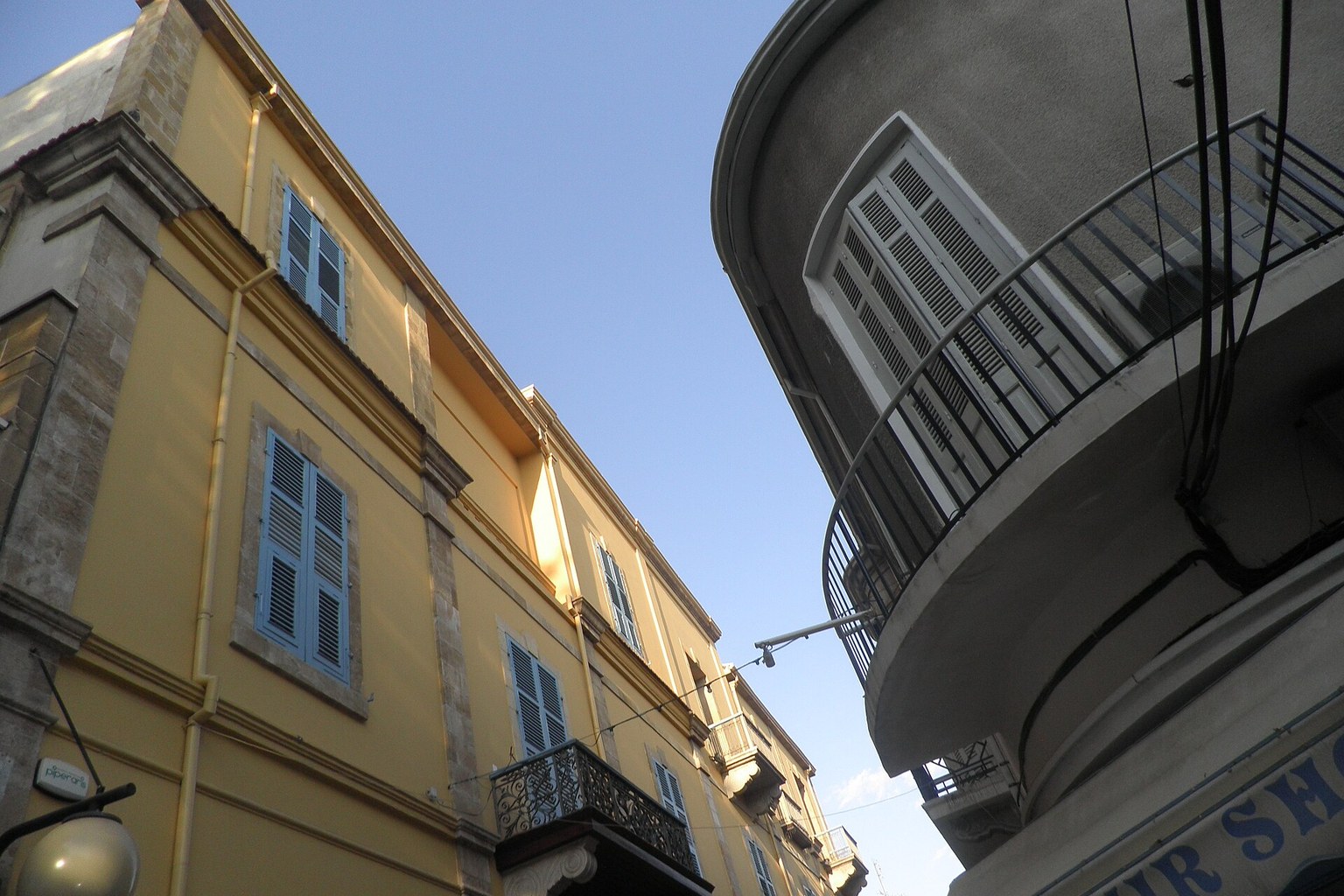
The Leventis Municipal Museum of Nicosia tells the history of Cyprus's capital from prehistory to the present day. It stands at 15-17 Ippokratous Street in the Laiki Geitonia quarter of the city. Its own pages say that it occupies three historic buildings, restored and adapted for the museum, and that more than 10,000 objects, among them maps, documents, paintings, engravings and costumes, tell the story of the city.
The museum's history page says that it was born in 1984 from an idea of Lellos Demetriades, then mayor of Nicosia, and from the sponsorship of the A. G. Leventis Foundation, and that it was inaugurated in April 1989. The Foundation's own page adds three points. After an agreement with the municipality in 1984, the Foundation bought and renovated a listed neoclassical building on Ippokratous Street. The municipality and the Foundation opened the museum to the public by 1989. In 2002 and 2008 the Foundation bought two more buildings, behind and next to the first one, which doubled the exhibition space.
In 1991 the museum received the European Museum of the Year Award, which both the museum and the Foundation record on their pages. The museum's page says that the award was given by a committee working under the auspices of the Council of Europe.
The galleries: Nicosia period by period
The museum's three floors house the permanent galleries, in chronological order: ancient Nicosia, the Byzantine period, the medieval Frankish and Venetian periods, the Ottoman period and the British period, ending with the Republic of Cyprus and Nicosia today.
The museum's page on the first gallery traces the city back to the kingdom of Ledra. Around 672 BC, it says, a list of the kingdoms that paid tribute to the Assyrian king Esarhaddon named Onasagoras as king of Ledra. The objects the page shows include pottery dated 1450 to 1200 BC and a pair of gold earrings of the 4th century BC. In the Roman period, the page adds, Ledra dwindled to a small village.
Nicosia probably became the island's capital in the 10th century, according to the Byzantine gallery's page. In the early 13th century its Greek name, Leukosia, was recorded in texts, and its Latin form, Nicosia, also became widespread. During the Frankish period, which the museum dates from 1191 to 1489, Nicosia was the seat of the kingdom that the Lusignans, a family of French nobles, established on the island. In 1567 the Venetians decided to fortify the city, and the military engineer Giulio Savorgnano proposed walls shaped like a star, with 11 heart-shaped bastions. In 1570 the city fell to the Ottomans.
The Ottoman gallery's page describes Nicosia as the seat of the island's governor and of the kadi, the Ottoman judge, and records the return of the Greek Orthodox archbishop to the city. One of the objects on that page is an engraving of 1880, drawn over in pencil and charcoal by the German engraver Hermann Vogel, which shows a scene from the Ottoman siege of Nicosia in the summer of 1570.
The British gallery's page begins in July 1878, when the first British high commissioner, Sir Garnet Wolseley, arrived on the island. Cyprus became a Crown colony on 1 May 1925 and an independent state in 1960. A curfew pass from the years 1955 to 1959 is one of the objects on the gallery's page.
The last gallery covers the Republic of Cyprus from 1960: the constitutional crisis of December 1963, after which the city was divided into a Greek Cypriot and a Turkish Cypriot sector, the coup of 15 July 1974 and the Turkish invasion that followed, and Cyprus's entry into the European Union on 1 May 2004. The museum says that the dividing line came to be called the Green Line because Major-General Peter Young, then commander of the British forces in Cyprus, drew it on the map with a green pencil.
Six special collections
Besides the period galleries, the museum's website lists six collections under the heading 'Unique Collections'. Two are private collections of antiquities that the museum holds on long-term loan. The Leto and Costakis Severis Collection, mainly ancient Cypriot pottery from the Chalcolithic to the Hellenistic period, has its own gallery in the Constantine Leventis Wing. The museum says that this wing was the home of Christodoulos Severis (1834 to 1900), the first mayor of Nicosia. The Chris Phylactou Collection, mainly Bronze Age pottery with jewellery of the Classical and Hellenistic periods, was first shown to the public in 2010, when, the museum's page says, the museum reopened.
The medieval ceramics collection follows Cypriot glazed tableware from the 13th century to the 16th, most of it decorated in the sgraffito technique, with knights, noble ladies and coats of arms among its motifs. A gallery on Caterina Cornaro, the last queen of Cyprus, who handed the island to Venice in 1489, shows paintings and engravings, and its page shows a paper score, dated 1841, of La Reine de Chypre, an opera about her.
The map collection began in 1989 with nine maps given by Lellos Demetriades. It holds mainly maps of Nicosia from the 16th to the 18th century that show or refer to the Venetian walls and the Ottoman siege of 1570. The museum's page on the jewellery collection says that under Ottoman rule Nicosia was the island's largest centre for goldsmiths and silversmiths, and it names earrings, bracelets and rings as the most common pieces.
Messages on Metal, to 10 January 2027
When we checked on 21 November 2026, the museum was showing 'Messages on Metal. A Timeless Dialogue with Cyprus', a temporary exhibition presented with Alpha Bank Cyprus. The museum's page gives its dates as 16 October 2026 to 10 January 2027. According to the museum, the exhibition brings part of the Alpha Bank Numismatic Collection to Cyprus for the first time. Of its 136 coins, 110 come from Alpha Bank's collection, 23 from the museum's own and 3 from the collection of the A. G. Leventis Gallery. They are arranged in three sections: 'Transactions', 'Narration' and 'Symbolism'.
The museum's programme also listed two free workshops in Greek with the engraver Panayiotis Andreou, both from 10:30 to 12:00 and both needing a booking on +357 22661475: 'From the coin... to your own imprint!', which the museum's website lists among its programmes for adults, on Saturday 28 November 2026, and 'I engrave my own coin!', for children aged 8 to 12, on Sunday 29 November 2026. Both pages describe participants designing a coin, engraving it on a wooden block and printing it on paper.
A European award in 2026
In 2026 the museum's project on the Green Line, built around its temporary exhibition 'Sector 2: Nicosia', won a European Heritage Award / Europa Nostra Award in the category Citizens' Engagement and Awareness-raising, and Europa Nostra's own list of the 2026 winners includes it. The museum says that the exhibition linked oral testimonies, objects, photographs and personal memorabilia with archive material. When we checked, the exhibition was not among the current events on the museum's What's On page, and the museum's website has a 360-degree virtual tour of it.
Opening hours, entry and getting there
The museum's contact page gives its opening hours as Tuesday to Sunday, 10:00 to 16:30, and says that it is closed on Mondays and all public holidays. Visit Cyprus lists the entrance as free. For Christmas 2025 and New Year 2026, the museum's notice gave closures on 25 and 26 December 2025 and on 1, 2 and 6 January 2026, and closing at 15:00 on 24 and 31 December 2025. Its hours for Christmas 2026 and New Year 2027 were not on its website when we checked, so look there or ring +357 22661475 before a visit over Christmas and New Year.
Visit Cyprus says that the museum offers facilities for disabled visitors. Its accessibility listing for the museum records a lift and an accessible toilet, and it marks access ramps and disabled parking as not available, so ring ahead if you need step-free access. The free Smartify app has information on selected objects from the collections.
In the bus timetable data for 21 to 27 November 2026, Intercity buses from Limassol, Larnaca and Paphos were timetabled to stop at Dionysios Solomos Square on every one of those days: at least 22 journeys a day from Limassol, at least 20 from Larnaca and at least eight from Paphos. From that Intercity stop to the museum's entrance is about 350 metres on foot by the OpenStreetMap walking route, or about 260 metres in a straight line.
We checked the museum's own pages, the A. G. Leventis Foundation's page on the museum, Visit Cyprus's listings, Europa Nostra's list of the 2026 winners and the bus timetables on 21 November 2026.

