Kritou Terra is a village in the Paphos district, about 20 km north of Paphos town and about 9 km south of Polis in a straight line. Visit Pafos, the Paphos regional tourism board, places it in the Laona area, overlooking Chrysochou Bay, and Visit Cyprus counts it among the area's wine-growing villages. It stands at about 460 m above sea level: Visit Cyprus gives 470 m and Visit Pafos's villages page 465 m, close to the 446 to 466 m that the two elevation models we checked give across the village, although another Visit Pafos page says 570 m, about 100 m higher.
The name is explained in two ways. Visit Pafos says the first part is believed to come from Erotokritos, the village's first settler and feudal lord, and that terra, Latin for land, was added in the Frankish period, when the village became a fief. Visit Cyprus says the village was known as Kritou under Frankish rule and is marked on old maps as both Critu and Terra, which it takes as a sign that two villages merged into one; OpenStreetMap still maps a hamlet called Terra about 1 km north of the village in a straight line. Visit Pafos also says Kritou Terra set up its own elementary school in 1796, the first village in the district to do so.
The Kefalovryso spring
At the entrance to the village is Kefalovryso, a stone-built spring that Visit Pafos dates to 1908 and credits to Kritou Terra's own stonemasons. Its six carved spouts still run, it says, and its water irrigated the orchards (a pump still supplies the nearby fields), powered four of the village's fifteen watermills and filled the troughs of the communal laundry, where the women washed clothes and bathed. Visit Pafos says on one page that it was once the third largest in Cyprus by volume and on another that it is the fourth largest, so we will not rank it.
Visit Pafos also describes a cave-tunnel more than 100 m long, on the right as you enter the village, that crosses its whole width. It served as an underground waterway and, according to legend, as a secret refuge for villagers under Ottoman rule.
The casino and its painted salon
The village also has a 19th-century casino, about 150 m from the village centre in a straight line. Visit Pafos says it was founded by a local man, Savvas Makrides; it was an entertainment and events centre as well as a gambling house, drew well-off visitors from nearby villages, the rest of Cyprus and abroad, and its managers brought in dancers from Alexandria, Izmir, Antalya and Adana. The sources do not agree on its place in history: Visit Pafos's casino page calls it the only casino in Cyprus from 1880, its villages page speaks of one of the island's first casinos in the Ottoman period, and Visit Cyprus of the island's first, so we vouch for none of them.
Its salon, about 45 square metres, keeps folk-art wall paintings that Visit Pafos describes in detail. On the western wall, a man with a frilly scarf wrapped round his head stands beside a woman holding flowers, and a second scene shows Athanasios Diakos, a hero of the Greek War of Independence, being captured by two armed Turkish soldiers. Another mural shows the Greek wrestler Panagis Koutalianos (1847 to 1916) with a cannon as a symbol of his strength; Visit Pafos says he visited the area in 1896. Visit Pafos also says there was a coffee shop underneath, where notes of what regulars owed can still be seen on the walls. Neither tourism board gives opening times for the building, so do not count on seeing inside.
Kornesios and the village church
Visit Cyprus calls Kritou Terra the birthplace of Hadjigeorgakis Kornesios, the most prominent dragoman of Cyprus, an office that, it explains, linked the Ottoman pasha with the local population; the Ottomans executed him in 1809. Visit Pafos says a large mansion in the village, now divided into smaller houses, was his family's summer house, and that he built Panagia Chryseleousa, which Visit Cyprus calls the village's main church, in 1804; it stands about 170 m north of the village centre in a straight line. His house in Nicosia, now the Ethnological Museum, has been closed to the public since 1 September 2026 until further notice because of technical problems, according to Visit Cyprus.
Agia Aikaterini at Fytefkia
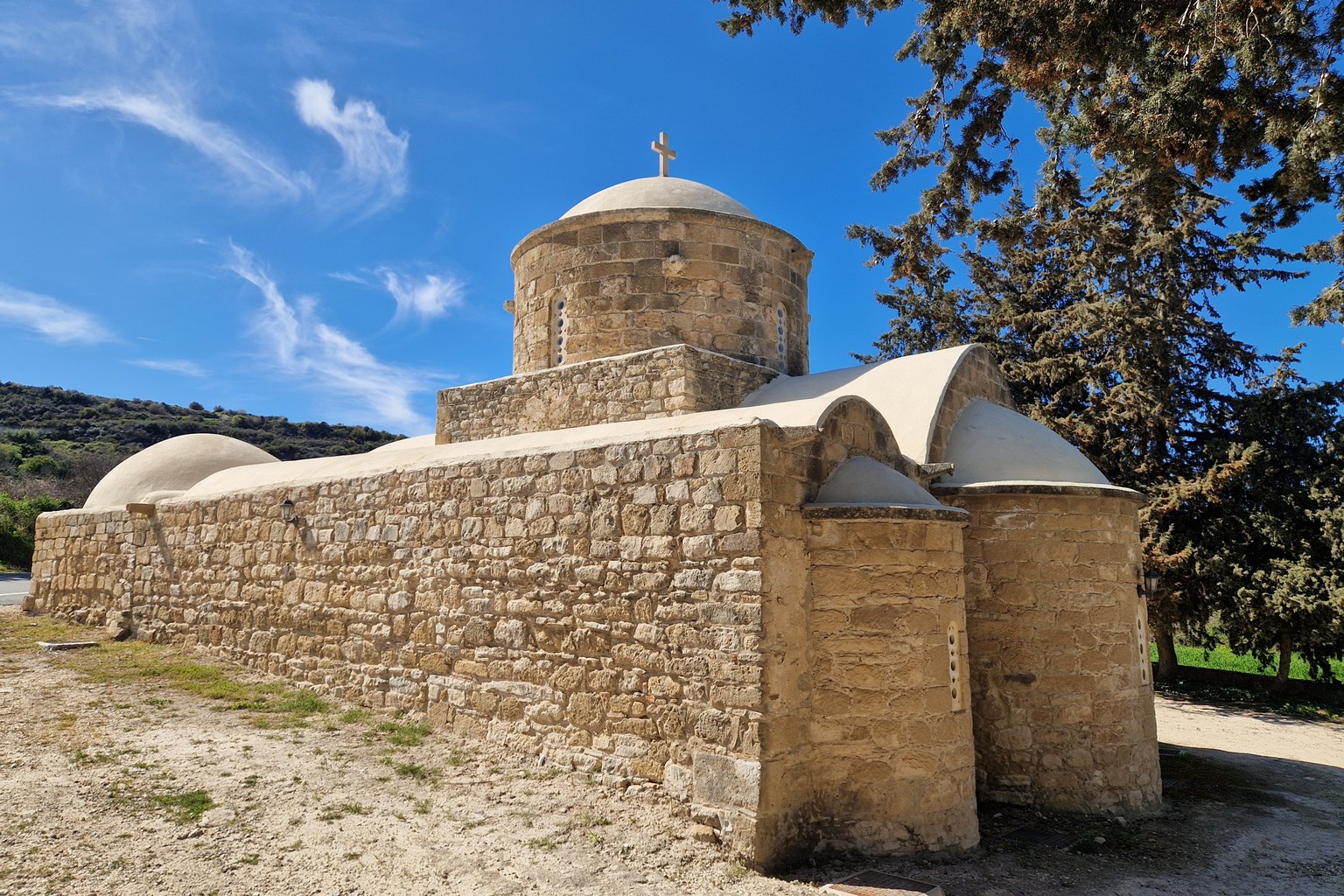
Of the village's many churches and chapels, Visit Pafos says one stands out, and it is in the countryside: Agia Aikaterini (Saint Catherine) at Fytefkia. Visit Cyprus puts it about 3 km from the village; on OpenStreetMap it stands 2.6 km north-east of the village centre in a straight line. The Metropolis of Paphos dates it to the 15th century and describes a three-aisled basilica with a dome and a narthex roofed by three domes; Visit Pafos dates it to the late 15th and early 16th centuries and calls it one of the most important basilicas of the Latin period.
According to the Metropolis, the church was badly damaged in the earthquakes of 1953 and restored by the Department of Antiquities in 1956 and 1957, and a few of its wall paintings survive. It was a dependency of the Monastery of Saint Catherine at Sinai until 1911, when its property was sold. After a new altar was installed and a large part of the church was restored, Metropolitan Tychikos of Paphos consecrated it again: the Metropolis's service schedule announced the consecration for Saturday 23 November 2024, although its page on the church gives 23 November 2023.
Saint Catherine's feast is on 25 November (a Wednesday in 2026), and the Metropolis says the saint is especially honoured in Kritou Terra, where the church serves as the village's country chapel. Visit Cyprus says services are held there once a year, on the saint's day. We found no published time for the 2026 service: check the Metropolis's website, where it posts each week's services in Greek a few days ahead, or ring it on +357 26 821 000 before you go, and do not count on finding the church open on other days.
The Kremmiotis waterfall
North-east of the village runs the Kremmiotis (spelt Kremiotis on OpenStreetMap), one of four rivers that Visit Pafos says pass through Kritou Terra, and Visit Pafos calls its waterfall renowned and says it draws thousands of locals and visitors every year. It describes the fall in two parts, a cave where the water drops through a large hole and, through a four-metre tunnel, a second fall where the water lands on a rock, and says the community has worked since 2016 to promote the area's natural assets, above all the birds that rest there.
OpenStreetMap shows a gravel car park for the waterfall about 900 m north-east of the village centre (it marks it as a paid car park, which we could not confirm) and the fall it labels Kremiotis Waterfall about 1.5 km north-east of the village centre, both in a straight line. On foot from the village bus stop, the route we mapped is about 2.2 km, roughly half an hour each way: on OpenStreetMap it follows village streets and paved lanes, then an unpaved track and, at the end, a path with steps and a footbridge, so wear sturdy shoes. Visit Pafos says the river once flowed strongly all year round, and we found no current report of how much water is falling this month.
Getting there, when to go and costs
By car, Kritou Terra is 29.5 km and about 37 minutes from Karavella Bus Station in Paphos by OSRM's routing estimate without traffic, and 32.7 km and about 43 minutes from Paphos Castle at the harbour: about 17 km of it on the B7 north out of Paphos, then 6.5 km on the E711 and 4.5 km on the E709. From the bus station in Polis Chrysochous it is 11.4 km, about 16 minutes.
By bus, we checked the timetables of all seven operators published on the Motion bus card site, and only one route stops in the village: OSYPA's 641 between Karavella Bus Station and Polis Chrysochous, which runs from Monday to Saturday, with no Sunday service, on the timetable valid until 1 January 2027. Buses leave Karavella at 12:00 and 15:20 and, after calling at Kathikas, Pano Arodes, Ineia and Drouseia, reach the stop called Kritou Tera, about 110 m on foot from the village centre, at 13:06 and 16:11. Towards Paphos, buses leave Kritou Tera at 07:42 and 14:06 and reach Karavella at 08:40 and 15:00. Towards Polis they leave at 13:06 and 16:11 and arrive at 13:30 and 16:30, and the buses from Polis at 07:20 and 13:45 reach Kritou Tera at 07:42 and 14:06. A single ticket on OSYPA's district routes costs 2 EUR, paid to the driver on the bus.
From Paphos, the bus leaves you about an hour in the village, between the 13:06 arrival and the 14:06 back, which is not enough for the waterfall as well; from Polis, the 07:20 out and the 13:06 or 16:11 back leave most of a day. To see Agia Aikaterini open, 25 November is the day to aim for. The church is about 3.6 km on foot from the Kritou Tera bus stop and the first bus from Paphos arrives at 13:06, so check the service time with the Metropolis before you rely on the bus. Neither tourism board lists an entry fee for any of the village's sights, so the only cost we could confirm is the bus fare. The facts in this guide were checked on 17 November 2026. If days out like this are part of why you are thinking of moving to Cyprus, our relocation help can take the paperwork off your hands.

