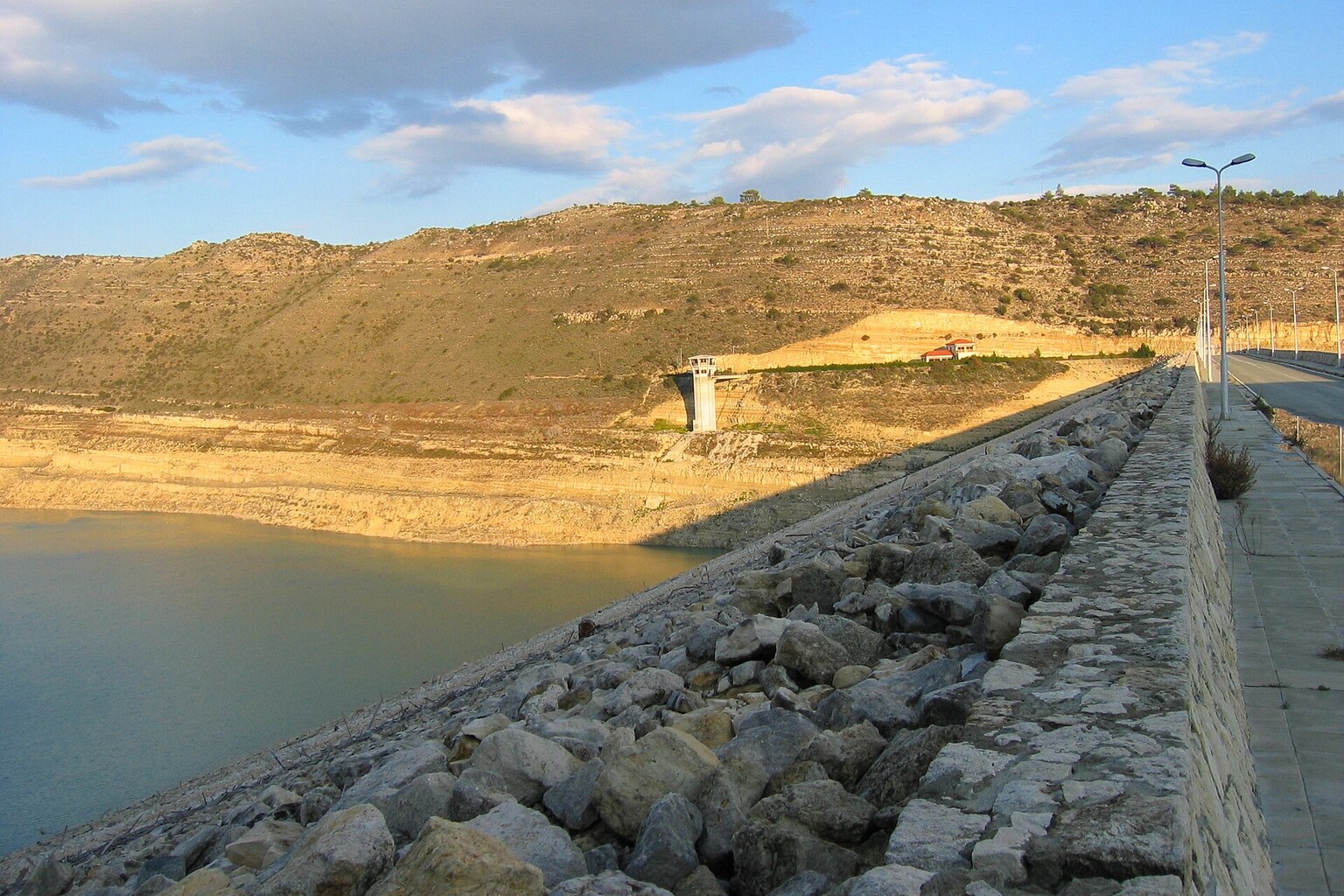
The Water Development Department is the government department responsible for planning, building and operating dams and other waterworks, and it also buys desalinated water under contract. On the Reservoir Storage page of its website it posts the amount of water held in its reservoirs as an Excel file. When we checked early on 19 November 2026, the latest file was dated Tuesday 17 November 2026. Its grand total covers 18 reservoirs with a combined capacity of 290.8 million cubic metres, and on that day they held 101.4 million cubic metres, 34.9% of capacity. On the same day of 2025 the same file gives 29.0 million cubic metres, 10.0% of capacity, so on 17 November the reservoirs held three and a half times as much water as a year earlier.
The file sorts the reservoirs under four headings: eight under "Southern Conveyor", three under "Pafos", four under "Chrysochou" and three under "Nicosia". Three more, Tamassos, Klirou-Malounta and Solea, are listed separately under "Recharge/Other" and are left out of the grand total. None of the 21 reservoirs in the file is in the north, and the file is not a list of every dam: the Department's catalogue of reservoirs has 109 entries. The Department's statistics run by hydrological year, from 1 October to 30 September, and the file shows 3.3 million cubic metres flowing into the 18 reservoirs between 1 October and 17 November 2026.
A big inflow after two poor years
The difference from last year comes from the inflow, the water that flows into the reservoirs. By the Department's figures, 117.1 million cubic metres flowed into the reservoirs in the hydrological year from October 2025 to September 2026, against 18.7 million in 2024/25 and 24.7 million in 2023/24. The Department's yearly series begins in 1987/88, and only three years in it had a smaller inflow than 2024/25: 1990/91, 2013/14 and 2015/16. From 1987/88 to 2023/24 the inflow averaged about 83 million cubic metres a year, and the largest in the series was 265.0 million, in 2018/19. The 2025/26 total was the largest since 2021/22, when 153.8 million cubic metres flowed in.
Most of the 2025/26 water arrived between February and April 2026: those three months brought 83.2 million cubic metres between them, 71% of the year's inflow, and March alone brought 35.4 million. The file's column headed "Maximum Storage 2026" gives 123.4 million cubic metres for the 18 reservoirs on 3 June, and 3 June also has the highest total of any day in 2026 in the Department's online monitor; by 17 November the total was 22.0 million lower. In the new hydrological year, October 2026 brought 2.3 million cubic metres and November, up to the 17th, 1.0 million. A year earlier, the file shows 0.1 million in October 2025 and 0.2 million in the whole of November 2025.
Dam by dam: Kouris, Asprokremmos and the rest
All four groups were well above last year's level. The Southern Conveyor reservoirs were at 33.1% of capacity on 17 November, against 10.5% a year earlier; the Pafos group at 36.1%, against 8.7%; the Chrysochou group at 39.0%, against 10.4%; and the three Nicosia reservoirs at 73.7%, against 2.0%. The Nicosia group is small, though, with a combined capacity of 3.5 million cubic metres.
Kouris, in the Limassol district, is by far the biggest reservoir in the file: its capacity of 115 million cubic metres is 39.5% of the total capacity. The Department's table of large dams and its online monitor both date the dam to 1988, and the table puts it on the Kouris river. On 17 November it held 41.7 million cubic metres, 36.3% of capacity, against 10.2 million, 8.9%, a year earlier. The file's column headed "Maximum Storage 2026" gives 48.3 million cubic metres at Kouris, on 16 June, 42.0% of its capacity.
Asprokremmos, in the Paphos district, is the second largest, with a capacity of 52.4 million cubic metres; the same two sources date it to 1982. On 17 November it held 18.2 million cubic metres, 34.8% of capacity, against 4.4 million a year earlier. Between them, Kouris and Asprokremmos held 59.9 of the 101.4 million cubic metres stored that day, almost three fifths of the total.
The next five by capacity ranged from 17.2% to 40.3% full. Evretou, in the Paphos district, was at 38.0% of its 24.0 million cubic metres and Kannaviou, also in the Paphos district, at 40.3% of 17.2 million. In the Larnaca district, Kalavasos was at 21.2% of 17.1 million, Dipotamos at 23.2% of 15.5 million and the Lefkara reservoir at 17.2% of 13.9 million. Germasogeia, in the Limassol district, the eighth largest, was fuller than any of them: 45.9% of 13.5 million cubic metres, up from 4.2% a year earlier.
The lowest level, as a share of capacity, was at Achna, 8.4% of 6.8 million cubic metres. Of the 18 reservoirs in the grand total, Arminou, in the Paphos district, had the highest share, 75.1% of 4.3 million cubic metres, apart from the small Kalopanagiotis reservoir, which has a capacity of 0.36 million cubic metres and was full. The three listed under "Recharge/Other" were fuller still: Klirou-Malounta at 91.2%, Solea at 81.7% and Tamassos at 75.9%. The file also has a line for water moved from Arminou to Kouris, and that line showed that no water had been moved since 1 October 2026.
Dams, desalination and boreholes
The reservoirs are only part of the supply. The Department says that until 1997 rainfall was the only source of water in Cyprus, and that two other sources have since been added: desalinated sea water, which goes to the drinking water supply, and recycled waste water after tertiary treatment, which irrigates farmland and green areas. Its desalination page says the plant at Dhekelia started operating in April 1997.
The Department's introduction to the island's water resources explains the need: of the water that falls on the area the government controls, 2,750 million cubic metres a year on average, only 10%, some 275 million cubic metres, can be used, because about 90% returns to the atmosphere through evaporation and transpiration. The Department's rainfall table for the same area gives an average of 541 millimetres a year from 1901/02 to 1970/71 and 471 millimetres from 1971/72 to 2023/24, the latest year in the table.
The Department's table of water supplied for domestic use from the government waterworks shows how the mix changes from year to year. In 2023, the latest year in the table, desalination plants supplied 59.9 million cubic metres of a total of 105.9 million, dams 41.5 million and boreholes 4.5 million. In 2013 the dams supplied 59.1 million cubic metres and desalination 10.7 million, while in 2016 the dams supplied 16.4 million and desalination 68.2 million. For 2008 and 2009 the table also lists water brought from Greece: 3.3 million cubic metres in 2008 and 2.0 million in 2009.
Domestic use is not the only demand on the dams. In 2023 the government waterworks supplied 179.3 million cubic metres in all, by the Department's supply table: 105.9 million for domestic use, 69.9 million for irrigation and 3.5 million for recharge. Of the irrigation water, 44.9 million cubic metres came from dams, 14.5 million was recycled water and 10.5 million came from boreholes.
How to check the figures yourself
The Department's figures are free to read, with no sign-in. Its Reservoir Storage page on gov.cy carries the latest Excel file, named by date (17-NOV-2026 UK when we checked), with a file of graphs beside it, and it links to the Department's Reservoir Storage Monitor System at dams.wdd.moa.gov.cy. When we checked, the monitor already had figures for Wednesday 18 November 2026: by our sum of its figures for the same 18 reservoirs, they held 101.3 million cubic metres, 34.8% of capacity. It had no figures for any Saturday or Sunday in 2026, and some weekdays were missing too.
In the Excel file, each row gives a reservoir's capacity, its inflow in the last 24 hours and since 1 October, the water stored that day as a quantity and as a percentage, and the figure for the same day a year earlier. The last two columns, headed "Maximum Storage 2026", give a quantity and its date. These maximum figures do not seem to count October and November: for Arminou and Achna they are lower than what the two reservoirs held on 17 November. The quantities are in MCM, million cubic metres, and one million cubic metres is a billion litres. The Department's working hours are Monday to Friday, 07:30 to 15:00, and its phone number is +357 22 609 000.
We checked the Department's Reservoir Storage page, its Excel files, its online monitor and its statistics files on 19 November 2026. The levels change every day, so read the latest file before you rely on a figure. If you are weighing up a move to Cyprus, our relocation help can take the paperwork off your hands.

