The Department of Agriculture lists the Cypriot farm products and foods whose names are registered in the EU as protected designations of origin (PDO) or protected geographical indications (PGI). When we checked on 20 November 2026, it listed 13 registered names, and four of them are cured meats made from pork: Pafitiko Loukaniko, a sausage from the Paphos district, and three products of the Pitsilia area, Hiromeri Pitsilias, Lountza Pitsilias and Loukaniko Pitsilias. All four are PGIs.
Each registered name comes with a product specification that sets out what goes in, which steps must take place in the defined area and what the finished product must be like. The EU entered Pafitiko Loukaniko in its register in October 2015, Hiromeri Pitsilias in October 2020, and Lountza Pitsilias and Loukaniko Pitsilias in February 2021. Under EU law, a product that does not follow the specification may not use the name. One company that had sold sausages as Loukaniko Pitsilias for more than ten years before the registration, and that did not follow the specification, was later given a transitional period by the European Commission (Implementing Regulation (EU) 2022/462): backdated to 2 March 2021, when the registration took effect, it let the company use the name until 1 March 2026.
Hiromeri Pitsilias: a pressed and smoked leg of pork
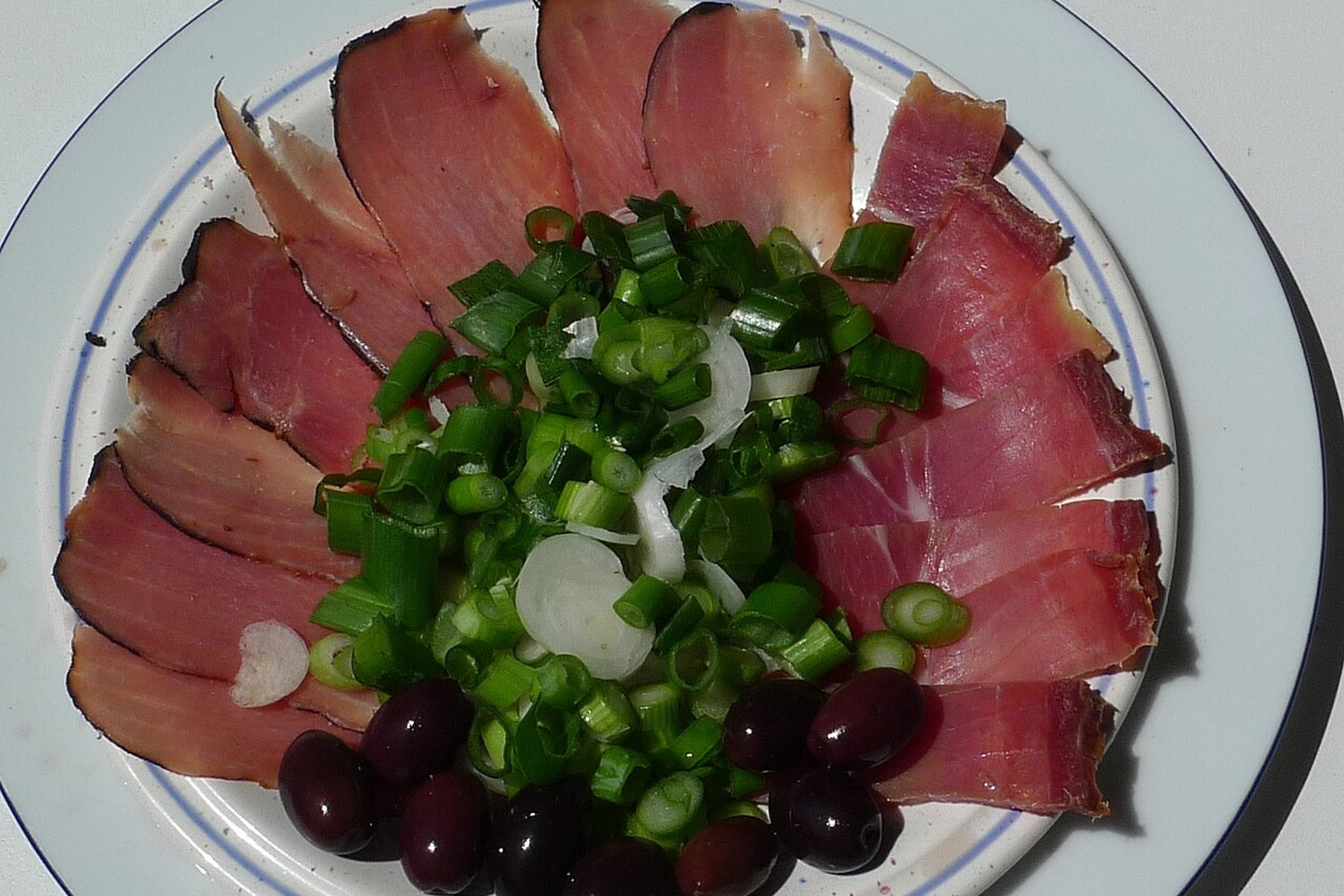
Hiromeri Pitsilias is made from a fresh leg of pork in a single piece. The only bones it may contain are those from the thigh down to the ankle. It is skinned, though the skin may be kept on the lower end of the leg, from the tip to the ankle, where it covers no meat. The other ingredients are coarse sea salt, dry red wine and, if the producer chooses, crushed coriander. The specification allows no preservatives such as nitrates or nitrites, no flavour enhancers and no other additives. On arrival the meat is checked for its colour and smell, an internal temperature of 0 to 7 °C and a pH between 5.3 and 6.
The steps that must take place in the defined area include dry salting for five to seven days, soaking in dry red wine for at least two weeks, smoking for at least one month, pressing, and further drying in a ripening room. Smoking alone, or smoking and ripening together, must last at least two and a half months. The smoking is mild, gradual and cold and alternates with pressing, and larger hams need more pressings. The finished hiromeri is pear-shaped and flattened on one side, weighs 3 to 5 kg, is dark red to black outside and red to purple inside, and contains 5 to 10% salt.
Hiromeri Pitsilias may be sold whole, with or without the bone, or sliced, packed or loose, and with or without the crust that forms on the outside during production. Removing that crust is work for the producers themselves, inside the area. Slicing and packing may take place elsewhere, the Department of Agriculture's Greek text of the specification adds. The summary published in the EU's Official Journal also cites a 2013 study by N. Patapiou and C. Lazarou that mentions exports of hiromeri from Pitsilia to Syria as early as the 18th century.
Lountza and Loukaniko Pitsilias: smoked fillet and smoked sausage
Lountza Pitsilias is made from pork fillet. It is dry salted for at least 24 hours, soaked in wine for 7 to 10 days, seasoned with crushed coriander and, if the producer chooses, ground cumin, black pepper or both, and smoked for one to two weeks, with time in a ripening room where needed. The Greek text of the lountza specification allows the salt to be sprinkled on by hand only: salting in brine and injecting salt into the meat are not accepted. The finished lountza is long, narrow and cylindrical, weighs 0.8 to 2.5 kg and contains 3 to 7% salt.
Loukaniko Pitsilias starts as pork mince, which is salted and soaked in dry red wine at the same time, for at least three days, and mixed regularly; crushed coriander, ground cumin and ground black pepper are added. The mixture goes into natural pork casing, which is tied at intervals into a string of links, and the producers make small holes in it so that moisture is not trapped inside. The sausages are smoked for two to five days and ripened where needed. Each is 2 to 4 cm across and 5 to 40 cm long, with no more than 35% fat and 1.5 to 3% salt.
Where Pitsilia begins: 37 localities and a wine rule
The three Pitsilia specifications define the same area, which they describe as mountainous: the land at 700 metres or more within the administrative boundaries of 37 localities. Twenty of them are in the Nicosia district, among them Platanistasa, Lagoudera and Fikardou; sixteen are in the Limassol district, among them Agros, Pelendri and Kyperounta; and one, Odou, is in the Larnaca district. The salting, the soaking in wine, the seasoning, the smoking and any ripening must all take place within that area.
The wine must be a dry red wine made in the area from vineyards of the local Mavro grape, which may also have vines of the red Maratheftiko, and on arrival it is checked for an alcohol content of 12 to 15% and less than 4 grams of sugar a litre. By the specifications, Mavro covered around 80% of the area planted with vines in Pitsilia. They also say that Pitsilia's cool, dry summers, mild winters and sloping, fairly poor land helped develop a way of keeping cured meat at room temperature, so that families had meat all year without storing it in fat.
Pafitiko Loukaniko: the Paphos district sausage
Pafitiko Loukaniko may be made anywhere within the administrative boundaries of the Paphos district. The pork comes from the whole animal: once the bones and fat are removed, the meat is minced and left to mature with salt in dry red wine made in the district from Mavro grapes grown there. Coriander, cumin and black pepper are compulsory, and producers may add cinnamon, cloves and mastic berries. The mixture is stuffed into pork casing and twisted so that each rope holds 6 to 10 sausages, called teratsia, which are hung to dry for two or three days in an enclosed space under controlled conditions, at no more than 45 °C and at low humidity.
Each sausage is about 3 cm across, with a length and weight left to the producer, and contains 22 to 35% fat and 1.5 to 2.5% salt. By the Department's list, a group of five producers applied for the name in Cyprus in October 2004, almost eleven years before it was registered.
From the January pig slaughter to today's producers
The specifications also record why curing belonged to winter. Until the middle of the 20th century, the Lountza Pitsilias specification says, every rural family in Cyprus raised one or two pigs a year to slaughter. In the Pitsilia villages the slaughter began on 6 January, the day of the blessing of the waters, and the meat was cured in January and February, when average daily temperatures of up to 6.5 °C kept the fresh meat from spoiling until the curing was done. The Pafitiko Loukaniko specification gives a different start: the pig slaughter began when the cold set in, around the middle of October, though somewhat later in parts of the Paphos district.
Today, the summaries published in the EU's Official Journal say, Pitsilia's producers use the same know-how in modern facilities. The lountza specification describes how smoking changes in summer, when the temperature is higher and the air drier: the fire is kept less intense and the smoking is shorter. The Greek texts of the three Pitsilia specifications name the Department of Agriculture as the control body, whose inspectors are appointed under Law 139(I)/2006: producers must be entered in a register kept by the competent authority, keep records of every delivery of raw materials and open their premises to official inspection.
Buying it: the label, the price and the date we checked
The three Pitsilia specifications require every piece, packed or loose, whole or sliced, to be labelled with the registered name and the details of the plant where it was made, of the plant that sliced and packed it, or of both. Under Regulation (EU) 2024/1143, which has applied since 13 May 2024, an agricultural product or food from the EU sold under a geographical indication must carry the EU symbol in its labelling and advertising, with the registered name in the same field of vision as the symbol, and, except on packs whose largest surface is smaller than 10 cm², the name of the producer or operator must appear in that field of vision too. Products labelled before 14 May 2026 may stay on sale until existing stocks run out without the producer's or operator's name in that field of vision.
When we checked on 20 November 2026, the online shop of one Pitsilia producer, Allantika tou Daskalou (P & I Allantopoiio Ltd, of Agros), listed its Hiromeri Pitsilias (PGI) at €31.90 a kilo, its lountza (PGI) at €22.50 a kilo and a 400 g pack of Loukaniko Pitsilias (PGI) at €6.50, all including 5% VAT. By their specifications, all three Pitsilia products may be stored packed for up to 12 months at 0 to 7 °C.
Agros, where that producer gives its address, is one of the 37 localities. By our measure on OpenStreetMap data, the village is about 38 km by road from Limassol Castle (27 km in a straight line) and about 55 km by road from Eleftheria Square in Nicosia (42 km in a straight line).
The EU's register, eAmbrosia, and the Department of Agriculture's page on protected names are free to read, and the Department's page links the full specifications, in Greek. We checked the EU regulations, the Department's list and specifications and the shop's prices on 20 November 2026.

