Pedoulas, Alona and Askas are all mountain villages, but seeing all three in a day means crossing the mountains. Alona and Askas sit on the north side of Pitsilia, the eastern part of the Troodos, 8 km and about 10 minutes apart by road. Pedoulas is on the other side of the range, in the Marathasa valley: about 40 km and 53 minutes from Alona, and 48 km and an hour from Askas, on mountain roads via Prodromos (times for an empty road; allow more for the bends). All three are small: the 2021 census counted 139 people in Pedoulas, 90 in Askas and 39 in Alona.
Pedoulas: the church of the Archangel Michael
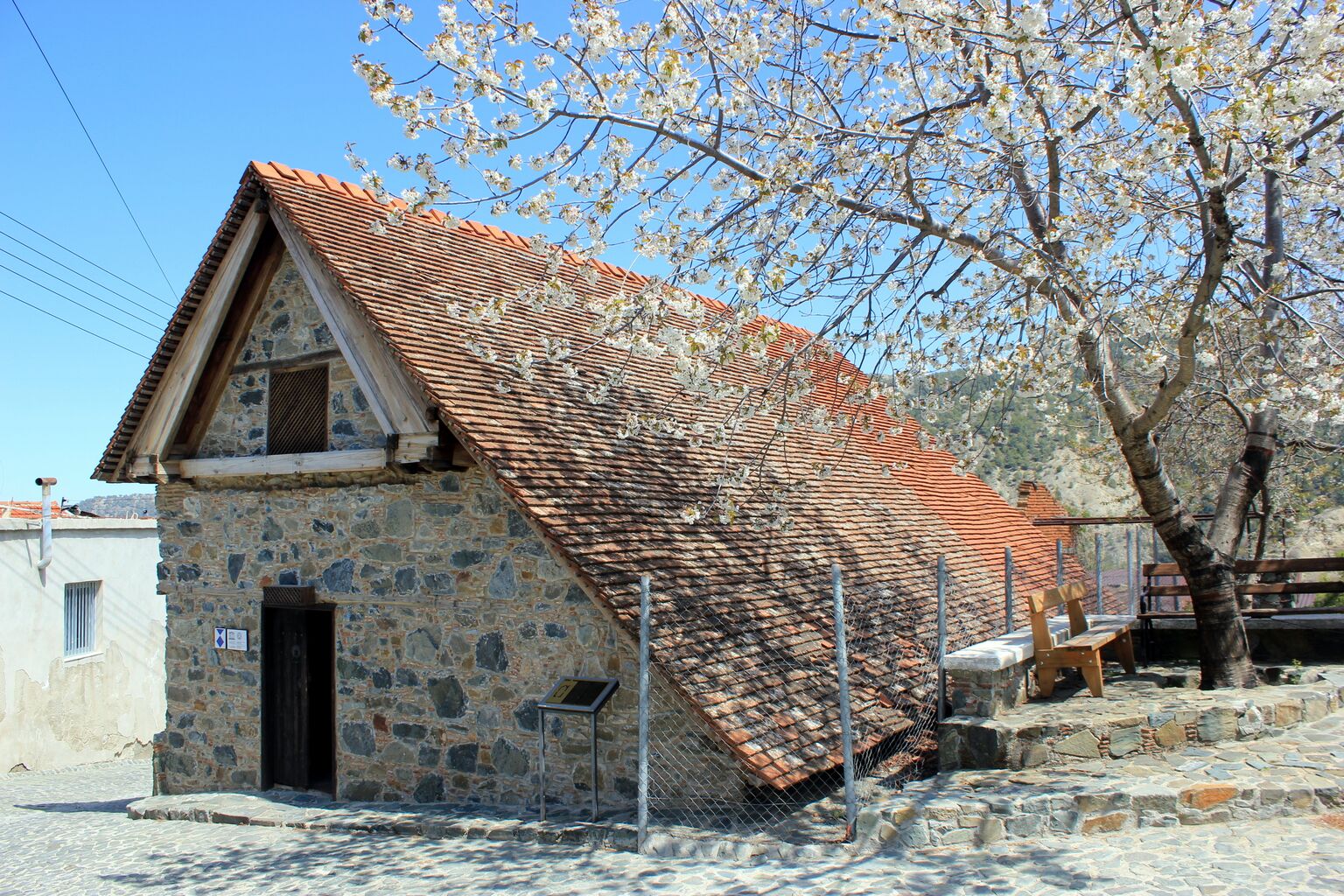
The church of Archangelos Michael stands in lower Pedoulas, a few metres from the village's Byzantine Museum. According to the dedicatory inscription above its north entrance, it was built and painted in 1474, paid for by the priest Vasilios Chamados, who is shown above the inscription with his wife and two daughters, offering the Archangel a model of the church. It is one of the few churches in Cyprus whose painter is known by name: Minas, a local painter from Marathasa, whom the Department of Antiquities calls a typical naive painter with a conservative style who followed the Byzantine tradition but was aware of the artistic trends of his time and place, hence the Western elements in his work.
It is a small single-aisled church with a timber roof, the type found across the Troodos. Because it is so small, the narthex on its south and west sides was used as a loft for the women, while only the men entered the church itself. The wooden templon also dates from 1474, and its painted epistyle carries the coats of arms of the medieval Kingdom of Cyprus next to the double-headed eagle of the Palaiologan dynasty, the last Byzantine emperors. Inside, look for the large armed Archangel Michael beside the north door and the soldiers in Western armour in the scene of the Betrayal. In 1985 UNESCO inscribed the church on the World Heritage List with eight other painted churches of the Troodos; a tenth, at Palaichori, was added in 2001.
Since August 2025 all ten churches have kept one timetable. From 16 September to 15 April they open Tuesday to Saturday 10:00 to 16:30 and Sunday 11:00 to 16:30; from 16 April to 15 September, Tuesday to Saturday 10:00 to 13:00 and 14:00 to 17:30, and Sunday 11:00 to 16:30. They close on Mondays and on the great feasts (Christmas, Holy Week and Easter, and 15 August), and entry is free. The numbers for the Pedoulas church are +357 99 812 347 and +357 22 953 636. Flash photography is not allowed, and shorts, backless tops and very short dresses should be avoided. Pedoulas celebrates the feast of the Archangels on 8 November; for service times, ask the community council (+357 22 952 629).
Two museums and the village's other churches
The Byzantine Museum, open since 1999, holds icons, sacred vessels, manuscripts and church books from the churches of Pedoulas, objects the Department of Antiquities dates from the 13th to the 20th century. Among the pieces the community council singles out are a 13th-century Virgin Hodegetria, a 14th-century Virgin Eleousa, a silver Gospel cover of 1778 and coins including a gros of King Hugh IV of Cyprus and a bezant of 1570, the last struck by the island's Venetian governors. It opens 10:00 to 16:00 in winter and 11:00 to 17:00 in summer, and closes on Mondays and public holidays (+357 22 952 629, the community council). The council does not publish an entry price, so ask at the door.
The Folklore Museum, in the village centre near the main church, opened in 2005 in a restored building that once housed a tailor, a smithy, a butcher, a coffee shop and a bakery. It shows a zivania still, wine-making and tanning tools, the tools of chair-makers, shoemakers and barbers, and the inside of a furnished village house. Entry is free, and its hours are the same as the Byzantine Museum's.
The main church of the village, the Holy Cross, was completed in 1935 and keeps a relic of the True Cross in a 17th-century silver-gilt cover, which is carried through the lanes on 1 August. A fire, reported by the Holy Metropolis of Morphou in July 2022, seriously damaged its iconostasis and wall paintings, and the church is in use again. On the Fythkia hilltop stands the chapel of the Exaltation of the Holy Cross, finished in 1986, with a cross 25.3 m high beside it.
Cherries, zivania and a base for Marathasa
Pedoulas is a cherry village. June is the peak of the Cyprus cherry season, and the two main varieties are the purple-black petrokeraza and the pinkish-white 'French' cherry, eaten fresh or made into spoon sweets and jam. Pedoulas held its Cherry Festival on 13 and 14 June 2026, and the Deputy Ministry of Tourism's festival site gives only 'June 2027' for the next one. On 25 October 2026 the Folklore Museum hosted the village's zivania and palouze festival, on the same day as Alona's.
With eight hotels and traditional guesthouses on the Deputy Ministry of Tourism's list of 8 October 2026, Pedoulas is the natural overnight base of the three, and it has a health centre (weekdays 07:30 to 15:00), a police station, a petrol station, an ATM and a post office. Two more of the ten UNESCO churches are close: Panagia tou Moutoulla, 4.5 km down the valley, and the monastery of Agios Ioannis Lampadistis at Kalopanagiotis, about 6 km away. Kykkos Monastery is about 17 km by road.
Alona: hazels, cherries and zivania
Alona sits at about 1,200 m on the north side of the Troodos, between the Madari and Papoutsa peaks, above a green valley of hazels; its community council says the hazel is grown in Cyprus only in Pitsilia. The council counts fruit for seven months of the year, from the cherries of May to the late grapes of November, and vine pergolas shade the main street for about 600 m from the village entrance to the square. The painter Telemachos Kanthos (1910 to 1993) was born here.
Alona is a zivania village. At its Zivania Festival the spirit is distilled in traditional stills and handed out free with palouze. In the late 2010s the festival was held on the first Sunday of November, but in 2025 and 2026 it was on the last Sunday of October: 26 October 2025 and 25 October 2026 (the 15th festival). In November the village keeps the feast of St George on the 3rd, with vespers the evening before.
The village church of Agios Georgios was rebuilt in 1835 after a fire, and its carved facade of 1903 is the work of the teacher and artist Christodoulos Kanthos, Telemachos's father. Its icon of St George is dated 1641. About 1 km north-west of the village, beside the old footpath to Nicosia, the chapel of Panagia Kardakiotissa, probably a 15th-century building, burned down on 30 July 1987 together with its icon and has been rebuilt.
A nature trail named after Petros Vanezis, laid out by the Cyprus Tourism Organisation, starts in the village centre and runs under the hazels. According to the council, violets and ferns grow in its damp spots in spring, and small white cyclamens flower early in autumn.
Askas: stone lanes and two old churches
Askas lies at around 900 m at the foot of Mount Papoutsa, 2 km west of Palaichori. Its houses, built of local stone, earth and pine, are packed along narrow winding lanes between tall stone walls, and the community likens the village to a swallow's nest stuck to the rock. Like most mountain villages it is emptying: the census counted 170 people in 2011 and 90 in 2021.
The main church of Askas, Timios Prodromos (St John the Baptist), stands among the hazels just south-east of the village and keeps wall paintings that, according to the community, date from about 1510 (the sanctuary) to the early 1600s and were conserved in the late 1990s by the Courtauld Institute of Art, with the Department of Antiquities and the Leventis Foundation. The smaller Holy Cross church, at the lower end of the village, has a single wall painting, a life-size St George on horseback, and clay jars built into the walls of the sanctuary and arches, which the parish text says were put there to amplify the voice. The Deputy Ministry of Tourism lists traditional games in Askas on Easter Sunday and Monday, and two licensed traditional houses in the village take guests.
Getting there
From central Nicosia it is about 47 km (49 minutes) to Askas, 50 km (57 minutes) to Alona and 74 km (77 minutes) to Pedoulas; from Limassol it is about an hour to Askas, 70 minutes to Alona and 80 minutes to Pedoulas. A loop from Nicosia through Askas, Alona and Pedoulas and back is about 170 km, more than three hours at the wheel before any stops.
Buses run, but slowly, and none links Pitsilia with Marathasa. From Tamasos bus station, which has buses to central Nicosia, route 63 goes to Askas and route 61 to Alona, six or seven times each way on weekdays and two or three times each way at weekends. Route 81 runs down the Marathasa valley from Prodromos through Pedoulas to the Atsas stop at Evrychou, where it meets buses to Nicosia: in the November 2026 timetable it makes seven trips down the valley and six up on weekdays, and four each way on Saturdays and Sundays.
In snow the police can restrict the mountain roads to four-wheel drives and cars with snow chains. On 14 January 2026 that included the Pedoulas to Prodromos road and the roads up to Troodos, and in the heavy snow of February 2025 also the Pitsilia roads around Alona and Askas. The Cyprus Police post these restrictions on their news site, so check before driving up in winter.
