Kormakitis (Κορμακίτης in Greek, Koruçam in Turkish) is one of the four villages where Cyprus's Maronite Christians have traditionally lived; the others are Asomatos, Karpasha and Agia Marina Skyllouras. At the 1960 census it had 1,115 inhabitants, 1,093 of them Maronites, so about two in five of all the Maronites on the island lived there. The Council of Europe calls it "the historic village of the Maronites, where Cypriot Maronite Arabic is traditionally spoken". Kormakitis lies in the Turkish occupied north, so a visit means crossing at one of the official checkpoints with your passport or ID.
Who the Maronites are
The Maronites are Eastern Catholics in full communion with Rome, with their own Antiochian (West Syriac) rite, and their church grew up in Syria and Lebanon. They came to Cyprus in several waves, from the late 7th or the 8th century to the end of the 13th, when the crusader states on the mainland fell. The Republic's Press and Information Office dates the first documented arrival to 686, while Guita Hourani of the Maronite Research Institute says little evidence confirms or refutes the first two waves. According to Hourani, there were 60 Maronite settlements on the island in 1224 and only four by 1878.
The 1960 Constitution recognises the Maronites as one of three religious groups, with the Armenians and the Latins, and in 1960 they chose to belong to the Greek Cypriot community. They elect a Representative who sits in the House of Representatives without a vote; since May 2026 that is Petros Nacouzi. The Maronite archbishop's seat, founded in Nicosia in 1316, moved to Lebanon in 1673 and came back to Nicosia in 1988, and the cathedral is Our Lady of Graces by the Paphos Gate. Cypriot Maronites keep Easter on the Orthodox date. The 2021 census counted 5,245 people in the Maronite group in the areas the government controls.
From 1974 to the return
In 1974 all four villages came under Turkish military control. Most people in Kormakitis stayed at first: according to the Peace Research Institute Oslo's displacement project, 813 Maronites still lived there in August 1976. Families then left over the years, mainly because of the difficulty of schooling their children and the restrictions on movement, and the number of enclaved Maronites in all the villages fell from 979 in 1975 to 234 in 1995. Agia Marina has been a military zone since 1974, and Asomatos is a Turkish army camp that opens for a few hours on Sundays for Mass; a 2017 announcement by the Turkish Cypriot leader's office on returns to those two villages has not been put into practice.
Until the late 1990s residents of Kormakitis needed police permission to leave the village, and the last restrictions went in April 2003, when the first crossing points opened. Since then many displaced families have rebuilt or renovated houses there, mainly as weekend homes. A Republic of Cyprus scheme approved in 2019 gives grants to couples aged up to 45 who move back (in 2022 Philenews reported 15,000 euros for a family with children and 10,000 for a couple without). More people live there again, though the counts measure different things: in October 2022 MPs heard that the incentives had raised the number of residents to 310, from 51 permanent enclaved residents a couple of years earlier, and that some people claimed the grants without living there full time; in February 2026 the President spoke of the successful resettlement of 367 people in Kormakitis.
The primary school reopened in April 2024, and by February 2026 the kindergarten had reopened too, after 25 years, the President said. In the same speech he listed measures his government had already decided and was putting into practice: a 30% rise in the allowances paid to enclaved and resettled people, 320,000 euros to the community council for flood works and for restoring the old kindergarten building that houses the folklore museum, and a new bus for residents' trips to and from Nicosia. UNFICYP, the UN force, still delivers basic provisions to 45 Maronites and 283 Greek Cypriots in the north, according to the UN Secretary-General's July 2026 report on the force.
Sanna, the village's own Arabic
Cypriot Maronite Arabic, which its speakers call Sanna ("our language"), is an Arabic variety with traces of Aramaic and a strong Greek influence. Until 1974 it was the main language of Kormakitis, and children learned Greek when they started school. On 17 October 2008 the Republic recognised it as a minority language under the Council of Europe's European Charter for Regional or Minority Languages. UNESCO lists it as severely endangered, and in March 2025 the Council of Europe's experts said it was "in danger of extinction", with only one qualified teacher in Cyprus in June 2024. AP put the number of speakers at about 900 in 2025.
From 2016 to 2025 a University of Cyprus team taught the Sanna Camp, a summer language camp for children held in the village each August, since 2023 at the Kormakitis Centre for Co-operation, a building with classrooms, a hall, a kitchen and dormitory rooms that opened that year, partly with EU money. The 2025 camp, the tenth, closed on 7 August with 85 children. Free adult classes for 2026-27 were due to start on Monday 9 November if enough people signed up: at the centre on Tuesdays for beginners and Thursdays for native speakers, both 18:30 to 20:00, with two more groups at St Maron school in Nicosia on Mondays and Wednesdays. CyBC radio broadcasts "The Voice of the Maronites", in Greek, for 90 minutes a week.
St George's and the village's other churches
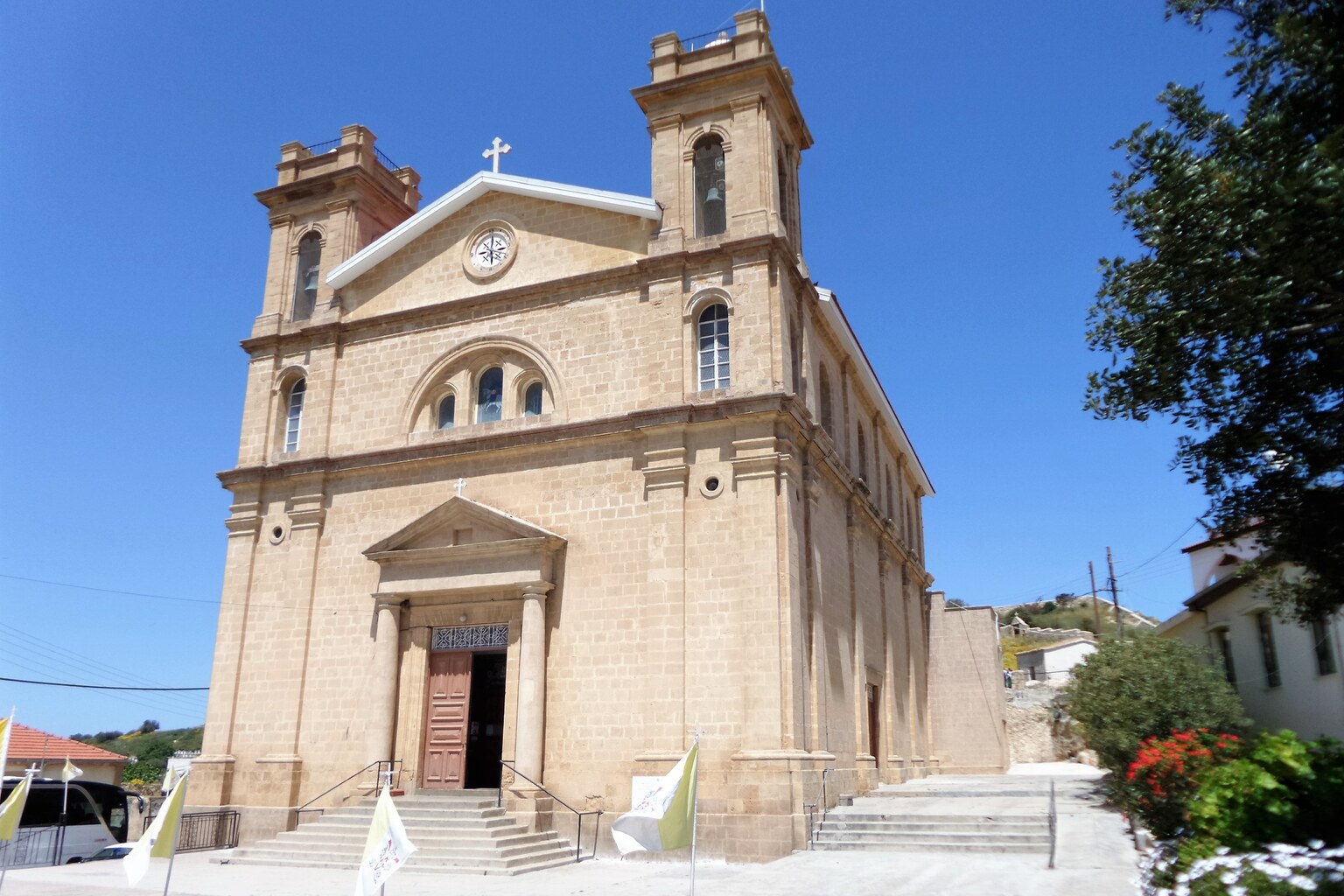
St George's, the parish church on the village square, was consecrated on 20 October 1933; the parish calls it a co-cathedral, and its stone front has two bell towers. Inside is a church museum, opened in 2010 with funding from the A.G. Leventis Foundation, and a marble statue of St Joseph holding the Child (1948) stands in the churchyard. Sunday Mass is at 08:00 and weekday Mass at 07:30, according to the November 2026 parish bulletin; the Saturday afternoon Mass moves with the season (16:00 in November 2026), so check the monthly bulletin on kormakitis.net, the village news site. It is a working parish: visit outside service times, or join a service quietly.
About 90 m away, inside the courtyard of the Franciscan sisters' convent, stands Old St George's, a 16th-century church (1534, according to the Press and Information Office) that was the village's main church until the early 20th century. The bicommunal Technical Committee on Cultural Heritage restored it between July 2014 and September 2015 with 195,265 euros of EU funds, cleaning cement off the stone and rebuilding the belfry. On the west side of the village is the chapel of the Virgin Mary (Panagia), dated 1453, with a statue of the Virgin and a small park, both opened in 2009.
In the square, a ship's mast carved from stone brought from Kour in Lebanon was unveiled by the Maronite Patriarch, Bechara Boutros Rai, on 11 February 2012. Its inscription in Sanna, "Naxni jina u Kur majit" ("we came but Kour did not come"), recalls one of the stories told about the village's name. The Folklore Museum opened the same day in the restored old kindergarten building; ask in the village about visiting it.
Two feasts of St George
The village keeps two feasts of its patron saint. On St George's Day, 23 April, the feast Mass in 2026 was at 17:30 on the Thursday, led by Archbishop Selim Sfeir with Catholic bishops from across the EU, in Cyprus for their COMECE assembly, and in 2025 the community council advertised a three-day festival on the square from 20 to 22 April, with stalls and an Easter Sunday music night. In 2027, when 23 April falls before Orthodox Easter, check the parish bulletin for the feast date. Every 3 November is St George of the Seeds, when the new seed is blessed at a small chapel of 1852 by the sea at Kornos beach. This year it fell on Tuesday 3 November, with Mass at 10:00 and families cooking on charcoal in huts by the shore afterwards; in 2027 it falls on a Wednesday. The community council also held an evening fiesta on the square on 14 August 2025, and in December 2025 the village ran a Christmas village with stalls on the fountain square, although its lighting ceremony was cancelled because of bad weather and power cuts.
Getting there
Kormakitis is in the north-west of the island: in a straight line, Cape Kormakitis is about 10 km to the north-west, Morphou (Güzelyurt) about 16 km to the south and Kyrenia about 28 km to the east. From Nicosia, the crossing for cars is at Agios Dometios (Metehan); Ledra Street and Ledra Palace are for pedestrians only. From Agios Dometios it is about 40 km and 47 minutes by road to St George's, along the road to Morphou and then north-west through Myrtou (Çamlıbel), not counting any queue at the crossing, which was expanded with extra lanes in February 2026. From the Astromeritis-Zodia crossing, west of Nicosia, it is about 31 km and 38 minutes via Morphou.
Check with your insurer before you go: the UK Foreign Office says you will not be let through a crossing without the correct insurance documents, and insurance for the north can be bought at some crossings, including Agios Dometios. Cars hired in the Republic often have no cover in the north at all, so check the rental terms before you set off. Enter the north only from the Republic's side: arriving through Ercan airport or a northern port counts as illegal entry into the Republic. Do not photograph military sites, which matters near the army zones at Asomatos and Agia Marina. Kormakitis is an easy day trip from Nicosia; if you think of staying overnight anywhere in the north, the Republic's foreign ministry warns that staying in property belonging to displaced Greek Cypriots, including hotels, can lead to legal action by the owners. Our transport guide covers the crossings in more detail, and if you are planning a move to Cyprus, our relocation help covers the practical side.
