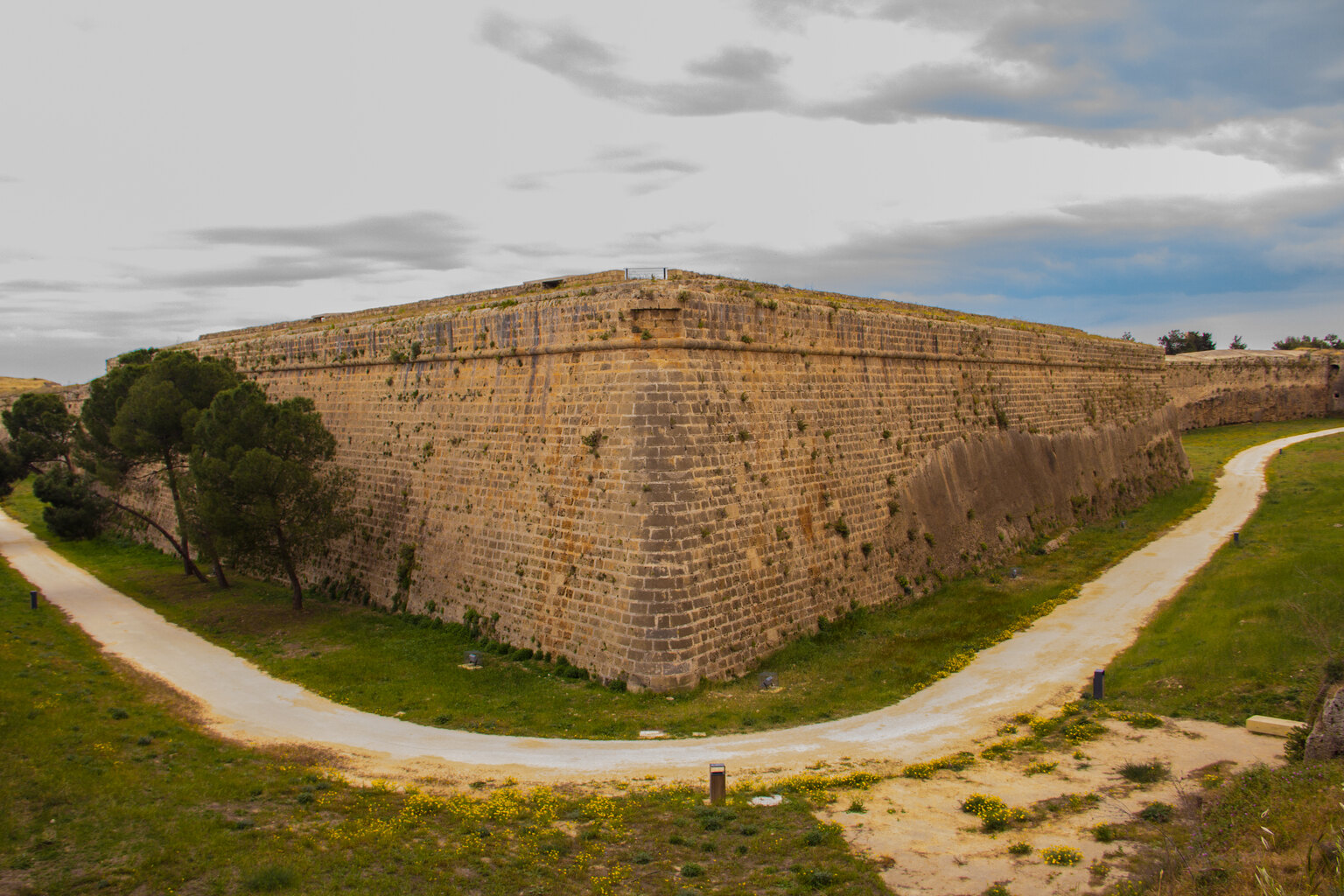
Famagusta's old town still stands inside its ring of walls. They run right round it, more than 10 metres high, behind a dry moat that averages perhaps 20 metres across, and the town inside measures roughly 600 by 900 metres, according to a 2012 study for the World Monuments Fund. What you see is mostly the fortress Venice built between 1492 and the 1560s round the walls of the medieval Lusignan kingdom, and it is where Venetian rule in Cyprus ended, with the surrender agreed on 1 August 1571. The walled town lies in the Turkish occupied north, 6.6 km by road from the Deryneia crossing point, so a visit from the Republic-controlled areas means crossing at an official crossing point with your passport, or with a national identity card if you are from the EU, Switzerland, Norway, Iceland or Liechtenstein.
A Lusignan town, then a Genoese one
The walls began with the Lusignan kings. After the fall of Acre in 1291, Henry II, who reigned from 1285 to 1324 (with a break from 1306 to 1310), reorganised and enlarged Famagusta and gave it a new, much longer circuit of walls. The ditch cut into the rock, which George Jeffery called the most remarkable feature of the fortifications in his 1918 survey of the island's monuments, was in his view dug both for defence and as a quarry for building stone. Nicholas Martoni, an Italian notary who visited in 1394, wrote that Famagusta had "finer walls than I have seen in any town", high, with broad alleys round them and many high towers.
The town then changed hands three times. After a riot at the coronation of Peter II in Famagusta in 1372, Genoa sent a fleet and took the city in 1373. It held Famagusta at first as security for a huge debt and, after King James I was forced to cede it, as its own, until James II of Cyprus won it back in 1464. In 1489 Venice took over the whole island from Caterina Cornaro, the last queen of Cyprus: the banner of St Mark was raised on 26 February, and she left from Famagusta on 14 March.
What Venice built
Venice turned the medieval walls into a fortress for the age of artillery. Jeffery dated the main works from the inscriptions on them. The citadel by the harbour, a square Lusignan castle, had its corner towers cut down and was wrapped in gun platforms under Nicolò Foscarini, whom Jeffery calls the first Venetian prefect: he left his name and the date 1492 on the marble slab with the winged lion of St Mark over the entrance gate. The Sea Gate and the west wall followed under Nicolò Priuli, whose Latin inscription dated 1496 is carved over the Sea Gate and, Jeffery recorded, again on the Moratto Bastion of the west wall. He also recorded an inscription dated 1520 on the east wall and the date 1544 on the bastion of the Land Gate, and he placed the Martinengo Bastion and the other northern works in the 1550s and 1560s.
Paolo Paruta, the Venetian historian of the war, described the result as an imperfect square, with two sides facing the sea and two the land, a wall twenty feet thick on the land side and a ditch chiefly cut out of the rock. Not everything was modern: most of the towers, he wrote, were "so small that they allowed room for small pieces of artillery only".
Who designed the new works is less certain than many guides suggest. Michele Sanmicheli of Verona became Venice's chief military engineer in 1535 and fortified Padua, Chioggia and Venice's forts on Crete. Jeffery wrote that Famagusta was remodelled in his style, but the 2017 entry on him in the Dizionario Biografico degli Italiani lists no work of his in Cyprus, and Giorgio Vasari, in his life of Michele, has only a general line that he did the same "in all the places in Cyprus and Candia". His younger relative Gian Girolamo Sanmicheli, the son of Michele's cousin but usually called his nephew, was sent to Cyprus in great haste to inspect the island's defences. According to Vasari, he went all round the island in three months, then died of a fever at 45 and was buried in St Nicholas in Famagusta; the year was 1558 or 1559, depending on the source. Tradition credits him with the Martinengo Bastion, and Vasari adds that he handed his drawings to Luigi Brugnoli, a relative by marriage, who was then working on Famagusta's fortifications.
The siege of 1570 and 1571
The Ottoman army landed unopposed on 3 July 1570. Nicosia fell on 9 September after about two months, Kyrenia surrendered without a fight, and Famagusta was left as the only city in Cyprus still holding for Venice. The army of Lala Mustafa Pasha camped round it from 17 September. Inside, Marcantonio Bragadin, the Venetian captain of Cyprus, held the city, with Astorre Baglioni in command of the troops.
Over the winter the besiegers pulled back, and a Venetian relief fleet brought reinforcements into the city. The close siege began in the spring of 1571: trenches from mid-April, a bombardment from 19 May, then mines and general assaults on 21 and 29 June, on 9 and 14 July and three more before the end of July. The Ravelin by the Land Gate, Jeffery wrote, was the part of the fortifications most hotly contested. On 31 July, with seven barrels of powder left, the commanders agreed to talk terms, and on 1 August they agreed a surrender that let the defenders leave for Crete with the civilians, their arms and five guns.
The terms did not hold. On the evening of 5 August, once the embarkation was complete, Bragadin, Baglioni and the other commanders went to Lala Mustafa's camp with the keys of the city. Lala Mustafa accused Bragadin of having some fifty Turkish prisoners killed the night before, which Bragadin denied; the officers were put to death, and on 17 August Bragadin was flayed alive in the main square. His skin was taken to Constantinople, stolen in 1580 and brought to Venice, where it is kept in the church of Santi Giovanni e Paolo.
Ottoman and British changes
The Ottomans did not redesign the fortress, but they did change it. In 1599 a visitor found the walls still full of breaches. Later the Ravelin was turned into a kind of secondary bastion and its gates were blocked; today's Land Gate entrance, made in the Ottoman period, runs through what was a 16th-century gun chamber covering the Ravelin; the south wall, Jeffery judged from its appearance, was much restored by them; and the Arsenal bastion at the south-east corner was rebuilt with a tomb inside, and is now known as the Canbulat bastion. For about three centuries Christians were not allowed to live inside the walls: in 1738 the traveller Richard Pococke lodged at a village he called Merash, half a mile south of the city, "where the Christians live who are not permitted to dwell within the city".
Britain took over the running of the island in 1878 and left its own marks. The citadel's moat was filled in around the 1890s; three openings in the sea wall gave access to the port, which the British enlarged from 1903, and the 2012 study found them closed; and in 1933 the medieval Arsenal Gate became a road gate. In 1965 the Turkish Cypriot municipality opened a new North Gate. In August 1974 Turkish forces took Famagusta and its Greek Cypriot population fled south; the town has been in the Turkish occupied north ever since, and the resort quarter of Varosha outside the walls was fenced off. Our Varosha guide tells that story.
Round the walls: what to look for
Start at the Land Gate on the south-west side, where the road crosses the moat on a bridge and, as Jeffery described it, passes through a former 16th-century gun chamber beside the Ravelin. The Turkish Cypriot antiquities department lists the Ravelin itself, Akkule in Turkish, as open on weekdays from 08:00 to 15:30, with the last entry at 15:00, in its timetable for 1 November 2026 to 31 March 2027; it charges 100 Turkish lira, or 50 for students, and it is closed at weekends and on holidays. Along the south wall, the Andruzzi, Santa Napa and Camposanto bastions were the most exposed to the Ottoman attack in 1571 and, Jeffery judged from their appearance, were much restored by the Ottomans afterwards. At the south-east corner stands the Arsenal, or Canbulat, bastion, restored with EU money and completed in November 2023; the small museum inside it is closed for restoration.
About halfway along the sea wall is the Sea Gate, the Porta del Mare, whose white marble frame carries a carved lion of St Mark and Priuli's inscription of 1496. At the north-east corner the citadel, linked with the Othello legend since British times and better known today as Othello's Tower, guards the harbour. It has been closed for restoration since the summer of 2025, according to the Turkish Cypriot antiquities department's opening-hours list and archived copies of it, and we found no reopening date. It had reopened in July 2015 after a first phase of EU-funded conservation work, begun in May 2014, that cost slightly over 1 million euros.
Shakespeare's Othello moves from Venice to Cyprus after the first act, and the play mentions a citadel, a castle and a harbour, but it never names Famagusta; the "sea-port in Cyprus" of many editions is a heading added by later editors. Jeffery wrote that the citadel had been associated with the Othello legend since the British occupation, which began in 1878, and in 1815 the traveller William Turner had attached the same legend to what he called a small Venetian castle at Larnaca.
On the north side, the Diamante bastion is now the most worn part of the walls, the Turkish Cypriot co-chair of the bi-communal Technical Committee on Cultural Heritage said in an interview published on 1 January 2026, and a project for it was being prepared. At the north-west corner rises the Martinengo Bastion, the great angular bastion credited by tradition to Gian Girolamo Sanmicheli, with double ramps leading into its gun chambers and, Jeffery noted, shafts for the gunpowder smoke and recesses for powder in the walls of all its gun chambers. EU-funded conservation work on it was completed in June 2017, with further work on the bastion and its courtyard, including a footpath from the main road, due to finish in May 2018. In 2021 a paved path with low lights ran through the moat at its foot, as the photo at the top of this page shows.
The bastions' names are a mix. Martinengo, Moratto, Andruzzi, Diamante and Del Mezzo are Italian names, San Luca (St Luke) and Santa Napa (Ayia Napa) carry religious names, Camposanto means a burial ground, and Canbulat and Akkule, the Turkish name for the Ravelin, are Turkish. They are not all Venetian family names, and we found no reliable count of the bastions, so we do not give one.
Can you walk right round the walls?
Not as far as we can confirm. In 2012 the study for the World Monuments Fund found steps and railings up onto the walls at four places, Othello's Tower, the Sea Gate, the Canbulat Gate and near the Land Gate, with informal ways up elsewhere, and a path round the dry moat; it also found the northern end of the walled town held by the Turkish military and the port a closed area, and local contacts advised the study team not to go into the moat, as a safety precaution. A path has since been laid at the Martinengo Bastion, but Othello's Tower is closed now, and we found no recent official word on the rest of the moat or on an open circuit, so plan to walk sections of the moat and the old town rather than the whole ring. Keep out of areas signed as military and do not photograph them: UK travel advice warns that taking photographs near sensitive areas such as military buildings can get you arrested.
How to visit
From the Deryneia crossing point, opened on 12 November 2018, the Land Gate is 6.6 km by road, about 8 minutes' drive when there is no queue. The Strovilia crossing point, under the authority of the British Eastern Sovereign Base Area, is nearer: 4.6 km from its north-side checkpoint to the Land Gate.
Take your passport; citizens of the EU, Switzerland, Norway, Iceland and Liechtenstein can show a national identity card instead. If you drive, check your insurance first: UK travel advice says cars hired in the Republic often have no cover in the Turkish occupied north, that you will not be let through a crossing without the right insurance documents, and that cover there can be bought at some crossing points. If you are in Cyprus on a 90-day visa-free stay, the Republic counts the days you spend in the Turkish occupied north towards it, and it treats arriving in Cyprus through an airport or port there, such as Ercan airport, as illegal entry. Coming back, Republic of Cyprus Customs lets you bring goods worth up to 260 euros a person in your luggage, plus 40 cigarettes and 1 litre of spirits if you are 17 or older, without paying duty, but rolling tobacco and other loose smoking tobacco, and live animals and animal products, may not be brought across at all, and UK travel advice warns that goods can be confiscated at the checkpoint and you could be fined.
Inside the walls, the cathedral of St Nicholas, where the Lusignan kings were crowned kings of Jerusalem and which became a mosque after 1571, now the Lala Mustafa Pasha Mosque, has been closed to worship and visits since 3 April 2026 for a restoration expected to take three to four years. With Othello's Tower and the Canbulat museum closed too, the walls, the moat and the Ravelin are the main sights for now. Our Famagusta day trips guide covers the Deryneia viewpoints, ancient Salamis and where to eat.
