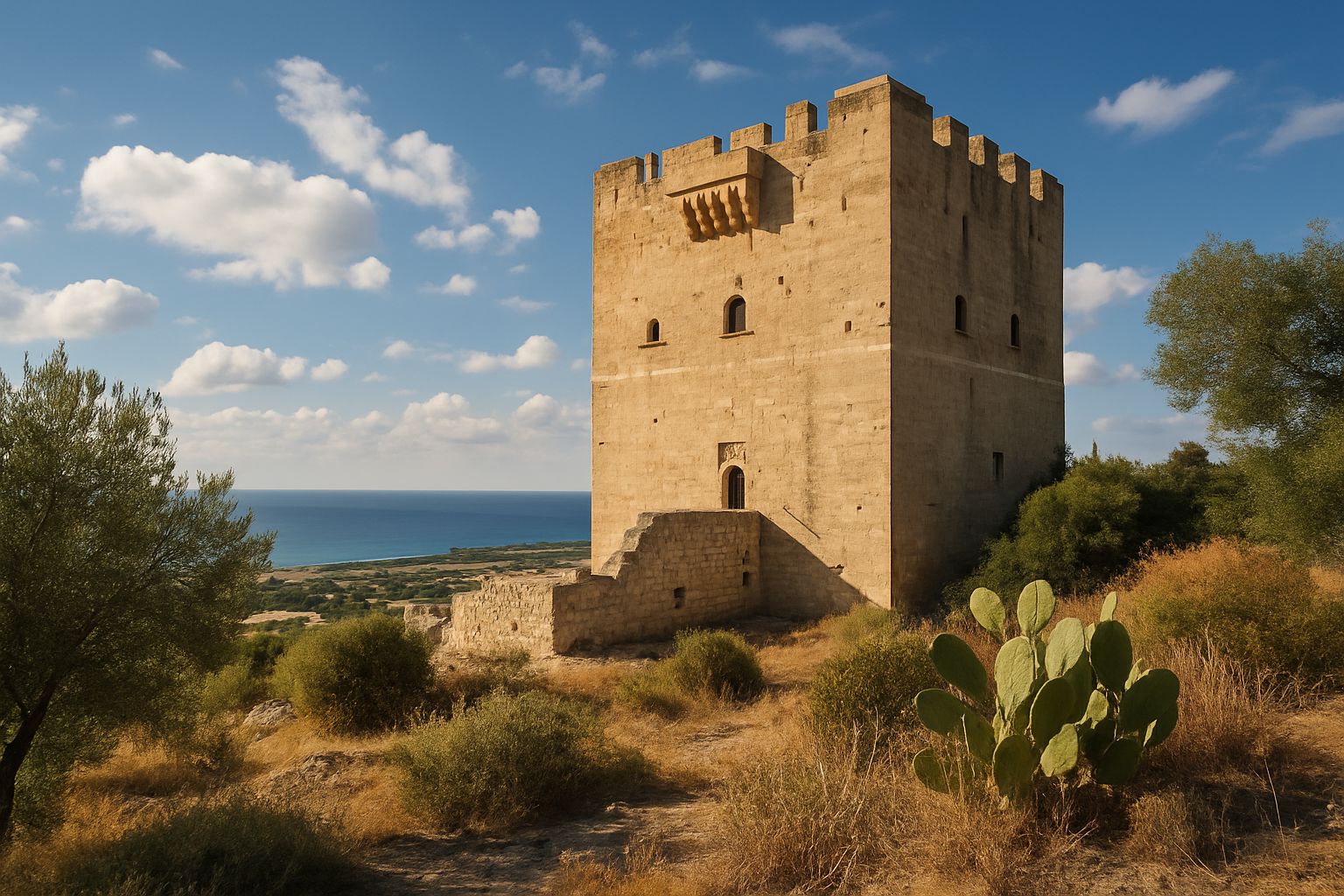
Venice ruled Cyprus for 82 years, from 1489 until the Ottoman conquest of 1571, and spent much of that time strengthening the island against the Ottoman threat. Its grandest works are the walls of Nicosia and the ramparts of Famagusta, but it also left towers you can still see today: one great harbour fortress and a chain of small lookouts on the Larnaca coast.
The great one is Othello Castle in Famagusta, also called Othello's Tower. The Lusignans built it in the 14th century to protect the port, and after Cyprus passed to Venice its square corner towers were cut down and the castle was remodelled for artillery. Above the main entrance is a relief of the winged Lion of St Mark, with the name of Nicolò Foscarini, the Venetian prefect who directed the work, and the date 1492. Inside are a refectory and a dormitory from the Lusignan period. Shakespeare's Othello moves from Venice to Cyprus after the first act but never names Famagusta, and the castle has been linked with the play since British rule began in 1878. It reopened to visitors in July 2015 after restoration, but it has been closed again for restoration since the summer of 2025: the Turkish Cypriot antiquities department, which runs it, already listed it as closed in mid-September 2025 and still does in its timetable from 1 November 2026. Famagusta's walled city lies in the Turkish occupied north, so a visit means crossing at one of the official checkpoints with a passport or ID.
The smaller towers stand in the Larnaka district. Built more than 500 years ago as an early warning system against attack from the sea, Venetian watchtowers survive in four villages there: Pervolia near Cape Kiti, Alaminos, Pyla and Xylofagou.
The Rigena tower at Pervolia dates from 1563 and stands just 20 metres from the shore. It had no way in at ground level: the only entrance was an opening on an upper floor, reached by a ladder let down from inside. Above that raised entrance you can still see the crest of the Lion of St Mark, the emblem of Venice.
At the entrance to Alaminos stands a plain stone tower from around the end of the 15th or the start of the 16th century. It was once part of a larger complex that included a prison and a Latin church, and it was manned by a small permanent guard of Frankish and Albanian mercenaries. The Pyla tower, near the village church of the Archangel Michael, began life as part of a private feudal manor in the Middle Ages. Pyla is one of only four villages inside the UN buffer zone, and the only place in Cyprus still home to both its original Greek Cypriot and Turkish Cypriot inhabitants.
The odd one out is the Xylofagou tower, the only round one of the four. It sits about 100 metres above sea level on Cape Pyla, built under Venetian rule from roughly cut blocks of limestone, and during the Second World War the British used it as an observation post.
The Larnaka Tourism Board links the towers in two cycling routes. The western route (17 km) starts at the Cape Kiti lighthouse and takes in the Rigena and Alaminos towers and the Byzantine church of Angeloktisti in Kiti, known for its 6th-century mosaic; the eastern route (46 km) starts at Pyla beach on the Larnaka to Dhekelia road and passes the Pyla and Xylofagou towers.
If you find yourself captivated by the allure of Cyprus’s historical sites, consider diving deeper into the island’s rich tapestry of cultures and histories. Whether your interest lies in ancient ruins, medieval fortresses, or the vibrant life of modern Cyprus, there is much to discover. For those contemplating a more permanent connection with this Mediterranean gem, relocation help might just be the next step. Cyprus Decoded is here to guide you through the process, ensuring your journey is as seamless as the Cypriot blend of old and new.
