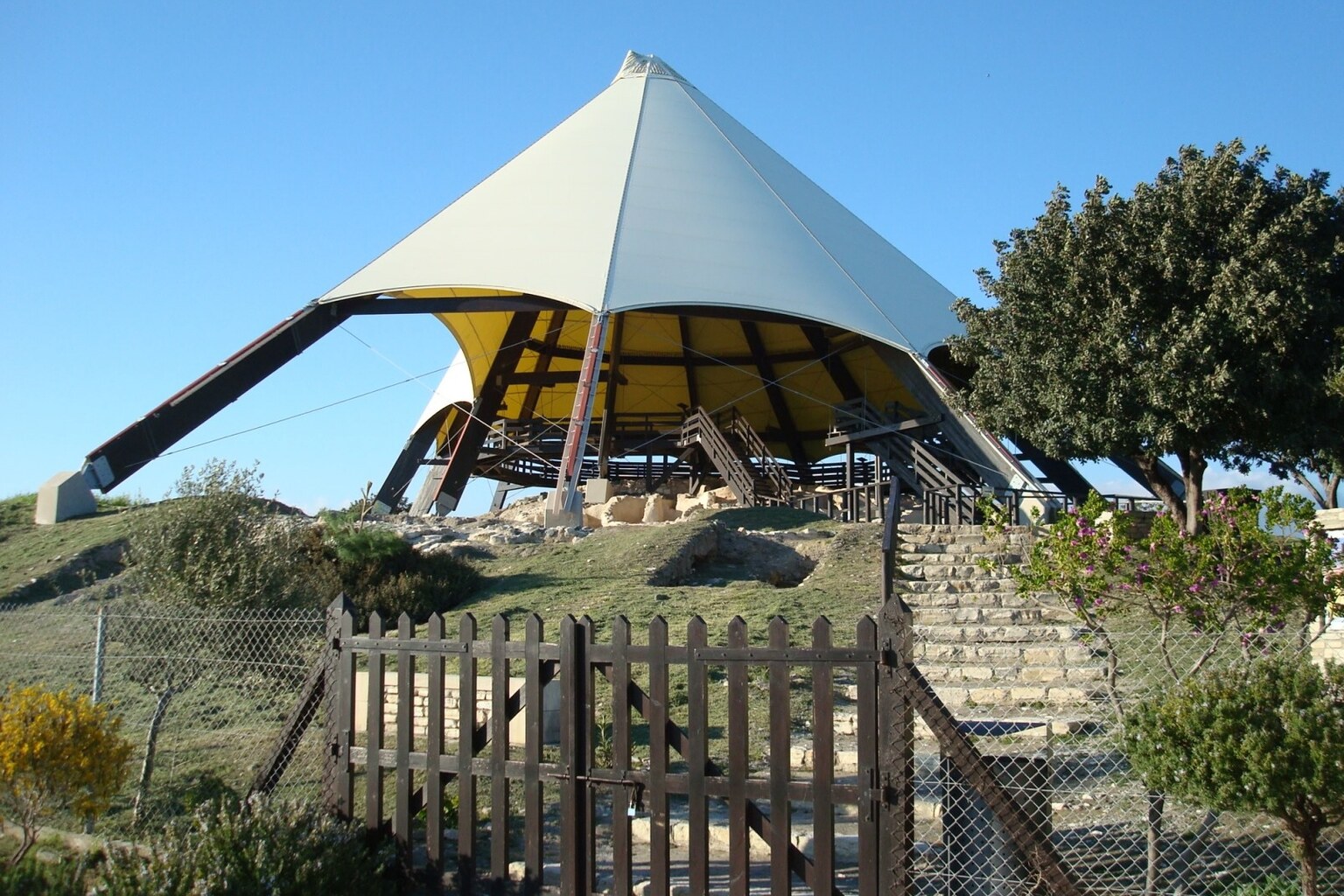
Drive the A1 motorway between Nicosia and Limassol and, near the Kalavasos junction, you pass a huge cream cone on a low hill. Under it lies Kalavasos-Tenta, one of the oldest villages in Cyprus, a settlement of round stone houses begun by some of the island's earliest farmers more than ten thousand years ago. The Department of Antiquities says simply that it can be seen from the highway, and the roof built over it in 1994 and 1995 has made it a landmark. It is a small site and an easy stop, as long as you go on a weekday that is not a public holiday: Tenta is closed every Saturday and Sunday.
Where it is
Tenta is not in Kalavasos village itself. It stands on a small hill on the west side of the Vasilikos river, on Kalavasos community land in Larnaca district, about 2.4 km south-south-east of the village centre in a straight line (2.6 km by road) and, according to the excavator, 3.2 km from the coast. The shelter is about 250 m from the motorway. From central Larnaca it is about 40 km by road (around 37 minutes), from Limassol about 30 km (31 minutes) and from Nicosia about 55 km (48 minutes). Leave the A1 at junction 15 (Kalavasos): the car park by the ticket office is about 2.4 km from the exit if you come from Nicosia or Larnaca, and about 3.5 km if you come from Limassol. Kalavasos itself had 880 residents at the 2021 census.
Older than Choirokoitia
Visit Cyprus dates Tenta to 7000 BC, but that figure is out of date. When radiocarbon dates came back from the dig, its excavator, Ian Todd, found the site was much older than he had expected; its earliest phase had left only lightly built structures. Later radiocarbon studies put the first settlement at around 8500 BC. The stone and mudbrick village grew up over the following two thousand years or so; when it was finally abandoned is still debated, with estimates ranging from about 6500 BC to well after 6000 BC. A 2019 re-assessment of the site by Joanne Clarke and Alexander Wasse argues that Tenta was lived in almost continuously from at least the mid 9th to the mid 7th millennium BC.
This is the Aceramic Neolithic, the time of farming villages that did not yet make pottery. Choirokoitia, the UNESCO World Heritage village about 6 km to the north-east, belongs to the same island tradition of round houses inside an enclosure wall, but Tenta was settled more than a thousand years earlier, and only its last phase overlaps with Choirokoitia. Seeing both in one day shows you the island's first villages at two different moments.
What you see under the roof
The roof covers the top of the hill, not the whole settlement. A walkway hangs from its beams, so you look down on the houses from above and out over the valley, the sea and, about 200 m to the south, the Late Bronze Age town of Kalavasos-Ayios Dhimitrios, first dug in 1979 and 1980 in rescue excavations ahead of the new motorway. Ayios Dhimitrios is not on the Department of Antiquities' list of sites open to visitors, but you can see it from the walkway. The houses of Tenta were round, with simple circular or double circular plans. What survives today is their stone lower walls; the upper walls, the Department of Antiquities says, were built of clay, straw, mudbrick and pebbles. The roofs were mostly flat, and inside the houses were hearths and stone platforms or benches, with rectangular piers that the Department believes held up a partial wooden upper floor.
The largest building stands at the very top of the hill. Clarke and Wasse read the three large round buildings that followed one another on the summit as communal buildings. A substantial wall encloses the settlement and still stands on its east and south sides, and in an early phase a ditch was cut into the soft limestone just outside it. The dead were buried beneath the floors of the houses or in the open spaces between them.
The people of Tenta herded animals, farmed, hunted and gathered. They made stone vessels of diabase, a hard stone, and jewellery from picrolite, a smooth green stone found in the bed of the Kouris river west of Limassol. The Department of Antiquities calls one find exceptionally rare: a wall painting of two human figures with raised arms. According to the excavator, it was painted in red on the central pier of a house at the southern edge of the hilltop, uncovered in 1979, and at the time was the only wall painting excavated anywhere in prehistoric Cyprus. The better-preserved part was lifted, and in 1982 he reported it on display in the Cyprus Museum in Nicosia. Other finds from the district's Neolithic villages, Tenta and Choirokoitia among them, are in the Larnaca District Archaeological Museum, which is free and opens Tuesday to Sunday from 09:00 to 16:30 (closed on public holidays).
The tent roof
The shelter was built in 1994 and 1995 by the Department of Antiquities, which paid for it together with the A.G. Leventis Foundation. It was commissioned by Vassos Karageorghis, a former Director of the Department, and designed by Martin Schmid, an architect at the French School at Athens. Fourteen beams of glued laminated timber, 16 to 30 m long, stand on concrete blocks and meet at a steel ring at the top, under a coated PVC membrane that lets in even daylight. Schmid described it as looking like a 12-faceted conical tent. It cost 170,000 Cyprus pounds and replaced a metal roof, put up around 1980, that covered only part of the site.
The name and the dig
According to local tradition, the name goes back to 327 AD, when St Helena, the mother of Constantine the Great, stayed here in a tent (tenta in the Cypriot dialect) on her visit to the island after finding the Cross in Jerusalem. The name is far older than the modern roof that suits it so well.
Porphyrios Dikaios made a short trial excavation for the Department of Antiquities in 1947, which was never fully published. The main excavation came with the Vasilikos Valley Project, the American mission of Brandeis University directed by Ian Todd, which dug at Tenta for five seasons, from 1976 to 1979 and in 1984, as part of a survey of the whole valley from the Kalavasos copper mines down to the coast. Todd published the final reports in 1987 and 2005, and the site has been studied again since, most fully in the 2019 re-assessment.
Opening hours, tickets and access
Tenta opens on weekdays only, all year. From 16 September to 15 April it is open Monday to Friday from 08:30 to 16:00, and from 16 April to 15 September Monday to Friday from 09:30 to 17:00. It is closed on Saturdays and Sundays, and you should expect it to be closed on public holidays too: it is not among the sites the Department of Antiquities keeps open on holidays. Entry costs 2.50 EUR. From 1 November 2026 to 31 January 2027 the Department takes payment only by credit card at Tenta, Kourion and Paphos Castle, and cash is not accepted.
The Department of Antiquities lists the site as not wheelchair accessible, and the walkway under the roof is reached by stairs. The Department lists no telephone number for Tenta; the number some tourism sites give, +357 24 304 169, belongs to the Larnaca District Archaeological Museum.
Choirokoitia and Kalavasos village nearby
Choirokoitia is 8.7 km away by road, about 9 minutes, from junction 15 to junction 14 of the A1. It has been a UNESCO World Heritage Site since 1998, and near its entrance stand reconstructions of five round houses and part of the defensive walls with their entrance. Unlike Tenta it opens every day: from 08:30 to 17:00 between 16 September and 15 April, and from 08:30 to 19:30 between 16 April and 15 September, with the last tickets at 19:00. Entry is 2.50 EUR, it opens on most public holidays (it closes on 1 January, Easter Sunday and 25 December), and while the path up its hill is not wheelchair accessible, the reconstructed houses are.
Kalavasos village is 2.6 km from Tenta by road. Visit Cyprus points to the Panagia Titiotissa church in the centre for its 16th-century two-sided icon, with the Virgin on the front and the Crucifixion on the back, and the village's copper-mining past is on show in the train park the community council points visitors to, where an old mine train is displayed. For a coffee or a snack, Visit Cyprus lists the Clock Cafe on Stavrodromiou Street, near the motorway junction.
Getting there by bus
Intercity buses on the Nicosia to Limassol, Limassol to Paralimni and Larnaca to Limassol routes, and two weekday Nicosia to Paphos buses, stop at Choirokoitia by its motorway junction, but not at Kalavasos. Larnaca's route 407 runs from Larnaca bus station past the airport, Kiti, Mazotos and Zygi to the Kalavasos to Mari road, about 1 km from Tenta as the crow flies (1.8 km on foot), five times a day each way, taking about an hour and 20 minutes. On weekdays it leaves Larnaca at 07:40, 11:00, 13:45, 16:30 and 19:45, and starts back from Kalavasos at 06:00, 09:05, 12:20, 14:45 and 18:20.
Route 401 links Choirokoitia with Kalavasos four times each way on weekdays. Towards Kalavasos it leaves the Choirokoitia Neolithic Settlement stop, about 300 m from the Intercity stop, at 06:38, 08:38, 14:42 and 17:42 and reaches the Kalavasos to Mari road about 20 minutes later. Going back, it leaves the Kalavasos to Mari road at 05:30, 07:25, 13:35 and 16:15 but first loops through Mari, Vasiliko and Zygi, so it reaches Choirokoitia 35 to 40 minutes later, at 06:08, 08:05, 14:11 and 16:50. From the stop to the site is about 1.8 km on foot, roughly 23 minutes along the B1 and then a lane up to the site, and we could not confirm a pavement, so take care on the verge. These are the weekday times in the official timetable that runs from 7 November 2026 to 4 February 2027; check them before you travel.
