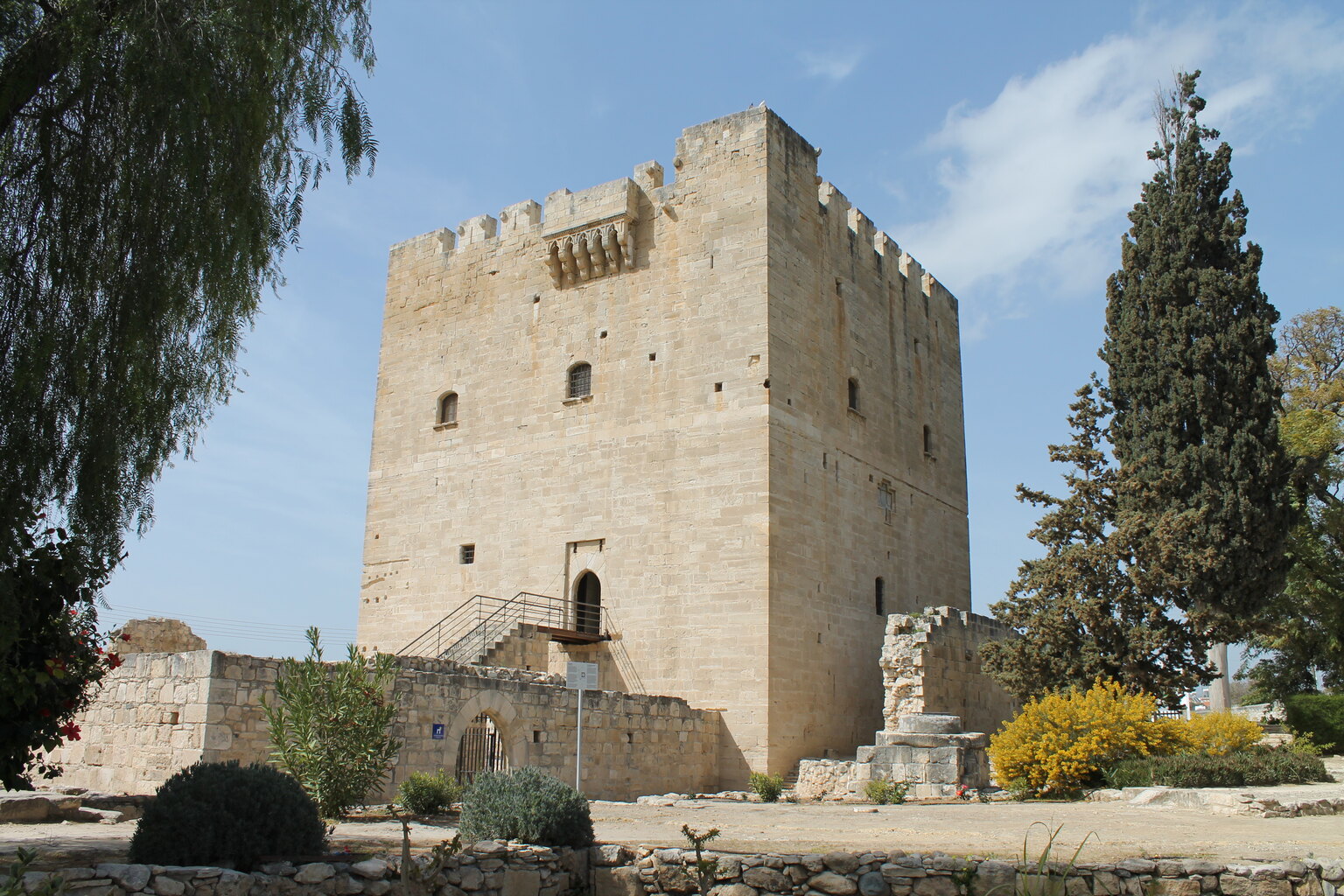
Kolossi Castle stands at the south edge of Kolossi village, about 14 km by road west of Limassol. It is a single square keep of three vaulted storeys, about 21 metres high, built in the 1450s by the Knights Hospitaller, the military Order of St John, at the centre of the Grand Commandery, for a long time the richest commandery the knights owned. Beside it are the ruins of the knights' sugar works, and the Commandery, by the usual explanation, gave its name to Commandaria, the sweet wine of Cyprus. The Department of Antiquities runs the site, which is open every day of the year except three holidays; a ticket costs 2.50 euros.
A village estate given to the knights
Kolossi was a village before it had a castle. In 1191 Richard I of England captured the camp of Isaac Komnenos, then ruler of Cyprus, at Kolossi, and the sources of the time, as the historian Sir George Hill noted, mention no fortress there. In September 1210 King Hugh I gave the village, called Colos in his Latin charter, to the Hospitallers, with three other estates, Platanistia, Phinika and Monagroulli, and other privileges, and he compensated its previous holder, Garinus de Colos. The knights probably built a first castle there in the 13th century; traces of it survive around the present keep.
Limassol, Rhodes and the Grand Commandery
After the Mamluks took Acre in 1291, the knights moved their headquarters to Cyprus, to Limassol, where their general chapters met in 1300, 1301 and 1305. A statute of 1301 ordered that Kolossi be run, in costs and everything else, just as Manueth, a village estate near Acre, had been. From 1306 the knights fought for Rhodes, which they held from August 1309, and made it their new base. Their lands in Cyprus were later divided into three commanderies, and the most important, the Grand Commandery, had its headquarters at Kolossi.
Hill called the estate "of immense value to the Hospitallers, who cultivated there corn, cotton, sugar, oil and wine". The historian John Hackett wrote that it was for a long time the richest commandery the knights owned: in 1330 the Order's general chapter fixed what the Grand Commandery owed the treasury on Rhodes at 60,000 Cypriot besants a year for ten years, equal to 15,000 gold florins and by far the largest contribution of any of the Order's fiefs at the time, and when Venetian rule began in 1489 it still held 41 villages, with an income estimated at 8,000 ducats a year.
Some guides, official ones among them, say the Knights Templar held Kolossi from 1306 to 1313. We found no source from the time that shows it. In 1306 Amaury of Tyre took power from his brother, King Henry II; the Templars were hostile to Henry, while the Hospitallers supported him, and a chronicler of those years, known as the Templar of Tyre, calls Kolossi the Hospital's casale. Kolossi does appear among the Templar properties handed to the Hospital in an inventory given by the 16th-century chronicler Florio Bustron, but Hill found it "difficult to understand how there can have been room for two castles belonging to rival Orders in the same place". When Mamluk forces from Egypt landed near Avdimou in July 1426 and took Limassol, they "seem ... to have found the castles at Episkopi and Kolossi too strong for them", Hill wrote, although he also thought the first castle had probably been damaged by the Genoese and by Muslim raiders, and the Department of Antiquities says it was destroyed in the Mamluk raids of 1425 and 1426.
The keep Louis de Magnac built
The keep standing today replaced the first castle in the 1450s. It is usually dated to about 1454 and credited to Louis de Magnac, the Order's Grand Commander of Cyprus, who appears as preceptor of Cyprus in 1452 and as Grand Commander in 1454 and about 1460. We found no inscription that gives the year: Hill inferred it from the 18th-century historian Dominique Jauna and from the arms on the keep of two Grand Masters of the Order, Jean de Lastic, who died in 1454, and his successor Jacques de Milly. In 1750 the traveller Alexander Drummond wrote that "Lewis de Magnac, grand commander in Cyprus, built, in this place, a plain, square, and strong tower", about seventy feet high and fifty-four feet broad. The architect George Jeffery, in his 1918 survey of the island's monuments, called it "a square block of fine masonry, all built at one time", and Hill noted Camille Enlart's view that it was meant to resist a pirate raid or a local revolt rather than to play a part in a real war.
Inside the keep
The door is on the south side, on the first floor, reached today by a stone stairway and a drawbridge. Jeffery wrote that it was once approached by an inclined way and a drawbridge under a machicolation, the stone box that still projects from the parapet high above the door, through which defenders could drop missiles on attackers. The ground floor, three vaulted halls over underground water cisterns, was for storage and could be reached only through a trap door from above.
The entrance floor has two halls. The western one, with a huge plain fireplace, was probably the kitchen; the eastern one has a wall painting of the Crucifixion, with the Virgin on the left, St John on the right and Magnac's fleur-de-lis arms in its lower left corner, which the Department of Antiquities has conserved and covered with glass. The top floor has two more halls, probably a dining hall and a bedchamber, each with a large carved fireplace bearing Magnac's arms, and small windows with stone seats facing each other "in mediaeval fashion", as Jeffery put it. A spacious spiral staircase in the south-east corner runs up from the entrance floor to the flat roof and its battlements. Visit Cyprus's audio guide describes the view from the roof over vineyards, citrus groves and the Limassol salt lake to the sea in the south, and to Kolossi and the Troodos in the north; the Department of Antiquities does not say whether the roof is open to visitors now, so ask at the ticket office.
The arms on the east wall
Set into the east wall is a cross-shaped marble panel of coats of arms. In the centre, under a crown, are the royal arms of the Lusignan kings of Cyprus, quartering Jerusalem, Lusignan, Armenia and Cyprus; on either side are the arms of the Grand Masters Jean de Lastic and Jacques de Milly; below is a smaller shield with a fleur-de-lis in each quarter, usually read as Magnac's, although Hill could not match it to any arms attributed to him. Jeffery thought the panel "perhaps the only example of the Cyprus Royal Arms, of the later period, which can be considered as dated".
The sugar works
East of the keep stand the ruins of the knights' sugar works, which the Department of Antiquities dates to the 14th century. The main standing building is the refinery, a long, narrow, vaulted stone hall, repaired in 1591 when Murad Pasha was governor of Cyprus, as an inscription on its south side records. North of it are the ruins of the water mill where the cane was crushed and of the aqueduct that brought it water from the Kouris river. The Department of Antiquities began excavating the sugar works in the 1990s; its annual report for 2007 records the fourteenth excavation season there.
Most of the records we found are from the 15th century. An unexpected frost in the autumn of 1447 destroyed the sugar crop at Kolossi. The German nobleman Steffan von Gumpenberg, who visited Cyprus in 1449 and again in 1450 and stayed at Kolossi, described the cane being ground under a millstone; the commander told his party that the Order drew 12,000 guilders a year from sugar and sent them a donkey loaded with sugar. In 1464 the Order agreed to sell the Venetian merchant Giovanni Martini 800 quintals of powdered sugar a year from Kolossi. Water was worth fighting over: in 1401 Venice was pressing a dispute between John Cornaro of Episkopi, the neighbouring estate to the west, and the Hospitallers of Kolossi over water rights, and in 1468 the knights diverted the water from Episkopi and the Cornaro lost a crop worth 10,000 ducats. Sugar was grown for export: the Cornaro family, who acquired the Episkopi estate in 1367, immediately invested hugely in it "for the export trade", writes Michael Given of the University of Glasgow, and Kolossi, Episkopi and the royal estate at Kouklia, near Paphos, all had large sugar works.
Commandaria: the name, not the birthplace
Commandaria, the sweet wine of Cyprus, is usually said to take its name from the knights' Commandery: the Italian traveller Giovanni Mariti wrote in 1769 that it took its name from the great Commandery of St John and that of the Templars, and we found no use of the name in writing before the 1760s. Sweet Cypriot wine was praised long before then: in 1211 the German pilgrim Wilbrand of Oldenburg wrote of the wines of the vineyards near Limassol, "for their sweetness trust to our experience, for we tried and tasted them". The Order's Cypriot estates did make and ship wine, but we found no medieval document that names a wine from Kolossi itself, so the knights cannot be shown to have invented Commandaria.
Today Commandaria is made only in 14 villages on the southern slopes of the Troodos in Limassol district, not at Kolossi or Erimi, from sun-dried Xynisteri and Mavro grapes, and aged for at least two years in oak. Cyprus has protected the name since 1990, the EU registered it as a protected designation of origin in 2006, and in December 2025 UNESCO added Commandaria wine to its Representative List of the Intangible Cultural Heritage of Humanity. Cyprus's tourism and agriculture authorities promote it as the world's oldest named wine, and a Guinness World Records page calls it the oldest manufactured wine in the world, without a date or a record holder; we found no historical proof of either claim, and none of the contemporary accounts of Richard the Lionheart's wedding in Limassol in May 1191 has him praising it there.
From the Cornaro to the British
In 1508, after Venice had taken over Cyprus, the Grand Commandery passed to Cardinal Marco Corner, a nephew of Queen Caterina Cornaro, who held it until his death in 1524, and then to his nephew Alvise Corner, aged seven, who kept it for about sixty years; the family's title outlived the Ottoman conquest of 1570 and 1571. In 1750 Drummond found the keep's great gate "buried in some vile house", though part of the convent, "which has been large", could still be seen. Jeffery recorded in 1918 that the castle had been sold as a farm in 1910 for about 6,000 pounds. The keep appeared on Cyprus stamps in 1934 and 1938, and today it is an Ancient Monument of the First Schedule in the care of the Department of Antiquities.
How to visit
The castle is at the south edge of Kolossi village, about 800 m south of the old Limassol to Paphos road. From Limassol Castle it is 13.9 km by road, about 16 minutes in free-flowing traffic, partly on the A6 motorway towards Paphos. The entrance is on Agiou Antoniou Street, with car parks next to the site.
It is open every day: from 16 September to 15 April from 08:30 to 17:00, and from 16 April to 15 September from 08:30 to 19:30. It closes only on 1 January, Greek Orthodox Easter Sunday (2 May in 2027) and 25 December, and stays open on the other public holidays. Tickets cost 2.50 euros, with 20% off for organised groups of more than ten, and the Department's multi-site cards (8.50 euros for one day, 17 for three, 25 for seven) are valid here. Until 31 January 2027 the Department takes only card payments at Kourion, Kalavasos-Tenta and Paphos Castle; Kolossi is not on that list. The castle is not wheelchair accessible: the door is up a stairway, and the floors are linked by a spiral staircase. Phone: +357 25 934 907.
By bus, route 33 of Limassol's EMEL buses is the only one that stops at the castle, at the Kolossi Castle stop about 40 m from the entrance. On weekdays it leaves the Old Port stop, by Limassol Castle, at 08:00, 10:00, 12:00, 13:15, 14:45 and 16:45 and takes 25 minutes, and the last bus back from the castle is at 18:19; at weekends there are four each way. In winter the 16:45 arrives after the castle has closed. Routes 16 and 27 run more often, roughly every 30 to 45 minutes on weekdays from the Leontiou EMEL station, and stop at Kolossi Elementary School A, about 10 minutes' walk away. A single ticket costs 2.50 euros, or 2.00 euros paid from a Motion card's e-wallet. These times are from the timetable valid until early February 2027.
The Cyprus Wine Museum at Erimi is 2.5 km away, about five minutes by car; entry is 5 euros, or 10 with a glass of wine or Commandaria, and its own website gives two different opening times, so call +357 25 873808 first. Kourion is 6.9 km away by road and the Sanctuary of Apollo Hylates 9.0 km; bus 33 continues from the castle to Kourion Beach and stops near the sanctuary. The Kourion museum at Episkopi has been closed for upgrade works since 1 August 2026. For the other castles and ancient sites, see our historic sites guide.
