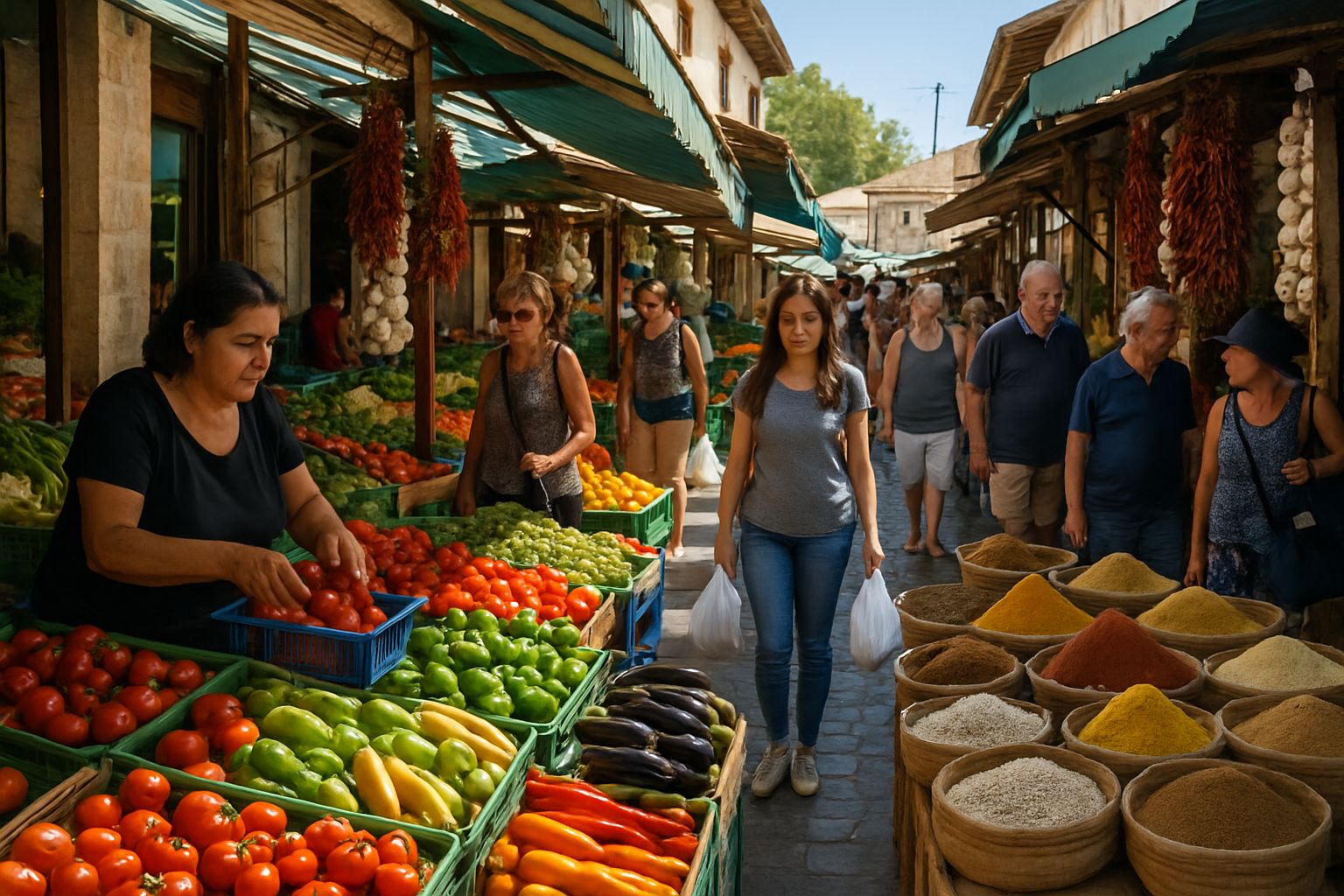
Food markets in Cyprus come in three kinds: the laiki, the open-air farmers' market where growers sell straight from the crate; the covered municipal market hall in town; and old market halls reborn as places to eat. Knowing which one you are walking into, and on which days it runs, makes all the difference.
In Nicosia the one to know is the OXI open-air market on the Constanza Bastion of the Venetian walls, beside the Bayraktar Mosque on Konstantinou Palaiologou Avenue. Farmers from the Nicosia district sell mostly seasonal fruit and vegetables here every Wednesday and Saturday, all year except public holidays, from 06:00 until mid afternoon, and entry is free. Arrive early for the best choice. By tradition, the mosque beside it honours the Ottoman standard-bearer who first scaled the walls in the siege of 1570.
One thing older guides get wrong: Nicosia's covered municipal market in the old town is no longer a market. After a restoration and expansion, the building reopened in April 2024 as the headquarters of the CYENS Centre of Excellence, a research and innovation centre, so do your shopping at OXI instead.
Larnaca rebuilt its market hall from scratch. The original municipal market opened in 1928, traded in its original form until 1963 and was demolished in the 1990s; the new Larnaka Municipal Market opened on the same site in the town centre in March 2023, with a design that recalls the round houses of the Neolithic settlement at Choirokoitia. Its 20 ground-floor shops sell fruit and vegetables, dairy and cured meats, wine, baked goods and sweets, herbal products and souvenirs, Monday to Saturday from 07:00 to 19:00 between March and October and until 18:00 from November to February. On Saturdays an open-air farmers' market fills the yard from 06:00 to 13:30 with fruit, vegetables and flowers.
In Limassol, the old municipal market, known locally as the Pantopolio, opened in 1918 and reopened after restoration in 2020 as Limassol Agora. Under its stone arches and iron trusses it is now more food hall than grocer: about 30 vendors, most of them street-food counters serving everything from Greek dishes to sushi and tacos, with crêpes and ice cream for afters, open daily from 08:30 to midnight according to its own website. Come here to eat rather than to do the weekly shop.
In Paphos, the covered Agora in the old town sells mostly souvenirs, lace, ceramics and local specialities, with fresh fruit and vegetables alongside; our guide to the island's craft markets covers it.
At OXI and at Larnaca's Saturday market you are often buying from the grower, so ask what is in season and how they cook it. If you buy halloumi, look at the label: since October 2021 the name has been an EU Protected Designation of Origin, so only halloumi made in Cyprus to the official specification can carry it. Our guide to spotting fake halloumi explains what else to check.
Exploring the culinary markets of Cyprus is more than just a shopping trip; it is a journey into the heart of Cypriot culture. Each market has its own distinct character, offering a glimpse into the daily life and culinary traditions of the island. Whether you're seeking the freshest ingredients, unique souvenirs or simply an unforgettable experience, these markets are a must-visit on any itinerary.
For those considering making Cyprus their home, these markets represent a delightful aspect of daily life on the island. With their abundance of fresh local produce and vibrant community atmosphere, they offer a glimpse of the relaxed, yet rich lifestyle that Cyprus has to offer. Whether you're in the process of moving or just dreaming of a future on this beautiful island, Cyprus Decoded can assist with relocation help to make your transition as smooth as possible.
